


Medical reference platform and search engine indexing billions of documents from government agencies, global health organizations, and medical journals.
You are Crossref - Crossref
Crossref runs open infrastructure to link research objects, entities, and actions—creating a lasting and reusable scholarly record that underpins open science. Together with our >25,000 members in 167 countries, we drive metadata exchange and support 2.1 billion monthly API queries, facilitating global research communication, for the benefit of society.

LibGuides: Open Access Publishing : OA Journals, Books and Repositories
This guide provides guidance in open access scholarly publishing for researchers in all disciplines.
Paperclip
Paperclip — search, read, and analyze 11M+ biomedical papers, regulatory documents, clinical trials, and biological databases (UniProt, PDB, ChEMBL) from the command line.
Paperclip
Paperclip — search, read, and analyze 11M+ biomedical papers, regulatory documents, clinical trials, and biological databases (UniProt, PDB, ChEMBL) from the command line.
Two billion citation links in Crossref help research travel further - Crossref
We’ve recently reached an important milestone for the research nexus: the works in our metadata corpus are now connected with over 2 billion citation links! This is a great opportunity to share a dedicated dataset and discuss why these are important for science.

Find Search Results for Personal Care & Cosmetics applications, search data sheets, SDS and request samples | Prospector
Personal Care & Cosmetics (Search Results) | Personal Care & Cosmetics formulations, data sheets, SDS search, specifications and request samples all in one location - Free Access.
Fabricated Citations — CITADEL
4,046 fabricated citations in the biomedical literature. A more than 12× rise in three years. Verified across PubMed, Crossref, OpenAlex, Google Scholar.
OME Project — open-metadata-exchange documentation
OME enables open educational resources to create, publish, and update their metadata on a peer-to-peer network. By solving authoring, publishing, and discovery issues, this network will provide broad visibility to current islands of OER information.
Crossref: The sustainable source of community-owned scholarly metadata
This paper describes the scholarly metadata collected and made available by Crossref, as well as its importance in the scholarly research ecosystem. Containing over 106 million records and expanding at an average rate of 11% a year, Crossref’s metadata has become one of the major sources of scholarly data for publishers, authors, librarians, funders, and researchers. The metadata set consists of 13 content types, including not only traditional types, such as journals and conference papers, but also data sets, reports, preprints, peer reviews, and grants. The metadata is not limited to basic publication metadata, but can also include abstracts and links to full text, funding and license information, citation links, and the information about corrections, updates, retractions, etc. This scale and breadth make Crossref a valuable source for research in scientometrics, including measuring the growth and impact of science and understanding new trends in scholarly communications. The metadata is available through a number of APIs, including REST API and OAI-PMH. In this paper, we describe the kind of metadata that Crossref provides and how it is collected and curated. We also look at Crossref’s role in the research ecosystem and trends in metadata curation over the years, including the evolution of its citation data provision. We summarize the research used in Crossref’s metadata and describe plans that will improve metadata quality and retrieval in the future.

AI linked to explosion of low-quality biomedical research papers
Analysis flags hundreds of studies that seem to follow a template, reporting correlations between complex health conditions and single variables based on publicly available data sets.

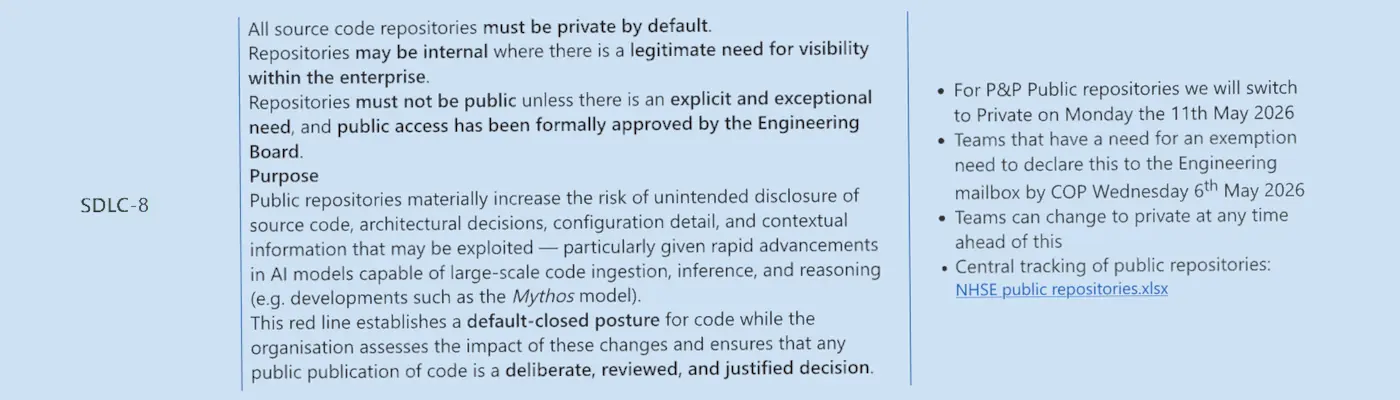
NHS Goes To War Against Open Source
The NHS is preparing to close nearly all of its Open Source repositories. Throughout my time working for the UK Government - in GDS, NHSX, i.AI, and others - I championed Open Source. I spoke to dozens of departments about it, wrote guidance still in use today, and briefed Ministers on why it was so important. That's why I'm beyond disappointed at recent moves from NHS England to backtrack on…
Manuscript submission systems and metadata completeness in Crossref: Patterns and associations
The importance of open research information, particularly publication metadata, is widely recognised. Crossref is one of the most important infrastructures for registering open metadata as part of DOI record registration. It is widely known, however, that the metadata of many publications is far from complete, with many publishers making certain metadata openly available, but failing to do so for other metadata elements. Publishers’ ability to register this metadata with Crossref depends on their capacity to capture and retain this data in their production workflows. Manuscript submission systems are an important, yet largely overlooked, factor in the extent to which publishers make metadata available through Crossref. In this paper, we present the results of an analysis investigating the relation between the level of metadata that publishers deposit with Crossref and the submission systems that they deploy for their journals. We have looked at the 153 publishers with the largest amounts of publications in Crossref and concentrate on the four most commonly used systems: Editorial Manager, ScholarOne, Open Journal Systems (OJS) and eJournalPress. We show that some submission systems appear better suited to capturing certain metadata elements. However, there are always cases where publishers using the same system differ widely in the level of metadata they register, suggesting that technology is not the only prohibiting factor and other considerations are at play.
OnCo: the open, cited map of cancer: treatments, targets, trials, and what is coming
The open, cited map of oncology: every cancer, treatment, target, trial, company, institution and idea on one page each, in plain English first, with…
tobi/qmd
mini cli search engine for your docs, knowledge bases, meeting notes, whatever. Tracking current sota approaches while being all local
Researchers published in NEJM about using OpenAI’s o3 DeepResearch to discover strong leads in 18 previously unsolved rare diseases o3 produced *explanations* of old lab results (not diagnoses), which researchers vetted and took to the lab AI is not just a black box openai.com/index/diagnose-rare-childhood…

Using AI to help physicians diagnose rare genetic diseases affecting children
openai.comCollection of collections: Health/medicine

Note that I don’t have an actual background on the subject (as is the case with most things, but I thought it’s especially important to mention here)
AI* and healthcare/medicine (by あ) — Semble
Public health (by あ) — Semble
COVID-19 vaccines (by あ) — Semble
Depression (by あ [#F04000]) — Semble
Cancer (unsorted) (by あ) — Semble
COVID-19 history (by あ) — Semble
