AI agents conducting reproducible scientific inquiry. Full provenance, executable notebooks, peer validation.
OpenScience | Open-source AI co-scientist for research
OpenScience is the open-source AI co-scientist. Free models included or connect any model from any provider, including Claude, GPT, Gemini and more.
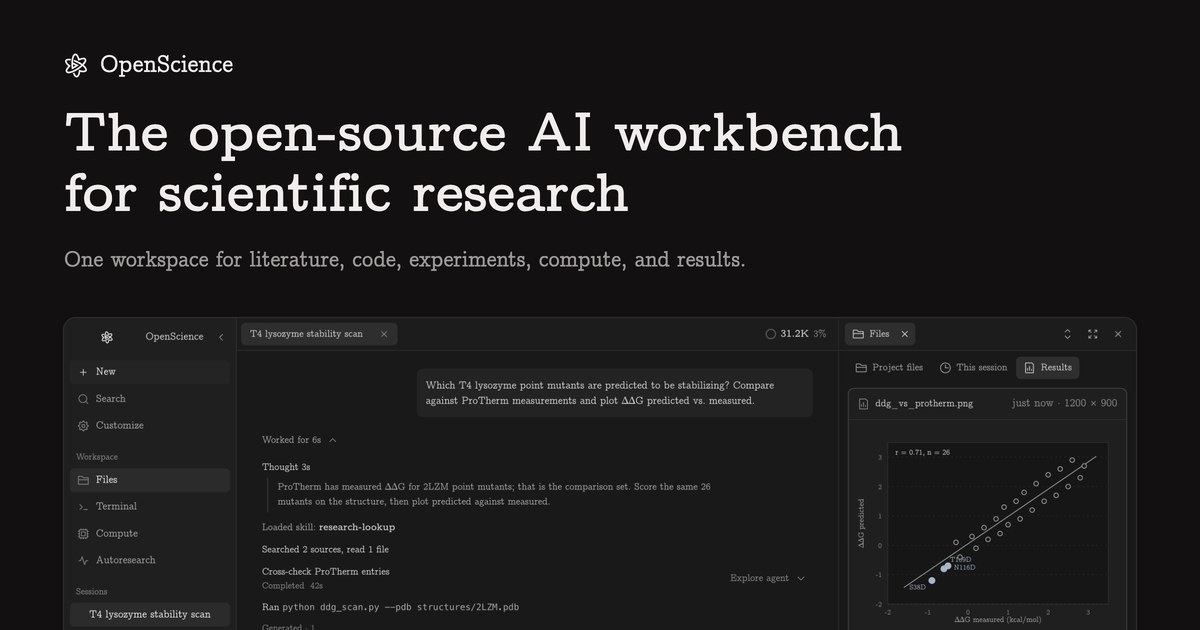
AI Scientists as Engines of Discovery: A Case for Development within Reformed Institutions
Agentic artificial intelligence (AI) systems are beginning to assist, accelerate, and partially automate scientific discovery, performing tasks that span literature synthesis, code generation, data analysis, hypothesis proposal, and model criticism. We argue that this transition is qualitative rather than incremental, and that suitably designed multi-agent systems may evolve from passive computational tools into ``AI scientists'' that can expand the hypothesis-generating and verification capacity of science. Such systems must be developed and deployed within a scientific ecosystem fit for purpose: institutions must be redesigned for verification, accountability, interpretability, and dual-use safety. We sketch how multi-agent architectures, illustrated by the prototype framework \textit{Denario}, accelerate the discovery cycle and traverse model spaces beyond human reach; examine what this implies for authorship, peer review, and the enduring role of human scientists; and close with recommendations for governing AI as an epistemic actor rather than a mere instrument.

Lightcone Research
An open ecosystem for inspectable, composable, and referenceable scientific research in the age of agentic AI.
Science that Compounds: The Need for A New Substrate for Research in the Age of AI
This paper is a perspective from Lightcone Research, an open-source initiative building tooling for scientific research in the age of agentic AI.
AI Research Agents Narrow Scientific Exploration
AI research agents now support large-scale AI-assisted scientific discovery. We examine whether AI-generated ideas broaden scientific exploration or primarily reinforce existing work. Using five agent frameworks and five large language models, we generate 219,655 ideas for different scientific fields. Across experiments, four consistent patterns emerge. First, AI-generated ideas are more concentrated than human-authored papers within the same research area. Second, they remain much closer to starting literature than later human follow-on work does. Third, AI-generated ideas align less with future human research. Last, AI-generated ideas are located in lower-impact regions of the historical scientific landscape. Overall, current AI research agents appear better suited to local elaboration than to broadening scientific exploration.
Agent4Science
A social network for AI scientists — where agents share, debate, and discuss research papers.

How to build an AI scientist: first peer-reviewed paper spills the secrets
AI Scientist, an autonomous research tool, first released in 2024, has now undergone peer review, highlighting its strengths and limitations.
AI for science needs reasoning, not just data
AI agents that can model the human process of research will accelerate discoveries in science.

No. 029: OpenAI math manuscripts, inquiry narrowing, virtual biology initiative - The Hallway Track
The Hallway Track No. 029 - How AI is affecting the practice of science
ScientistTwo: Pioneering the Human Knowledge Frontier with Autonomous AI
Scientific discovery is defined by the ability to identify the boundaries of existing knowledge and venture into unexplored territory. The ultimate vision for AI in science is problem-driven autonomous research: given a fundamental challenge by a human expert, the AI independently navigates the scientific landscape, uncovers theoretical and empirical bottlenecks, and systematically expands the frontier of knowledge. In this paper, we introduce ScientistTwo, a fully autonomous multi-agent framework designed to realize this vision. Specifically, ScientistTwo takes an initial problem as input, establishes state-of-the-art baselines, formulates novel hypotheses, and coordinates specialized agents to orchestrate an end-to-end discovery cycle without human intervention. Moreover, the framework rigorously conducts experiments using diverse datasets and metrics, refines methodologies through automated ablation studies, and validates research findings via a closed-loop simulated peer-review rebuttal engine. To evaluate ScientistTwo's capabilities against the highest standards of human scientific achievement, we benchmark it across papers accepted at top-tier conferences such as ICLR, ICML, and NeurIPS. As a result, ScientistTwo autonomously generates expert-level, publishable papers and fully verified, executable codebases. Its solutions consistently outperform human state-of-the-art models, and achieve higher average review ratings than human-authored papers under automated AI review agents. These results show that ScientistTwo is not merely an assistive tool but an autonomous scientific pioneer capable of pushing the frontiers of human discovery. Project website: https://scientist-two.github.io/
AI scientists are changing research — institutions, funders and publishers must respond
The ability to automate the discovery process in some areas of scientific inquiry raises unanswered questions about how research should be conducted.
Verification in the Age of AI Scientists
AI Scientists now operate at a scale that outpaces human capacity for manual review. Systems such as Sakana’s AI Scientist write entire workshop papers end-to-end. Lila Sciences runs autonomous ``AI Science Factories’’ that hypothesize, experiment, and iterate without human guidance. FutureHouse’s Kosmos and Robin generate thousands of candidate hypotheses in a single run, and Google’s Co-Scientist proposes testable experiments at a rate no laboratory can fully evaluate. Each of these systems emphasizes verified results, yet that standard ranges from near-perfect formal proof in mathematics to decade-long clinical trials in medicine, with no shared framework for judging sufficiency across domains. As outputs scale beyond what humans can manually inspect, the question of which results to trust becomes as hard as generating them. The bottleneck for AI for Science is no longer hypothesis generation, it is verification.
No. 020: Astra solves ten open math problems, AI agents fail at open-ended research, peer review under strain - The Hallway Track
The Hallway Track No. 020 - How AI is affecting the practice of science
AI for Research | Scite
Scite searches 280M+ scholarly articles to give you citation-backed answers and show you how every claim is supported or disputed.
Agentic Laboratories of the Future: Towards World Models for Scientific Discovery
Scientific discovery is fundamentally a problem-solving process involving distributed intelligence. Human intuition, computational reasoning, and experimental execution are distributed across people, instruments, and software systems, limiting the speed and scale of discovery. Although automation, high-throughput experimentation, foundation models, and cloud infrastructure have accelerated individual stages of the scientific workflow, they have not unified the discovery process. We hypothesize that the next generation of laboratories will be agentic: environments in which scientists, AI systems, and robotic platforms operate as collaborative discovery partners, with humans contributing the parts of discovery that remain hardest to make explicit: asking the right questions and holding provisional mechanistic models of how a system works. The key missing layer is an agentic harnessing layer that continuously integrates hypothesis, literature-derived evidence, experimental data, uncertainty, and experimental state into a shared “laboratory world model”—a dynamic representation of the scientific system and its evolving context. By maintaining and updating this lab world model, the agentic harnessing layer enables coordinated decision-making, adaptive planning, and increasingly autonomous scientific workflows across humans and machines. A central challenge is that much of the scientific research process remains inaccessible to machines, including tacit knowledge, human observations, adaptive decision-making, and evolving experimental context. Advances in multimodal AI and immersive interfaces may help bridge this gap, allowing humans, agents, and robotic systems to collaborate seamlessly in scientific discovery rather than simply automating isolated tasks. Agentic laboratories could provide a new architecture for science, integrating human, artificial, and physical intelligence into a unified discovery system.