

Empowering science communities with open, democratic, researcher-owned infrastructure.
We’re building communities and tech for publishing, curating, sharing, and discussing research online using ATProto and other decentralized protocols.
Empowering science communities with open, democratic, researcher-owned infrastructure.
We’re building communities and tech for publishing, curating, sharing, and discussing research online using ATProto and other decentralized protocols.
Metagov x Future of Science Seminar - Discourse Graphs with Matt Akamatsu
Open Sourcing Scientific Research with Lab Discourse Graphs
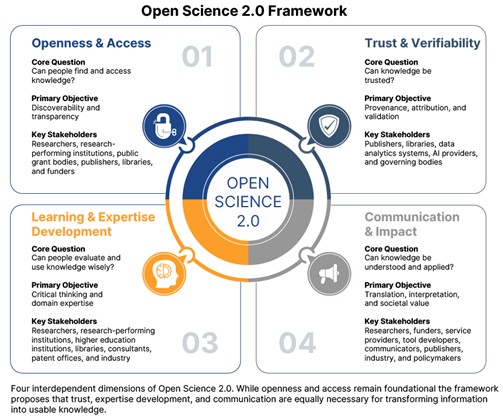
Open Science 2.0: Building Understanding in an AI-Mediated World - The Scholarly Kitchen
Open Science 2.0 must focus not only on access, but also on trust, interpretation, learning, and effective communication. The challenge facing the scholarly publishing ecosystem is ensuring that what is open is also trustworthy, understandable, and genuinely useful.
Discourse Graphs and the Future of Science | Protocol Labs Research
Interview between Tom Kalil, Chief Innovation Officer of Schmidt Futures, Dr. Evan Miyazono, Research Team Lead at Protocol Labs, and Dr. Matt Akamatsu, Assistant Professor of Biology at the University of Washington.
Governing by dismantling: tech oligarchy and the stifling of public data infrastructure
Published in Science as Culture (Ahead of Print, 2026)

Sensemaking Networks: Project Introduction - Cosmik Labs
Incorporating science social media into the scientific process
eLife Pathways home page
Moving beyond legacy publishing requires interoperable open-source infrastructure. With Wellcome’s support, we are evolving eLife’s technology to anchor a collaborative network, partnering with the open science community to reshape the communication and assessment of global research.
Building Collective Intelligence Networks for Flourishing Scientific Communities
Scientific communities are straining under mounting challenges—knowledge fragmentation, outdated publication processes, institutional erosion and funding cuts—that threaten our capacity to address urgent global problems. Traditional scientific process
Sensemaking Networks: Transforming Social Media into a Sensemaking Layer for Science | Ronen Tamari
Sensemaking Networks is a project aiming to address three interrelated limitations of the current science publishing and communication infrastructure: (1) poor reach and feedback, (2) knowledge fragmentation, and (3) rigid formats. To address these issues, Sensemaking Networks combine two promising trends in science publishing and communication: science social media and semantic nanopublishing. While science social media significantly impacts scientific processes and public engagement, it lacks formal recognition and accessibility. On the other hand, nanopublications offer the benefits of formal scientific publishing and machine-readable knowledge representation. Their integration represents a promising direction that could serve as a transformative sensemaking layer for science, enhancing the collective synthesis, dissemination, and evaluation of research.

Landing — Open Journals Collective
We're a collective of libraries, university presses, and non-profit publishers reshaping academic research.
NLnet; Nanoarguments
Scientific knowledge is currently scattered across papers, repositories, and disconnected platforms, with no structured way to trace how claims connect to evidence or how arguments develop. Nanoarguments builds a framework and tools for creating, browsing, and contributing to a global, federated graph of scientific discourse and evidence. Researchers and their communities can collaboratively structure claims, evidence chains, and discussion as nanopublications, which are small, cryptographically signed Linked Data snippets with precise provenance and authorship, published to a decentralized peer-to-peer network. The project builds upon the Nanodash interface to help users browse, edit, and aggregate discourse and evidence graphs, and integrates with dokieli to enable in-context authoring of nanopublications as inline annotations while reading or writing a document. A bidirectional ActivityPub connector bridges the nanopublication network and the fediverse, allowing discourse threads to start as social exchanges and crystallize into persistent, machine-readable evidence records. The project will be piloted with early adopter research groups in discourse and evidence modeling. All components will be released as open-source modules that other systems can build upon.
Frontiers In Research webinar on changes in science communication, the role of social media, and new infrastructure/tools - tomorrow (7/18) at 2 pm ET Looking forward to chatting with @ronentk.me & @joelchan86.bsky.social luma.com/7l18yyg4

Frontiers In Research: Open Science · Zoom · Luma
luma.com
Reclaim scientific discourse with federated digital spaces where researchers shape their own conversations, data, and collaborations
