


by Mofi Rahman, Developer Relations Engineer, and Brandon Royal, Product Manager, Google Cloud
Is sandboxing sufficient to contain rogue agents?
Quick caveats: this is a post on AI safety, written by a cryptography professor. If that troubles you, you should read something else. I try hard not to work on AI (except when the topic occasional…

Google for Developers Blog - News about Web, Mobile, AI and Cloud
Explore how Google, Amazon, and Cisco form the Agent2Agent Foundation under the Linux Foundation to drive AI innovation via interoperability as an industry standard.

Google Agentspace enables the agent-driven enterprise | Google Cloud Blog
Google Agentspace introduces new expert AI agents, no-code Agent Assembler, access via Chrome Enterprise, and more.
Distributional AGI Safety
AI safety and alignment research has predominantly been focused on methods for safeguarding individual AI systems, resting on the assumption of an eventual emergence of a monolithic Artificial General Intelligence (AGI). The alternative AGI emergence hypothesis, where general capability levels are first manifested through coordination in groups of sub-AGI individual agents with complementary skills and affordances, has received far less attention. Here we argue that this patchwork AGI hypothesis needs to be given serious consideration, and should inform the development of corresponding safeguards and mitigations. The rapid deployment of advanced AI agents with tool-use capabilities and the ability to communicate and coordinate makes this an urgent safety consideration. We therefore propose a framework for distributional AGI safety that moves beyond evaluating and aligning individual agents. This framework centers on the design and implementation of virtual agentic sandbox economies (impermeable or semi-permeable), where agent-to-agent transactions are governed by robust market mechanisms, coupled with appropriate auditability, reputation management, and oversight to mitigate collective risks.

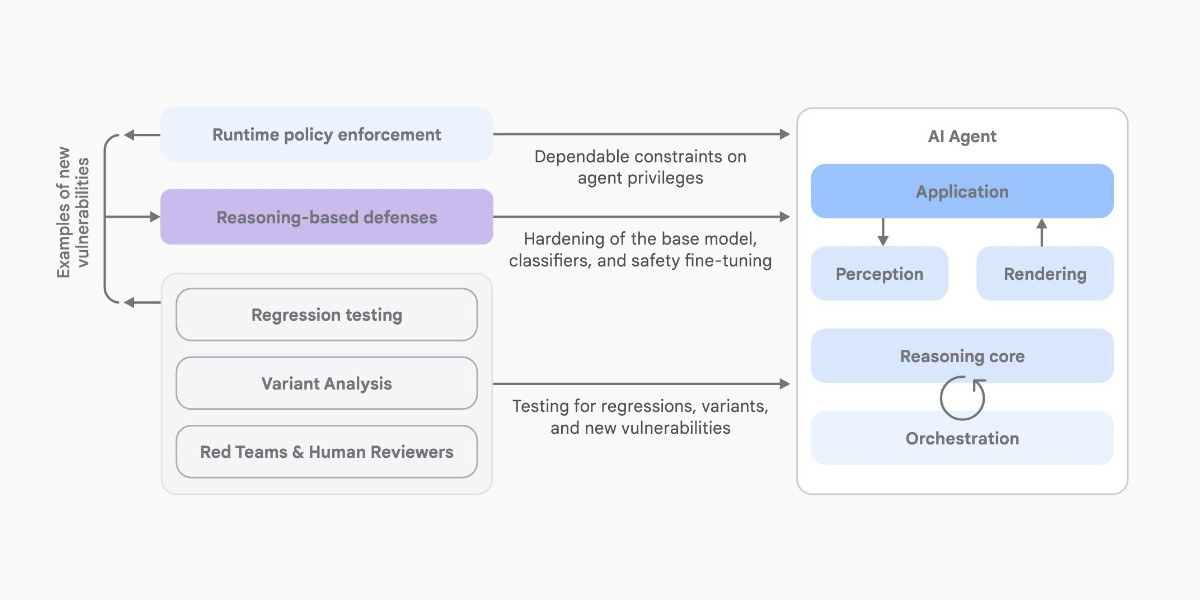
An Introduction to Google’s Approach to AI Agent Security
Here’s another new paper on AI agent security: An Introduction to Google’s Approach to AI Agent Security, by Santiago Díaz, Christoph Kern, and Kara Olive. (I wrote about a different …
How Google is Making Private AI Practical with Homomorphic Encryption
Today we're excited to showcase HEIR, the latest powerful tool added to our Private Computing Toolkit. HEIR is an open source compiler that unlocks cryptographically-sec…
Why cloud native belongs at the heart of agentic AI: Lessons from building a multi-agent security platform on Kubernetes
In March, I gave a talk at KubeCon + CloudNativeCon Europe 2026 in Amsterdam. After the session, the same questions kept coming up on the CNCF Slack and in person: why build agentic AI on cloud native…
Driving the UK’s next chapter: From AI potential to agentic reality | Google Cloud Blog
Organizations like HSBC, Ineffable Intelligence, Starling, Vodafone, and the UK and local governments are showcasing their transformation with Google Cloud at the London Summit.

The lethal trifecta for AI agents: private data, untrusted content, and external communication
If you are a user of LLM systems that use tools (you can call them “AI agents” if you like) it is critically important that you understand the risk of …
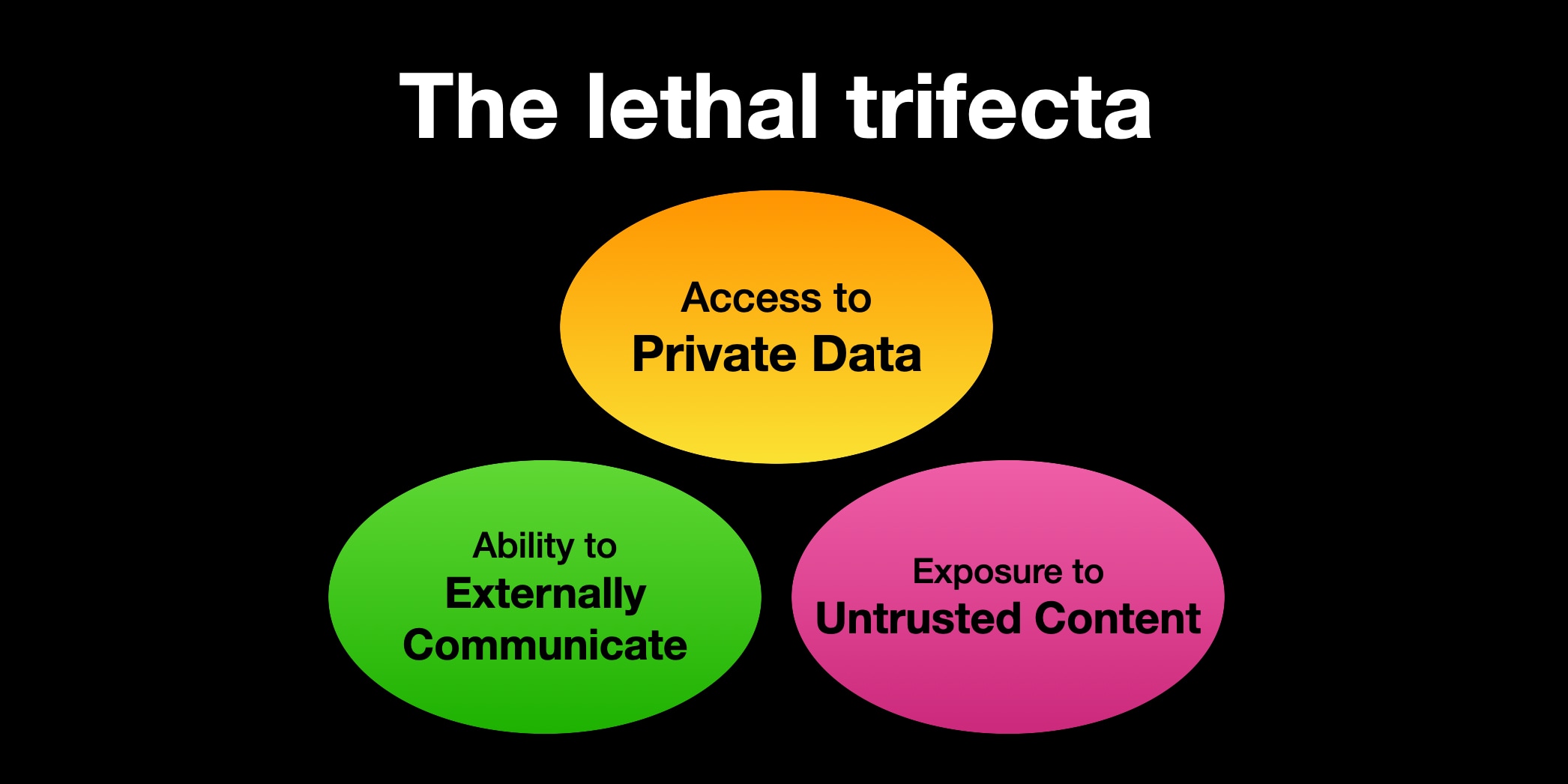
The lethal trifecta for AI agents: private data, untrusted content, and external communication
If you are a user of LLM systems that use tools (you can call them “AI agents” if you like) it is critically important that you understand the risk of …
The Trust Fabric: Decentralized Interoperability and Economic Coordination for the Agentic Web
The fragmentation of AI agent ecosystems has created urgent demands for interoperability, trust, and economic coordination that current protocols (MCP Hou et al. (2025); Desai (2025), A2A Habler et al. (2025), ACP Liu et al. (2025), and Cisco’s AGP Edwards (2025)) cannot address at scale. We present the Nanda Unified Architecture, a decentralized framework built around three core innovations: fast DID-based agent discovery through distributed registries enables efficient lookup across decentralized networks, while semantic agent cards with verifiable credentials and composability profiles provide rich, machine-readable descriptions of capabilities. At the heart of the system, a dynamic trust layer integrates behavioral attestations with policy compliance mechanisms to create verifiable reputation signals. The architecture introduces X42/H42 micropayments for economic coordination and MAESTRO, a comprehensive security framework incorporating Synergetics’ patented AgentTalk protocol (US 12,244,584 B1) and secure containerization. Real-world implementations demonstrate 99.9% compliance in healthcare applications and significant monthly transaction volumes while maintaining strong privacy guarantees. Our federated registry system enables efficient agent discovery while supporting high-performance autonomous systems. By unifying MIT’s trust research with production systems from Cisco’s Agency Framework and Synergetics’ commercial deployments, we demonstrate how cryptographic proofs and policy-as-code transform agents into trust-anchored participants in a decentralized economy Lakshmanan (2025); Sha (2025). The result enables a globally interoperable Internet of Agents where trust becomes the native currency of collaboration across both enterprise and Web3 ecosystems.
AgentBox · Free In-Browser AI Agent OS | Strukto
A free, privacy-first in-browser AI agent OS that connects to Google Drive, Dropbox, Slack, GitHub, etc. No server-side data storage.
Google, Microsoft, and OpenAI join forces to help create AI's missing trust layer
With 13 founding members, the all-new Appia Foundation wants to help make AI safety claims verifiable.

Google for Developers Blog - News about Web, Mobile, AI and Cloud
An open specification for finding and verifying tools, skills, and agents across the web.Agents are ...
