


Make informed decisions to help your open source project thrive by measuring and tracking its success.
Measuring Your Open Source Program’s Success
Open source program managers must demonstrate the ROI of their efforts. This guide provides an overview of some of the standard ways that organizations evaluate their open source programs, projects, and contributions.

All That Glitters (Like Stars) Is Not Gold: Metrics that matter when commercializing open source
We looked at all 134 open source companies founded since 2015 to understand what metrics are the most telling, from seed stage to growth.

A Replication Study on Measuring the Growth of Open Source
Context: Over the last decades, open-source software has pervaded the software industry and has become one of the key pillars in software engineering. The incomparable growth of open source reflected that pervasion: Prior work described open source as a whole to be growing linearly, polynomially, or even exponentially. Objective: In this study, we explore the long-term growth of open source and corroborating previous findings by replicating previous studies on measuring the growth of open source projects. Method: We replicate four existing measurements on the growth of open source on a sample of 172,833 open-source projects using Open Hub as the measurement system: We analyzed lines of code, commits, new projects, and the number of open-source contributors over the last 30 years in the known open-source universe. Results: We found growth of open source to be exhausted: After an initial exponential growth, all measurements show a monotonic downwards trend since its peak in 2013. None of the existing growth models could stand the test of time. Conclusion: Our results raise more questions on the growth of open source and the representativeness of Open Hub as a proxy for describing open source. We discuss multiple interpretations for our observations and encourage further research using alternative data sets.

Tools for Managing Open Source Programs
The road to strategic use of open source starts with a carefully planned, organized, and empowered open source program office to guide and manage its creation, distribution, and use. But that’s just a first step. To get such an office underway and running smoothly, you need the right tools. These mission-critical tools will be used to track goals and metrics in departments from engineering and legal to executive leadership, PR, and marketing, and give employees all the resources they need to gather data, provide snapshots of performance, and manage the daily use of open source within your company.
Setting an Open Source Strategy
The majority of companies that use open source understand its business value and identify its advantages in efficiency, flexibility, interoperability, and speed of innovation. Yet only half of these companies report practicing basic open source management, such as community development, code maintenance, and the like, according to the latest Future of Open Source survey.
The shape of open source
At its core, open source is about collaboration. Whether it’s version control, licenses, or issue trackers—everything exists to support people working with each other. Open source embodies a model for…

Open Source or Open Core: Why Should You Care?
Open source software has gained its significant foothold because the community development model works everywhere. Its momentum has moved it into the underlying infrastructure of some of the most sophisticated web scale companies, like Facebook and Google. Open source underpinnings now drive many of the most significant advances in the worlds of cloud and big data.

Open Source or Open Core: Why Should You Care?
Open source software has gained its significant foothold because the community development model works everywhere. Its momentum has moved it into the underlying infrastructure of some of the most sophisticated web scale companies, like Facebook and Google. Open source underpinnings now drive many of the most significant advances in the worlds of cloud and big data.
The Asymmetry of Open Source - Matt Holt
A comprehensive guide to funding open source software projects

5 ways open source software companies make money
A guide on how to evaluate the long-term sustainability of the business behind any open-source software you are using (or considering working on yourself).

Balancing Makers and Takers to scale and sustain Open Source
To scale and sustain Open Source ecosystems in a more efficient and fair manner, Open Source projects need to embrace new governance, coordination and incentive models.

Open source and the software supply chain
Managing something as esoteric as resources for building software with a variety of contributions made by the open source community is more amorphic.

Sustainable Open Source: The Maintainers Perspective or: How I Learned to Stop Caring and Love Open Source
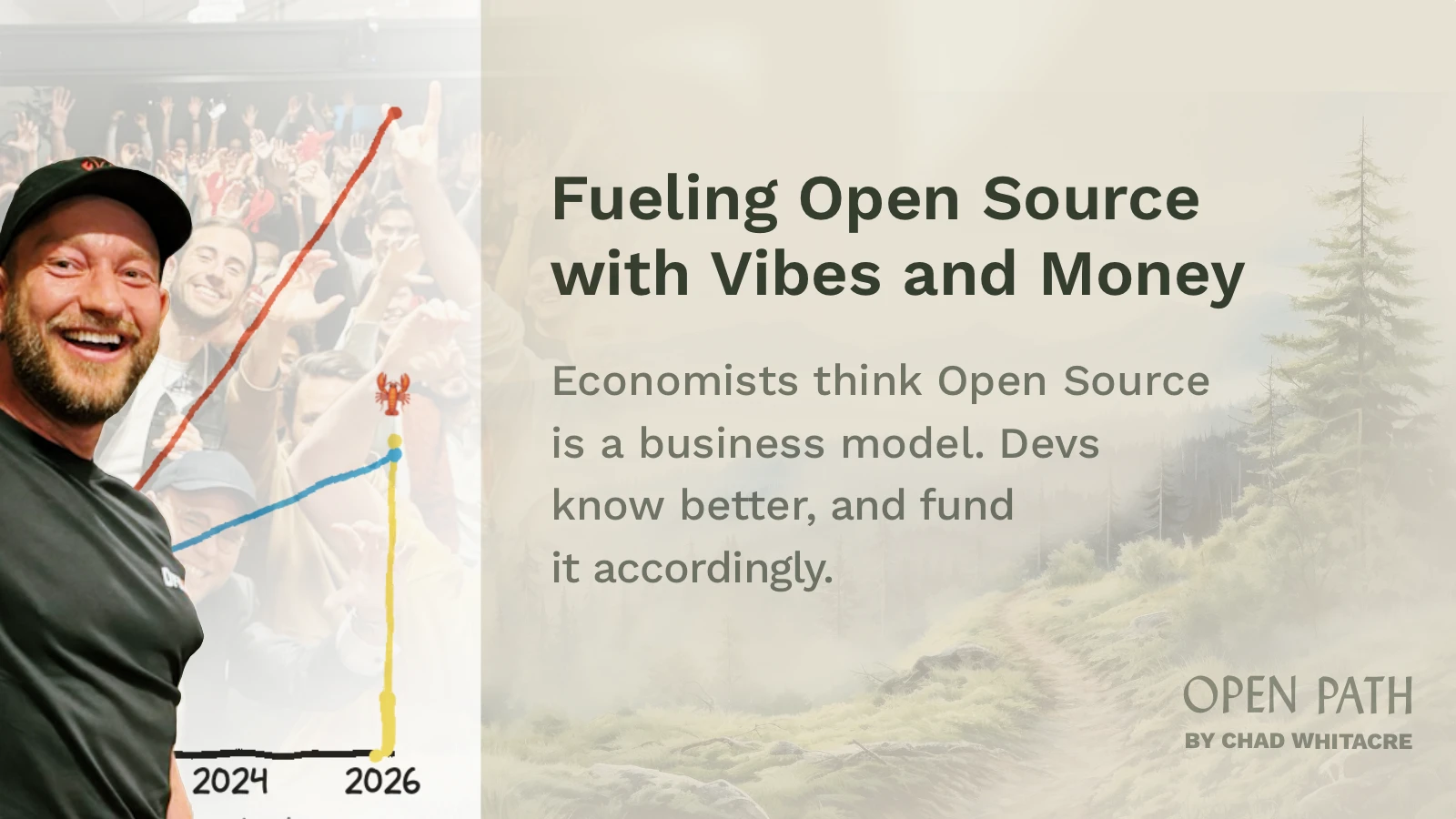
Fueling Open Source with Vibes & Money
Economists think Open Source is a business model. Devs know better, and fund it accordingly.
The Missing Middle of Open Source
Why serious, maintainer-driven projects struggle to sustain themselves—and what it will take to fix it.
