

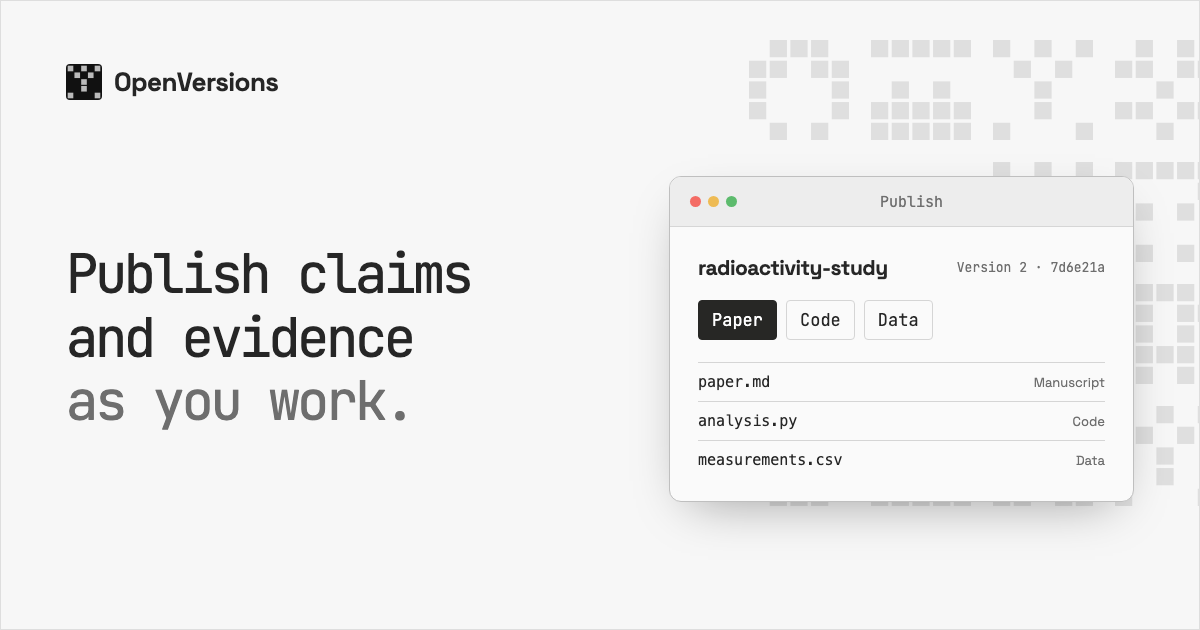
Publish your paper, code, and data together. OpenVersions extracts claims, verifies them, and lets others find, cite, and build on your work.

What comes after open source
In a previous post, I discussed the history of open source, and ended with this claim:
The shape of open source
At its core, open source is about collaboration. Whether it’s version control, licenses, or issue trackers—everything exists to support people working with each other. Open source embodies a model for…

Everything an open source maintainer might need to know about open source licensing | Ben Balter
There's lots of internet lore around open source licensing. An attorney and open source developer answers the most common questions.
Open Source Explained — Open Indie
Musings on the concept of ‘open source’, in the broadest possible definition of the term. Also an invitation to become a participant in ...

Nibble Stew: The Nine Phases of an Open Source Project Maintainer
There is more to running an open source project than writing code. In fact most of all work has to do with something else. This places addit...
Open source is only ajar without inclusion | The Mozilla Blog
Open source refers to software licensed so that others can view, copy, alter or share that code. “Open” was first used to describe an openly collaborat

Open Source Resistance
A direct-action manifesto for maintainers keeping open source alive on company time.
I Don’t Want to Know What “Open Source” Means
I am he as you are he as you are me and we are all on GitHub.

Save Open Source, Save the World. Following up on “Why Open Source… |…
archived 17 May 2023 07:18:18 UTC


Who really benefits from 'open source' A.I.? | Fortune
There's a reason Big Tech corporations are so enamored with releasing 'open' A.I. models, and it has nothing to do with the community ethos of open source software, according to a hard-hitting new report.

Keep Your Friends Close — Open Tech Strategies | Blog
One of the insider secrets of free and open source software (FOSS) is that most of the rules a project uses on a day-to-day basis are not found in the software’s license. There are contribution guidelines, which are enforced by the project only taking contributions that meet them. There are codes of conduct, which are a condition of community participation. There are endorsements, official membership, a voice in setting the project roadmap, and all kinds of other benefits that attach to varying types of community participation. In each case, entirely external to the license, there are official rules and unwritten norms that govern how participants gain the benefits of joining the civic life of a project.
Open-Source Contribution: The Ultimate Guide | Built In
How to get into open-source contribution according to these experts.

Linking the world's research to the code it runs on - OpenAlex blog
Research relies on software. Software written by scientists, for science, runs through the entire modern research stack: NumPy and SciPy, R and ggplot2, Jupyter, BLAST, ImageJ, AlphaFold. Yet in the scholarly record, that software is nearly invisible. Software is not usually cited formally in publications and is usually just mentioned in the text, which means […]

Tools for Managing Open Source Programs
The road to strategic use of open source starts with a carefully planned, organized, and empowered open source program office to guide and manage its creation, distribution, and use. But that’s just a first step. To get such an office underway and running smoothly, you need the right tools. These mission-critical tools will be used to track goals and metrics in departments from engineering and legal to executive leadership, PR, and marketing, and give employees all the resources they need to gather data, provide snapshots of performance, and manage the daily use of open source within your company.