

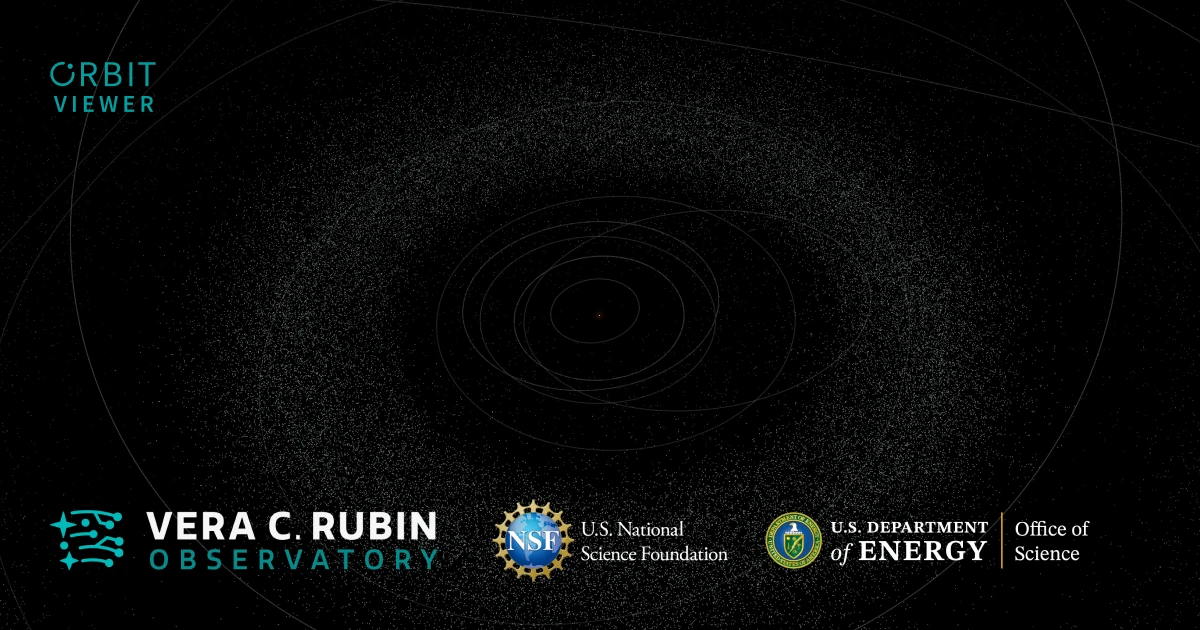
2026 ED138 is a large, bright trans-Neptunian object and dwarf planet candidate discovered in 2026 by scientists using data from NSF–DOE Vera C. Rubin...
NSF–DOE Vera C. Rubin Observatory Reveals Its First Dwarf Planet Candidate in Our Solar System
In the outer reaches of our Solar System, beyond the orbit of Pluto, NSF–DOE Vera C. Rubin Observatory has spotted 2026 ED138 — a large, bright trans-Neptunian object that scientists have identified as a dwarf planet candidate. The observations were announced today by the International Astronomical Union Minor Planet Center (MPC). If confirmed, ED138 would be among the largest dwarf planets ever discovered in this region of the Solar System.
2026 – Nepean By-election – Result Commentary
This post will contain commentary on the results of the 2026 Nepean by-election. Use the links below to navigate between the four results pages that I will be updating. Links: Result summary | Comm…

Commentary on Nepean By-election 2026
nepean Commentary on Nepean By-election 2026 2026
ATScience 2026
A full-day exploration of AT Protocol for science, education, and open knowledge. A side event to AtmosphereConf 2026 @ Vancouver, March 27, 2026

When the Scientists Showed Up: Notes from ATmosphereConf 2026 - Nightflight
The Daily Planet #119: On Deep Time - The Daily Planet
changelog.earth | Planetary release notes
New species. Balance changes. Unresolved bugs. An unofficial changelog for Earth.
Sunsetting Atom
We are archiving Atom and all projects under the Atom organization for an official sunset on December 15, 2022.

Sunsetting Atom
We are archiving Atom and all projects under the Atom organization for an official sunset on December 15, 2022.
Sunsetting Atom
We are archiving Atom and all projects under the Atom organization for an official sunset on December 15, 2022.
Planetary Sapience & Planetary Stupidity: a Bildungsroman for the Baby Noosphere | Antikythera
That is, the faculty of recollection and foresight? Until recently, I would argue, our planet was amnesiac. That is, no part of it was reflectively aware of the place of the present relative to the established past nor the expected future. But then peculiar animals emerged, capable—no matter how imperfectly—of cooperation, abstraction and invention. In the last blink of geologic time, through the collaboration of these animals with their increasingly cunning artifacts, this state of planetary amnesia has faltering begun being cured. That is, through our artifacts, our planet is becoming aware of its own unfolding biography. In our fallible attempts to model our world—alongside our growing legion of sensors—The Earth system has developed a way of recollecting its deepest past and tracking the changing complexities of its present so as to forecast its furthest future.
IOSP 2026: Institute of Open Science Practices (space) | nanodash
An event, a community, and a coordinating institute for the people building, using, and advancing the infrastructure open science depends on. IOSP 2026 is the third edition, held 12-15 October 2026 in Leiden: the Poortgebouw of the University of Leiden and GO FAIR host 12, 13 and 15 October, while 1…
The Coming Second Copernican Revolution | NOEMA
Astrobiology is rewiring our understanding of the intimate connection between life and planets as they appear in the universe.
Icarus, or, the Future of Science
