

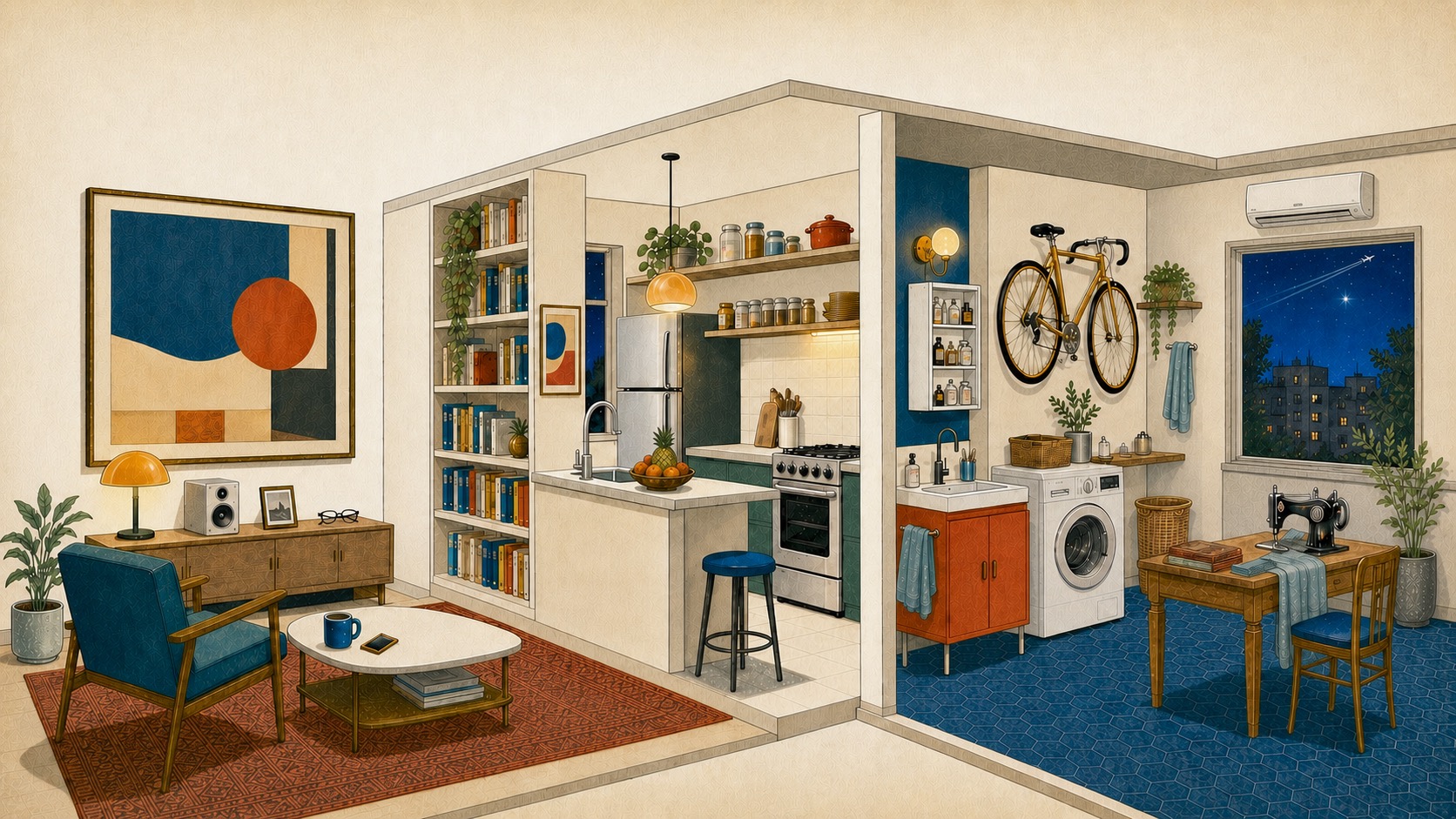
A walk through a modern apartment, through the eyes of the people for whom everything in it was new.
Ordinary Abundance
A walk through a modern apartment, through the eyes of the people for whom everything in it was new.
Exploring the social life of urban spaces through AI
We analyze changes in pedestrian behavior over a 30-y period in four urban public spaces located in New York, Boston, and Philadelphia. Building on William Whyte’s observational work, which involved manual video analysis of pedestrian behaviors, we employ computer vision and deep learning techniques to examine video footage from 1979–80 and 2008–10. Our analysis measures changes in walking speed, lingering behavior, group sizes, and group formation. We find that the average walking speed has increased by 15%, while the time spent lingering in these spaces has halved across all locations. Although the percentage of pedestrians walking alone remained relatively stable (from 67% to 68%), the frequency of group encounters declined, indicating fewer interactions in public spaces. This shift suggests that urban residents are using streets as thoroughfares rather than as social spaces, which has important implications for the role of public spaces in fostering social engagement.

Federating friendly spaces - Roomy
hearkening back to the cozy vibes of old-web neighborhoods
Sense of abundance
Expansive, curious, open, unfearful, unhurried. The opposite of Scarcity mindset .NoteLink.Active { background-color: rgba(10, 132, 255, 0.15); } .
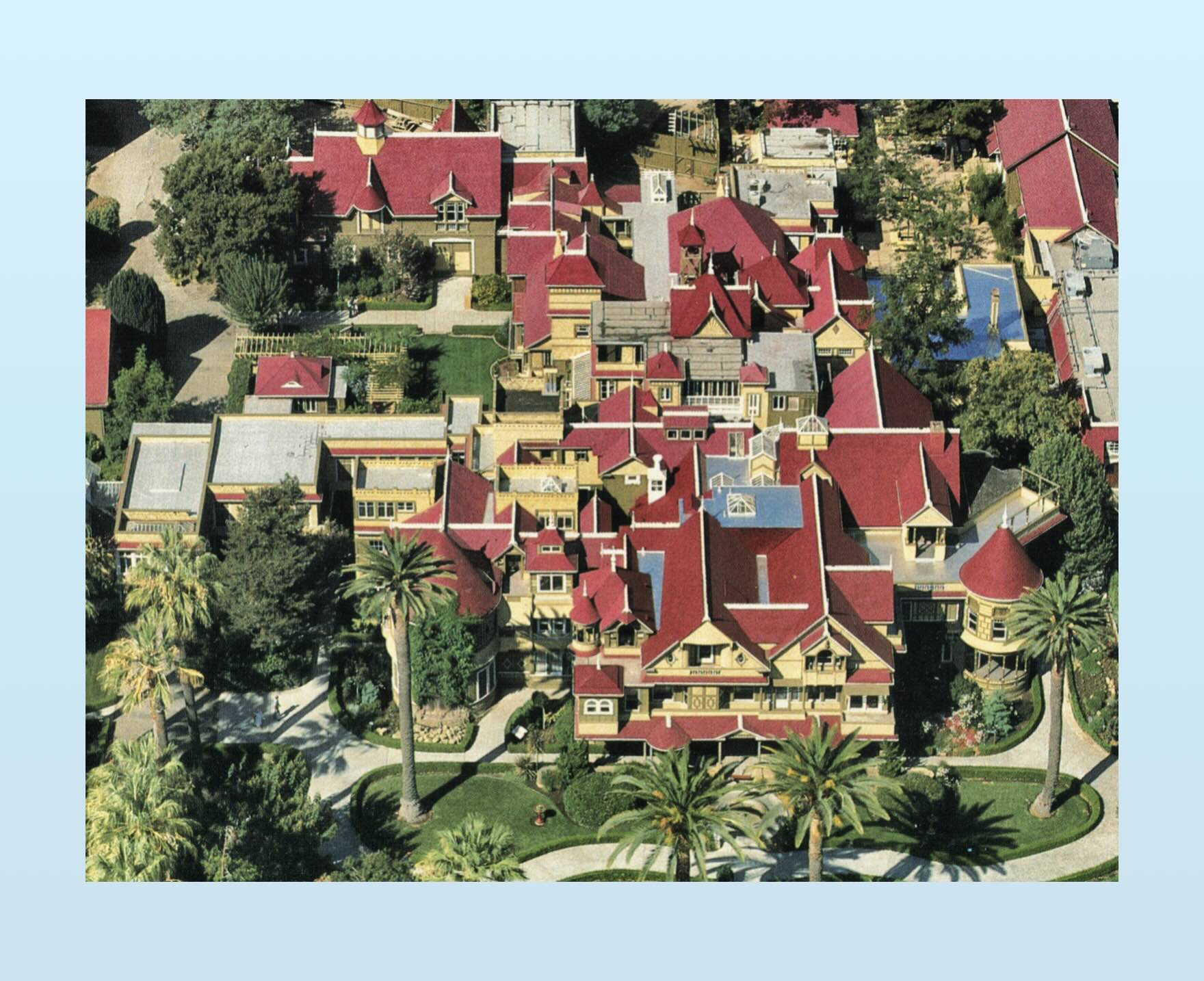
The Cathedral, the Bazaar, and the Winchester Mystery House
Welcome to the era of sprawling, idiosyncratic tooling.
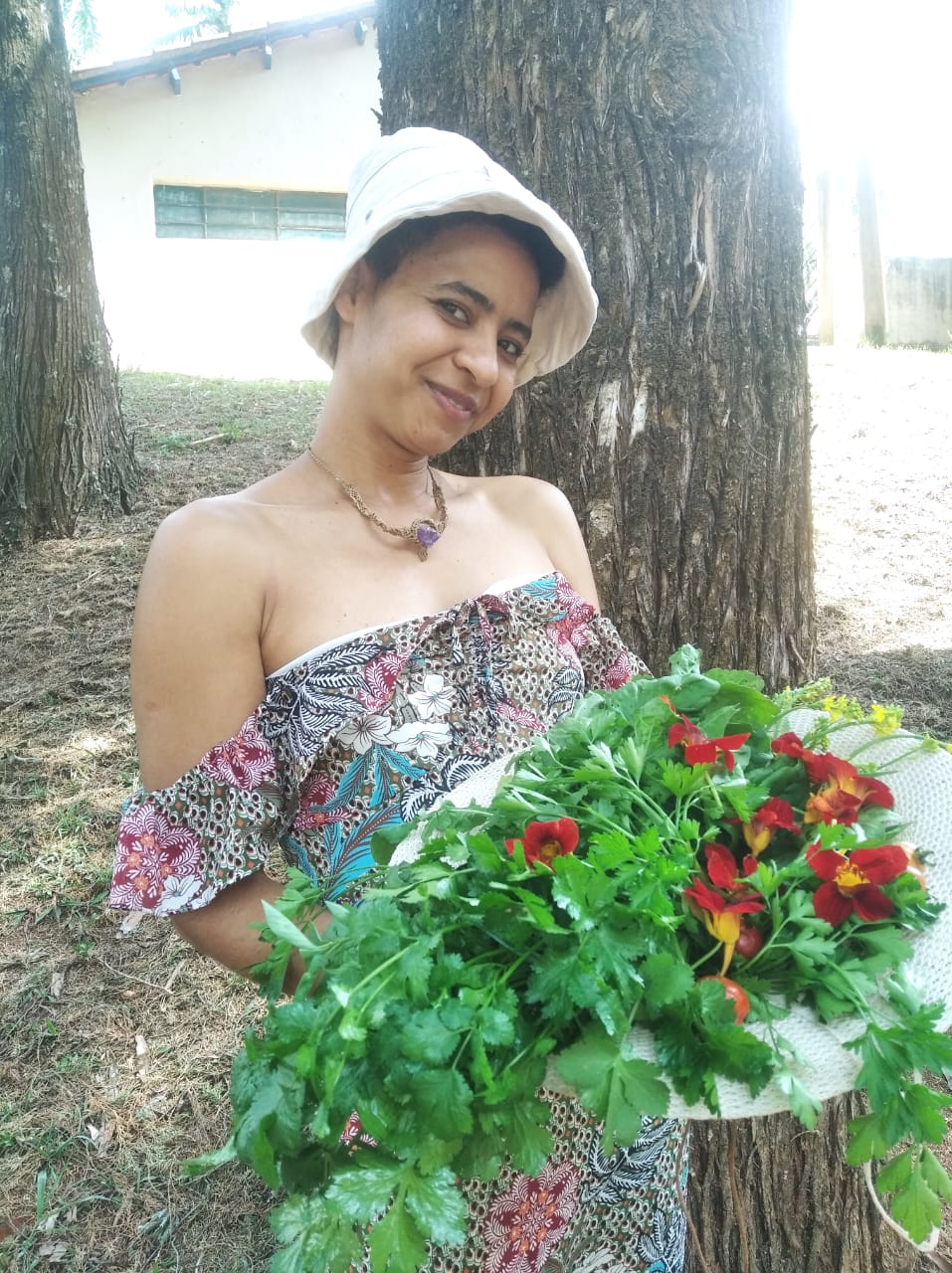
Living Museum of Food: Stories, Recipes, and Culinary Heritage from Traditional Communities
[PT-BR FOLLOWS] Introduction Back when city streets were paved with cobblestones, public telephones stood on street corners, and many neighborhoods were still unpaved, life followed a different rhy…
Understanding Abundance, part 1: It’s Caused by Consumers
Hello! If you’re coming here for the first time, thanks for checking out my writing on Medium. I don’t publish much here anymore — I’ve…
What’s the Matter with Abundance? | Malcolm Harris
“Abundance” by Ezra Klein and Derek Thompson is new packaging for a tried-and-failed attempt to escape from history on a rocket ship.
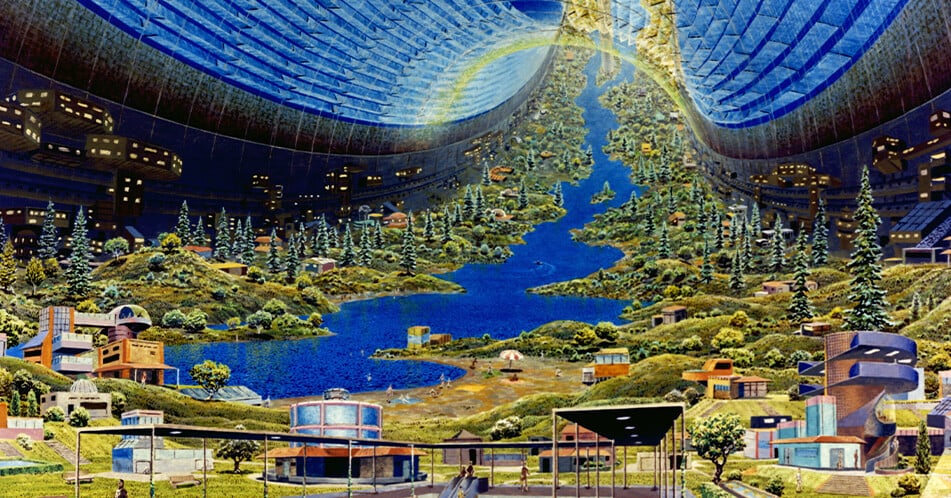
Playbooks — Renaissance Philanthropy – A brighter future for all through science, technology, and innovation
Christopher Alexander’s A Pattern Language defines 253 methods for constructing beautiful and practical designs at every scale, from cities to rooms.


The Guest House
This being human is a guest house. Every morning a new arrival. A joy, a depression, a meanness, some momentary awareness comes as an unexpected visitor.
Flânerie without Politics: The Middle-Class Fetishization of the City
The middle-class spectacle of urban decay.
How buildings learn : what happens after they're built
Originally published: New York, NY : Viking, 1994; Includes bibliographical references (p. 224-229) and index; Flow -- Shearing layers -- "Nobody cares what you do in there": the low road --- Houseproud: the high road -- Magazine architecture: no road -- Unreal estate -- Preservation: a quiet, populist, conservative, victorious revolution -- The romance of maintenance -- Vernacular: how buildings learn from each other -- Function melts form: satisficing home and office -- The scenario-buffered building -- Built for change -- Appendix: The study of buildings in time

New_ Public Invests in Local Online Spaces as Digital Civic Infrastru…
archived 11 Apr 2025 17:34:52 UTC

Home | Urban Nomad Adventures