


"This is the endgame of our isolation."
Naomi Klein’s new book calls out end times fascism. What is this – and what’s the role of big tech?
Two new books, End Times Fascism and Nerd Reich, take a hard look at fascism today – and its intersections with big tech.

Naomi Klein’s new book calls out end times fascism. What is this – and what’s the role of big tech?
Two new books, End Times Fascism and Nerd Reich, take a hard look at fascism today – and its intersections with big tech.
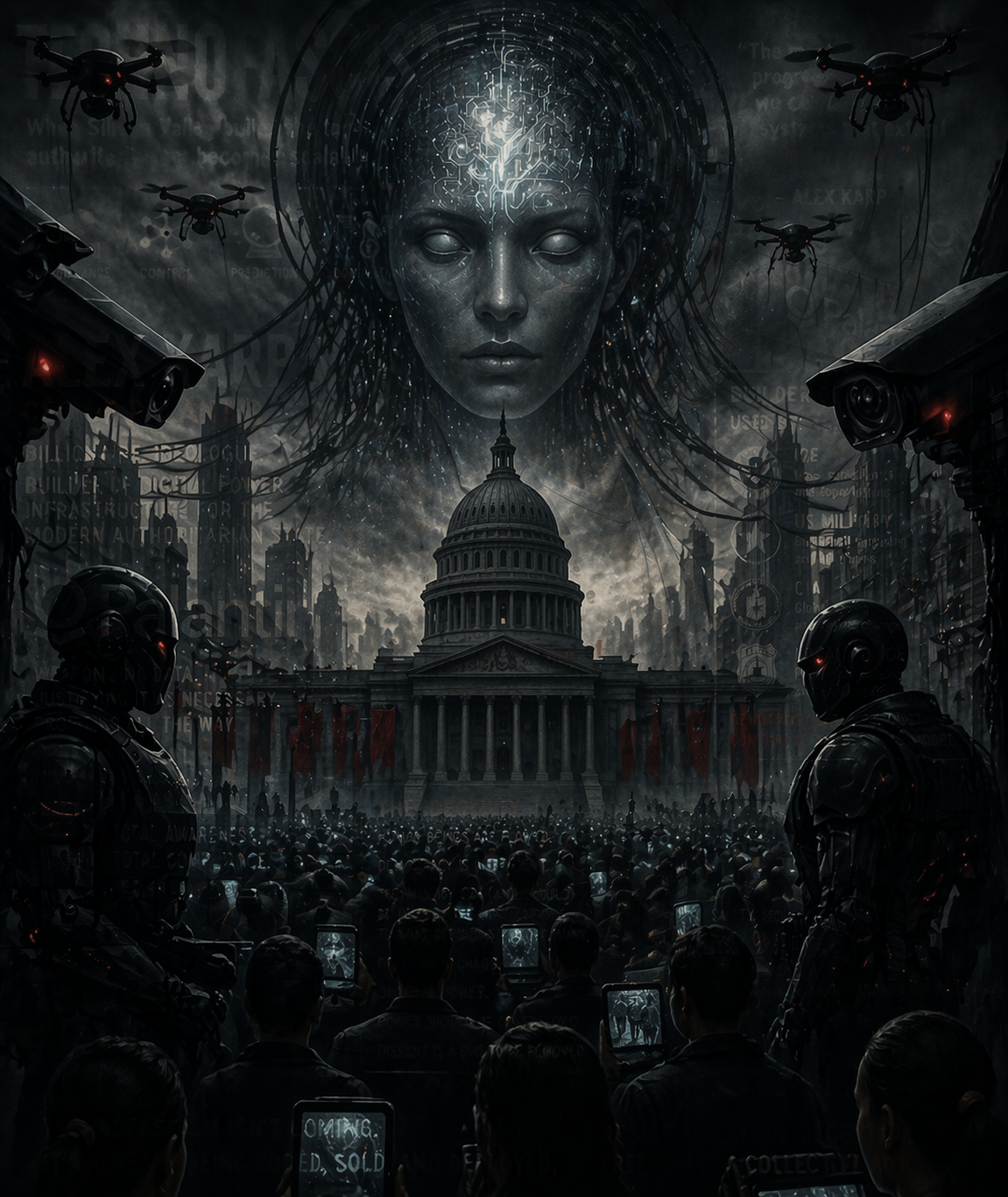
Palantir's social media manifesto is a blueprint for technofascism
The surveillance firm’s viral X post calls for hard power, conscription and the end of pluralism. AI expert and academic Mark Coeckelbergh on what happens when technology becomes the gateway to authoritarianism
End Times Fascism
The far right is on the march again – but this time it’s different from anything we’ve seen before. A new, apocalyptic alliance of religious fundamentalists, billionaire Silicon Valley tech kings and ethno-nationalists is on the move. They’re united in their belief that some kind of cleansing cataclysm is coming, and they welcome a future of shocks, scarcity and collapse, convinced they’ll be among the saved on the other side. This is the world of End Times Fascism. In this blistering reckoning with our age, Naomi Klein and Astra Taylor take us deep into this man-made Armageddon complex – and show us how to resist it. Around the globe, they investigate how those who are making our world unliveable through climate chaos and job-consuming AI are preparing to protect themselves from the fallout, whether it’s by repairing to luxurious private islands for the super-rich, rocketing off to Mars or bunkering nations against a dehumanized ‘other’. But, Klein and Taylor reveal, the new supremacist survivalists are far from impregnable. They have no vision of a shared future. All they offer are remixes of a bygone past: the nihilistic, sadistic pleasures of domination. If we’re to meet this critical moment and defend what’s left of democracy before it’s smashed up beyond repair, we must break the doom loop, and find a new way of living together, rooted in our existence on this earth, in the here and now. A story not of end times – but of better times. This book shows us how.

How the unholy alliance of Big Tech and the far right threatens the world
Far-right populists are the best chance for the tech oligarchs to hold onto power and wealth through the pursuit of ‘End Times Fascism’

A Thesis on the History of the 21st Century: Technocracy, AI, and the End of the World
Reviewing a trio of books by a sextet of ruling-class ideologues, Mathias Fuelling finds an ambient anxiety hanging over a perceived crisis in American capitalism, with visions of bolstering a Silicon Valley-led technocracy fueled by AI investment reflecting American fears over the dawn of a "Chinese Century."

The end times fascists are plotting their escape from our world. Our mission is clear | Naomi Klein and Astra Taylor
An unholy alliance is working toward an apocalyptic future from which only a chosen few will emerge unscathed. It’s becoming clear how we stop them

You Can’t Post Your Way Out of Fascism
Authoritarians and tech CEOs now share the same goal: to keep us locked in an eternal doomscroll instead of organizing against them, Janus Rose writes.

The end of capitalism has begun
Without us noticing, we are entering the postcapitalist era. At the heart of further change to come is information technology, new ways of working and the sharing economy. The old ways will take a long while to disappear, but it’s time to be utopian

TESCREAL
TESCREAL is a neologism proposed by computer scientist Timnit Gebru and philosopher Émile P. Torres. An acronym, it stands for Transhumanism, Extropianism, Singularitarianism, (modern) Cosmism, Rationalists (the internet community, not to be confused with other uses of the term), Effective Altruism, and Longtermism.[1][2] Gebru and Torres argue that these ideologies should be treated as an "interconnected and overlapping" group with shared origins.[1] They claim these constitute a movement that allows its proponents to use the threat of human extinction to justify expensive or detrimental projects and consider it pervasive in social and academic circles in Silicon Valley centered on artificial intelligence.[3] As such, the acronym is sometimes used to criticize a perceived belief system associated with Big Tech.[3][4][5]
Technopoly: The Surrender of Culture to Technology
A witty, often terrifying that chronicles our transform…

Whitepaper — The Collective Intelligence Project
I. Capitalist Acceleration: Sacrificing safety for progressII. Authoritarian Technocracy: Sacrificing participation for safetyIII. Shared Stagnation: Sacrificing progress for participation

Major Tech Investor Calls Architect of Fascism a 'Saint' in Unhinged Manifesto
Silicon Valley's 'techno-optimism' cult believes we should let rich tech guys do whatever they want.

Beyond AI: Infrastructuring the Common Good
Rather than taking AI as a central focus, this paper treats it as diagnostic of deeper contradictions. AI intensifies extractivism while being unable to deliver on its promises, and its rampant scaling of energy and resource demands heralds a form of ‘total mobilisation’. This paper proposes decomputing as a programme for pushing back against such technocratic nihilism. Decomputing adopts a degrowth framework and advocates for reclaiming agency through deautomatisation and people’s councils, in order to develop convivial alternatives that centre an ethics of care. It is a philosophical and tactical response to the wider crisis of care induced by the collapse of existing systems. Decomputing proposes a prefigurative praxis for those experiencing ruptures in the infrastructures of everyday life, while minimising the opening for an authoritarian turn or war economy. Rather than capitulating to an increasingly fascistic world order, decomputing advocates a shift in the idea of order itself, one that means challenging the idea that ever more advanced tech is synonymous with progress. The paper argues that reclaiming critical infrastructures can be decoupled from the collapse of the general technopolitical regime, and makes a plausibility argument informed by destituent power and largely forgotten British cybernetics. Where the Luddite call was to ‘put down all machinery hurtful to the Commonality’, the goal of decomputing is the infrastructuring of the common good.
Fascism | The Paper Pilot
The Paper Pilot's digital garden of thoughts on philosophy, politics, and sociology