The Open Research Knowledge Graph (ORKG) aims to describe research papers in a structured manner. With the ORKG, papers are easier to find and compare.
Checking Reproducibility with the Open Research Knowledge Graph. Husein, Lorenz
Introducing the Knowledge Graph: things, not strings
We hope this will give you a more complete picture of your interest, provide smarter search results, and pique your curiosity.

Orrery, a Knowledge Graph That Adapts to Its Corpus
Orrery is our open-source knowledge graph that gets deeper as you feed it: domains that hit critical mass earn their own custom extraction specs, agents get an API, and humans get a galaxy. The whole …

Open Sourcing Scientific Research with Lab Discourse Graphs
SemRepo.org
SemRepo is a large-scale RDF knowledge graph of GitHub repositories linked to scientific research. SemRepo captures fine-grained repository-level metadata (e.g., contributors, issues, programming languages) and interlinks this with external scholarly knowledge graphs: repositories to publications in LPWC, repository authors to their profiles in SemOpenAlex, and research artifacts (e.g., datasets, experiments) are linked via MLSea.
Getting started - Docs
Discourse Graphs are a tool and ecosystem for collaborative knowledge synthesis, enabling researchers to map ideas and arguments in a modular, composable graph format.
Connected Papers | Find and explore academic papers
A unique, visual tool to help researchers and applied scientists find and explore papers relevant to their field of work.
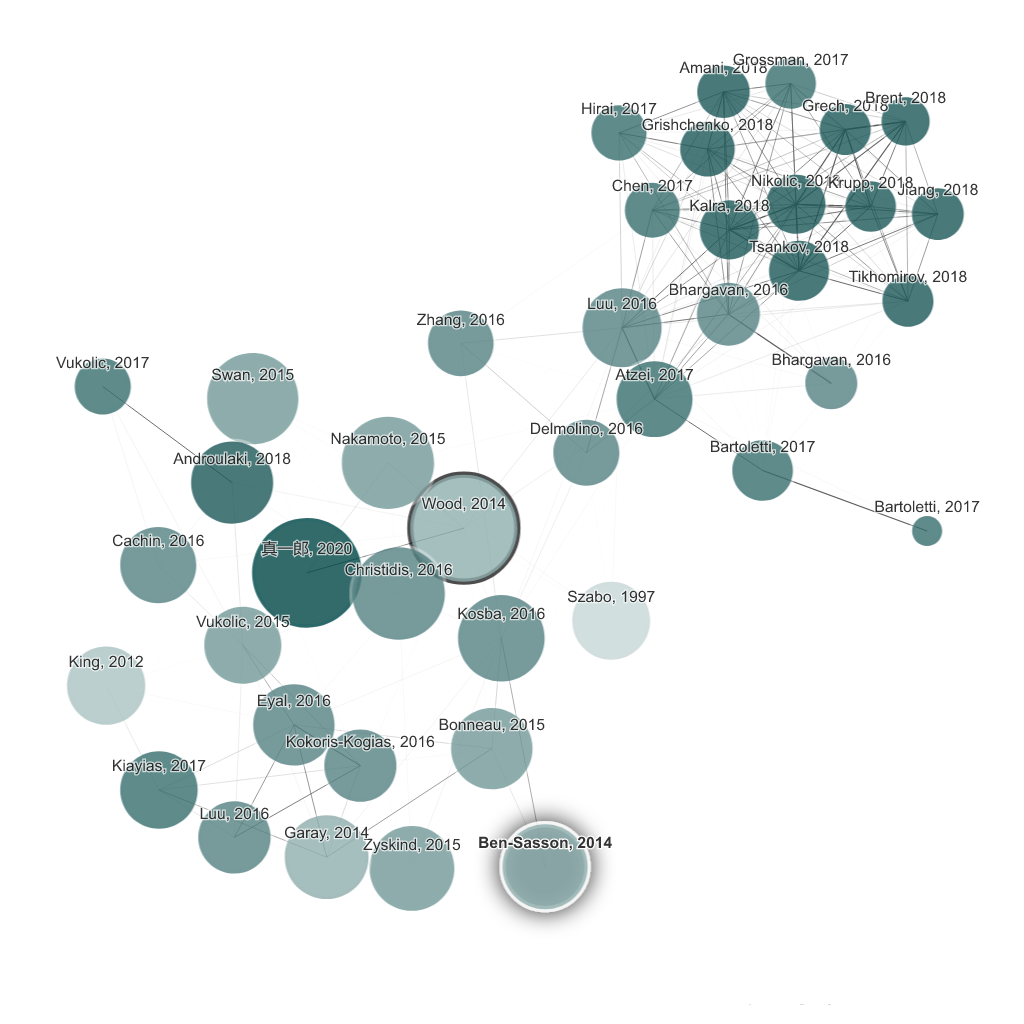
Connected Papers | Find and explore academic papers
A unique, visual tool to help researchers and applied scientists find and explore papers relevant to their field of work.
Semantic Scholar Academic Graph API | Semantic Scholar
Build projects that accelerate scientific progress with the Semantic Scholar Academic Graph API

SemRepo: A Knowledge Graph for Research Software and Its Scholarly Ecosystem
We present SemRepo, an RDF knowledge graph comprising over 81 million triples describing nearly 200,000 GitHub repositories associated with scientific research. SemRepo captures repository-level metadata, such as contributors, issues, and programming languages, and interlinks this information with external scholarly knowledge graphs. In particular, repository authors are linked to their profiles in SemOpenAlex, repositories are connected to scholarly publications in LPWC, and research artifacts, such as datasets and experiments, are linked via MLSea-KG. This integration enables queries that span publications and their scholarly artifacts, which are typically fragmented across separate platforms. SemRepo supports analyses that are difficult to perform with existing resources in isolation, including provenance reconstruction across repositories and publications, as well as the systematic identification of risks to research reproducibility and software sustainability. By unifying research software with its scholarly context in a single graph, SemRepo provides an important infrastructure for large-scale analysis of software within the broader scientific research ecosystem.

The Research Nexus vision for a more connected scholarly community
Crossref envisions “a rich and reusable open network of relationships connecting research organizations, people, things, and actions; a scholarly record that the global community can build on forever, for the benefit of society”. This Research Nexus expands on the importance of research objects being persistently and uniquely identified. The scholarly community has an established practice of connecting things such as citations to others’ work and it is increasingly critical to identify relationships beyond citations, bringing together published work, unpublished work, institutions, individuals, and identifying the actions that they take e.g., funding, publishing, creating, modifying, citing, and sharing. The Research Nexus brings together metadata and relationships to build a joined-up picture of the scholarly ecosystem and helps everyone identify these relationships and how they change through time. This vision is possible if all parts of the scholarly ecosystem (and beyond) work together, including various scholarly infrastructure organizations.

Knowledge Graphs
In this article, we provide a comprehensive introduction to knowledge graphs, which have recently garnered significant attention from both industry and academia in scenarios that require exploiting diverse, dynamic, large-scale collections of data. After some opening remarks, we motivate and contrast various graph-based data models, as well as languages used to query and validate knowledge graphs. We explain how knowledge can be represented and extracted using a combination of deductive and inductive techniques. We conclude with high-level future research directions for knowledge graphs.
Open Knowledge Repository
Open Knowledge Repository
Open Knowledge Repository
The new way we’ll do science
Papers should become human-readable views over a graph of data, tools, results, and certificates.