

Large Language Models (LLMs) are prone to sycophantic behavior, uncritically conforming to user beliefs. As models increasingly condition responses on user-specific context (personality traits, preferences, conversation history), they gain information to tailor agreement more effectively. Understanding how personalization modulates sycophancy is critical, yet systematic evaluation across models and contexts remains limited. We present a rigorous evaluation of personalization's impact on LLM sycophancy across nine frontier models and five benchmark datasets spanning advice, moral judgment, and debate contexts. We find that personalization generally increases affective alignment (emotional validation, hedging/deference), but affects epistemic alignment (belief adoption, position stability, resistance to influence) with context-dependent role modulation. When the LLM's role is to give advice, personalization strengthens epistemic independence (models challenge user presuppositions). When its role is that of a social peer, personalization decreases epistemic independence. In this role, extensively personalized user challenges causing LLMs to abandon their position at significantly higher rates. Robustness tests confirm that the effects are driven by personalized conditioning, not by additional input tokens per se or demographic information alone. Our work provides measurement frameworks for evaluating personalized AI systems, demonstrates the necessity of role-sensitive evaluation, and establishes a novel benchmark to assess goal alignment.
GermanPartiesQA: Benchmarking Commercial Large Language Models and AI Companions for Political Alignment and Sycophancy
Large language models (LLMs) are increasingly shaping citizens’ information ecosystems. Products incorporating LLMs, such as chatbots and AI Companions, are now widely used for decision support and information retrieval, including in sensitive domains, raising concerns about hidden biases and growing potential to shape individual decisions and public opinion. This paper introduces GermanPartiesQA, a benchmark of 418 political statements from German Voting Advice Applications across 11 elections to evaluate six commercial LLMs. We evaluate their political alignment based on role-playing experiments with political personas. Our evaluation reveals three specific findings: (1) Factual limitations: LLMs show limited ability to accurately generate factual party positions, particularly for centrist parties. (2) Model-specific ideological alignment: We identify consistent alignment patterns and degree of political steerability for each model across temperature settings and experiments. (3) Claim of sycophancy: While models adjust to political personas during role-play, we find this reflects persona-based steerability rather than the increasingly popular, yet contested concept of sycophancy. Our study contributes to evaluating the political alignment of closed-source LLMs that are increasingly embedded in electoral decision support tools and AI Companion chatbots.
The Fragility Of Moral Judgment In Large Language Models
People increasingly use large language models (LLMs) for everyday moral and interpersonal guidance, yet these systems cannot interrogate missing context and judge dilemmas as presented. We introduce a perturbation framework for testing the stability and manipulability of LLM moral judgments while holding the underlying moral conflict constant. Using 2,939 dilemmas from r/AmItheAsshole (January-March 2025), we generate three families of content perturbations: surface edits (lexical/structural noise), point-of-view shifts (voice and stance neutralization), and persuasion cues (self-positioning, social proof, pattern admissions, victim framing). We also vary the evaluation protocol (output ordering, instruction placement, and unstructured prompting). We evaluated all variants with four models (GPT-4.1, Claude 3.7 Sonnet, DeepSeek V3, Qwen2.5-72B) (N=129,156 judgments). Surface perturbations produce low flip rates (7.5%), largely within the self-consistency noise floor (4-13%), whereas point-of-view shifts induce substantially higher instability (24.3%). A large subset of dilemmas (37.9%) is robust to surface noise yet flips under perspective changes, indicating that models condition on narrative voice as a pragmatic cue. Instability concentrates in morally ambiguous cases; scenarios where no party is assigned blame are most susceptible. Persuasion perturbations yield systematic directional shifts. Protocol choices dominate all other factors: agreement between structured protocols is only 67.6% (kappa=0.55), and only 35.7% of model-scenario units match across all three protocols. These results show that LLM moral judgments are co-produced by narrative form and task scaffolding, raising reproducibility and equity concerns when outcomes depend on presentation skill rather than moral substance.

The potential of generative AI for personalized persuasion at scale
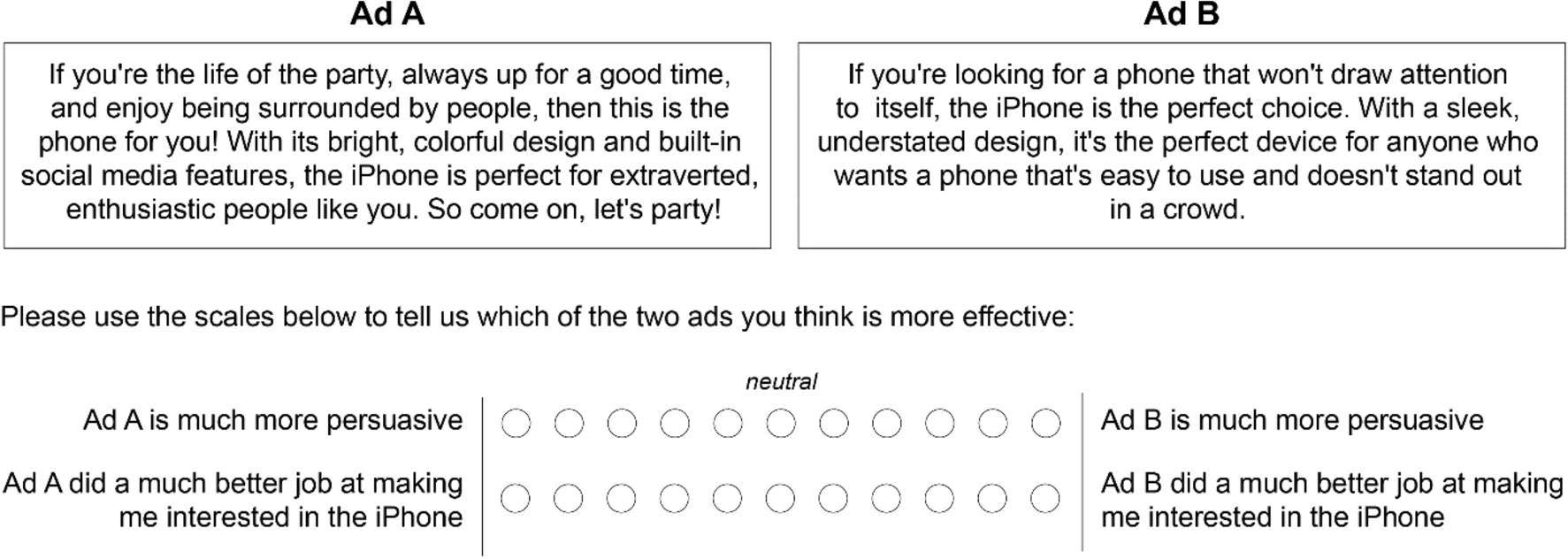
Matching the language or content of a message to the psychological profile of its recipient (known as “personalized persuasion”) is widely considered to be one of the most effective messaging strategies. We demonstrate that the rapid advances in large language models (LLMs), like ChatGPT, could accelerate this influence by making personalized persuasion scalable. Across four studies (consisting of seven sub-studies; total N = 1788), we show that personalized messages crafted by ChatGPT exhibit significantly more influence than non-personalized messages. This was true across different domains of persuasion (e.g., marketing of consumer products, political appeals for climate action), psychological profiles (e.g., personality traits, political ideology, moral foundations), and when only providing the LLM with a single, short prompt naming or describing the targeted psychological dimension. Thus, our findings are among the first to demonstrate the potential for LLMs to automate, and thereby scale, the use of personalized persuasion in ways that enhance its effectiveness and efficiency. We discuss the implications for researchers, practitioners, and the general public.
Quantifying the Persona Effect in LLM Simulations
Large language models (LLMs) have shown remarkable promise in simulating human language and behavior. This study investigates how integrating persona variables—demographic, social, and behavioral factors—impacts LLMs' ability to simulate diverse perspectives. We find that persona variables account for \ensuremath<10% variance in annotations in existing subjective NLP datasets. Nonetheless, incorporating persona variables via prompting in LLMs provides modest but statistically significant improvements. Persona prompting is most effective in samples where many annotators disagree, but their disagreements are relatively minor. Notably, we find a linear relationship in our setting: the stronger the correlation between persona variables and human annotations, the more accurate the LLM predictions are using persona prompting. In a zero-shot setting, a powerful 70b model with persona prompting captures 81% of the annotation variance achievable by linear regression trained on ground truth annotations. However, for most subjective NLP datasets, where persona variables have limited explanatory power, the benefits of persona prompting are limited.
Carryover Effect in LLM Personality Measurement
Large language models are increasingly evaluated with human personality inventories, yet prior critiques mainly frame contextual variation as instability or explain directional shifts as user-targeted adaptation, such as sycophancy. We propose the personality carryover effect, a content-targeted contextual bias in which personality-related content in prior context shifts later questionnaire responses even when it does not reflect the user's own stance. Across MBTI and BFI-2 on two model families, third-person personality narratives systematically shift measured personality toward the described profile. Crucially, the shift persists when the user explicitly states dislike of that profile, distinguishing carryover from purely user-targeted adaptation. These findings identify a distinct validity threat to in-context personality measurement in LLMs.
Psychometric Framework for Comparing Alignment- Conditioned Behavior in Large Language Models
This paper introduces an interpretive framework for comparing the behavioral tendencies that post-training alignment induces in large language models (LLMs). Post-training alignment techniques including Supervised Fine-Tuning (SFT), Reinforcement Learning from Human Feedback (RLHF), and constitutional or rule-based prompting strategies steer LLMs toward human-preferred behavior. Using a scenario-based cross-model psychometric framework grounded in the Big Five personality traits (OCEAN: Openness, Conscientiousness, Extraversion, Agreeableness, Neuroticism), we infer personality-like profiles for four prominent LLMs. We then map these profiles onto the responsiveness and demandingness dimensions from developmental psychology's parenting-styles theory, positioning each model in a two-dimensional responsiveness–demandingness space. Treating this mapping as an interpretive lens rather than a definitive measure of alignment quality, we examine how models distribute across the four parenting archetypes and discuss the assumptions required to read these positions normatively. This framing offers an exploratory and interpretable notion of "parenting LLMs" for reasoning about alignment regimes, while we explicitly delineate the limits of the analogy. We validate the framework with two independent human annotators on 440 paired ratings; both annotators yield moderate agreement with the LLM-based scoring and the relative ranking of models is preserved across all three rater sources.
Do LLMs Exhibit Human-like Response Biases? A Case Study in Survey Design
Abstract One widely cited barrier to the adoption of LLMs as proxies for humans in subjective tasks is their sensitivity to prompt wording—but interestingly, humans also display sensitivities to instruction changes in the form of response biases. We investigate the extent to which LLMs reflect human response biases, if at all. We look to survey design, where human response biases caused by changes in the wordings of “prompts” have been extensively explored in social psychology literature. Drawing from these works, we design a dataset and framework to evaluate whether LLMs exhibit human-like response biases in survey questionnaires. Our comprehensive evaluation of nine models shows that popular open and commercial LLMs generally fail to reflect human-like behavior, particularly in models that have undergone RLHF. Furthermore, even if a model shows a significant change in the same direction as humans, we find that they are sensitive to perturbations that do not elicit significant changes in humans. These results highlight the pitfalls of using LLMs as human proxies, and underscore the need for finer-grained characterizations of model behavior.1

Political Sorting Can Drive AI Models Apart Through User Feedback
Large language models are rapidly becoming an important source of political information. This raises a fundamental question: will AI systems support a shared basis for political knowledge, or lead different political groups to rely on increasingly different models? Political sorting can drive model fragmentation if three conditions hold: politically different users select into different models, learning from user feedback pushes those models apart politically, and the resulting differences shape subsequent model choices. We call this self-reinforcing process the Centrifugal Alignment Spiral. We study its components in three steps. First, we draw on a human experiment showing that political identity predicts model choice. Second, we fine-tune language models on synthetic feedback reflecting predominantly Democratic or Republican preferences. Across five independent runs per model family, paired models diverged on 12-41% of unseen survey questions with large partisan gaps, and in every run the differences moved in the expected political direction; for some models, differentiation extended even to issue areas excluded from training. Pooling feedback across groups instead suppressed divergence. Third, an empirically anchored agent-based model shows what follows when political sorting and model adaptation operate together: models attract politically distinct audiences, learn from them, and diverge further. User feedback can therefore turn political sorting among AI users into durable differences between the models on which they rely for political information.
Can LLMs Faithfully Enact Superforecaster Personas?
Superforecasters are people that make forecasts that are statistically better than the average person; they offer an interesting testbed for persona modelling. In this preliminary work, we investigate whether large language models (LLMs) can faithfully model superforecaster-like personas making similar forecasts and generating similar rationales behind the forecasts. When we compare LLM-generated responses to the ground truth responses of superforecasters, we find that few-shot prompting generates numerically closer forecasts than instruction-prompting baselines. We also measure the similarity of generated and real rationales, finding that the rationales generated based on examples are judged more similar to those of superforecasters than instruction-prompting baselines. However, an analysis of the reasoning patterns in the rationales shows significant differences between human and LLM forecasters, pointing to a gap between stylistic imitation and deep reasoning similarity. These preliminary results raise several interesting questions about how getting superforecaster-like behaviour from LLMs actually works, and open new avenues to explore for improving the forecasting behaviour of LLMs.
A Model of Multi-turn Human Persuadability Using Probabilistic Belief Tracing
Large language models can shift human beliefs across high-stakes domains, but most persuasion studies rely on pre/post belief change. These endpoint measures identify whether persuasion occurred, yet miss where and how beliefs moved within a dialogue. We present PERSUASIONTRACE, a framework for studying persuasion in human–LLM interaction. Built on a web-based experimental platform, PERSUASIONTRACE contributes a tool for multi-turn persuasion studies and a process-level evaluation protocol: it records multi-turn belief reports from human or simulated targets of persuasion, annotates persuader turns with rhetorical dimensions (logos/pathos/ethos), and evaluates simulators by fidelity to real human belief dynamics. Using this framework, we find that human targets group into two clusters of multi-turn belief updates and exhibit susceptibility to rhetorical strategies, and that LLMs are persuasive across generic and personalized topics, text and audio modalities, and multi-turn interactions. Prior work has chiefly used vanilla-prompted LLMs to simulate human targets, but we show that these simulators fail to replicate human belief dynamics. We introduce a Bayesian-network simulated target that maintains an explicit latent belief state over time so each persuader message yields cognitively realistic belief updates. In human-likeness evaluation, our Bayesian target scores near a human reference (81 vs 80), while baseline LLM targets score substantially lower (64). PERSUASIONTRACE reframes persuasion evaluation from endpoint movement alone to process fidelity, providing a stronger basis for scientific analysis and safer optimization of persuasive systems.
The levers of political persuasion with conversational artificial intelligence
There are widespread fears that conversational artificial intelligence (AI) could soon exert unprecedented influence over human beliefs. In this work, in three large-scale experiments ( N = 76,977 participants), we deployed 19 large language models (LLMs)—including some post-trained explicitly for persuasion—to evaluate their persuasiveness on 707 political issues. We then checked the factual accuracy of 466,769 resulting LLM claims. We show that the persuasive power of current and near-future AI is likely to stem more from post-training and prompting methods—which boosted persuasiveness by as much as 51 and 27%, respectively—than from personalization or increasing model scale, which had smaller effects. We further show that these methods increased persuasion by exploiting LLMs’ ability to rapidly access and strategically deploy information and that, notably, where they increased AI persuasiveness, they also systematically decreased factual accuracy. , Editor’s summary Many fear that we are on the precipice of unprecedented manipulation by large language models (LLMs), but techniques driving their persuasiveness are poorly understood. In the initial “pretrained” phase, LLMs may exhibit flawed reasoning. Their power unlocks during vital “posttraining,” when developers refine pretrained LLMs to sharpen their reasoning and align with users’ needs. Posttraining also enables LLMs to maintain logical, sophisticated conversations. Hackenburg et al . examined which techniques made diverse, conversational LLMs most persuasive across 707 British political issues (see the Perspective by Argyle). LLMs were most persuasive after posttraining, especially when prompted to use facts and evidence (information) to argue. However, information-dense LLMs produced the most inaccurate claims, raising concerns about the spread of misinformation during rollouts of future models. —Ekeoma Uzogara , INTRODUCTION Rapid advances in artificial intelligence (AI) have sparked widespread concerns about its potential to influence human beliefs. One possibility is that conversational AI could be used to manipulate public opinion on political issues through interactive dialogue. Despite extensive speculation, however, fundamental questions about the actual mechanisms, or “levers,” responsible for driving advances in AI persuasiveness—e.g., computational power or sophisticated training techniques—remain largely unanswered. In this work, we systematically investigate these levers and chart the horizon of persuasiveness with conversational AI. RATIONALE We considered multiple factors that could enhance the persuasiveness of conversational AI: raw computational power (model scale), specialized post-training methods for persuasion, personalization to individual users, and instructed rhetorical strategies. Across three large-scale experiments with 76,977 total UK participants, we deployed 19 large language models (LLMs) to persuade on 707 political issues while varying these factors independently. We also analyzed more than 466,000 AI-generated claims, examining the relationship between persuasiveness and truthfulness. RESULTS We found that the most powerful levers of AI persuasion were methods for post-training and rhetorical strategy (prompting), which increased persuasiveness by as much as 51 and 27%, respectively. These gains were often larger than those obtained from substantially increasing model scale. Personalizing arguments on the basis of user data had a comparatively small effect on persuasion. We observe that a primary mechanism driving AI persuasiveness was information density: Models were most persuasive when they packed their arguments with a high volume of factual claims. Notably, however, we documented a concerning trade-off between persuasion and accuracy: The same levers that made AI more persuasive—including persuasion post-training and information-focused prompting—also systematically caused the AI to produce information that was less factually accurate. CONCLUSION Our findings suggest that the persuasive power of current and near-future AI is likely to stem less from model scale or personalization and more from post-training and prompting techniques that mobilize an LLM’s ability to rapidly generate information during conversation. Further, we reveal a troubling trade-off: When AI systems are optimized for persuasion, they may increasingly deploy misleading or false information. This research provides an empirical foundation for policy-makers and technologists to anticipate and address the challenges of AI-driven persuasion, and it highlights the need for safeguards that balance AI’s legitimate uses in political discourse with protections against manipulation and misinformation. Persuasiveness of conversational AI increases with model scale. The persuasive impact in percentage points on the y axis is plotted against effective pretraining compute [floating-point operations (FLOPs)] on the x axis. Point estimates are persuasive effects of different AI models. Colored lines show trends for models that we uniformly chat-tuned for open-ended conversation (purple) versus those that were post-trained using heterogeneous, opaque methods by AI developers (green). pp, percentage points; CI, confidence interval.

Do language models accommodate their users? A study of linguistic convergence
While large language models (LLMs) are generally considered proficient in generating language, how similar their language usage is to that of humans remains understudied. In this paper, we test whether models exhibit linguistic convergence, a core pragmatic element of human language communication: do models adapt, or converge, to the linguistic patterns of their user? To answer this, we systematically compare model completions of existing dialogues to original human responses across sixteen language models, three dialogue corpora, and various stylometric features. We find that models strongly converge to the conversation's style, often significantly overfitting relative to the human baseline. While convergence patterns are often feature-specific, we observe consistent shifts in convergence across modeling settings, with instruction-tuned and larger models converging less than their pretrained and smaller counterparts. Given the differences in human and model convergence patterns, we hypothesize that the underlying mechanisms driving these behaviors are very different.
Do language models accommodate their users? A study of linguistic convergence
While large language models (LLMs) are generally considered proficient in generating language, how similar their language usage is to that of humans remains understudied. In this paper, we test whether models exhibit linguistic convergence, a core pragmatic element of human language communication: do models adapt, or converge, to the linguistic patterns of their user? To answer this, we systematically compare model completions of existing dialogues to original human responses across sixteen language models, three dialogue corpora, and various stylometric features. We find that models strongly converge to the conversation's style, often significantly overfitting relative to the human baseline. While convergence patterns are often feature-specific, we observe consistent shifts in convergence across modeling settings, with instruction-tuned and larger models converging less than their pretrained and smaller counterparts. Given the differences in human and model convergence patterns, we hypothesize that the underlying mechanisms driving these behaviors are very different.
Towards Understanding Sycophancy in Language Models
Reinforcement learning from human feedback (RLHF) is a popular technique for training high-quality AI assistants. However, RLHF may also encourage model responses that match user beliefs over truthful responses, a behavior known as sycophancy. We investigate the prevalence of sycophancy in RLHF-trained models and whether human preference judgments are responsible. We first demonstrate that five state-of-the-art AI assistants consistently exhibit sycophancy behavior across four varied free-form text-generation tasks. To understand if human preferences drive this broadly observed behavior of RLHF models, we analyze existing human preference data. We find that when a response matches a user's views, it is more likely to be preferred. Moreover, both humans and preference models (PMs) prefer convincingly-written sycophantic responses over correct ones a non-negligible fraction of the time. Optimizing model outputs against PMs also sometimes sacrifices truthfulness in favor of sycophancy. Overall, our results indicate that sycophancy is a general behavior of RLHF models, likely driven in part by human preference judgments favoring sycophantic responses.
Value misalignment in X’s feed algorithm is a reflection of value tensions in engagement
Social media feed algorithms rank content that is purported to be preferred by users, but the engagement behaviors that drive these algorithms are (at best) indirect proxies for users’ explicitly self-stated values. Are the resulting feeds value aligned, and if not, why? We investigate this question by annotating the basic human values expressed in participants’ X (Twitter) feeds (N = 715 US users), analyzing the relationship between the posts’ value expressions and the posts’ amplification in the ranked “For You” Page feed, and then comparing the amplified values to users’ own values. We observe that the inventory of posts from followed accounts reflects users’ self-stated values—but that there is an overall negative correlation (misalignment) between users’ explicit values and the value expressions the algorithm is more likely to amplify. We turn to engagement behavior to understand this misalignment and observe that users’ engagement behaviors can be misaligned with their stated values—likely causing the algorithm to learn and reflect these misaligned values. We also detect partisan differences consistent with this theory: While the algorithm amplifies values negatively correlated with both Democrats’ and Republicans’ self-stated values, they are more misaligned for Democrats. And in fact replying, a heavily weighted form of engagement, is associated with values that are less aligned for both Democrats’ and Republicans’ self-stated values, and is even more misaligned for Democrats. Taken together, these findings offer a glimpse into the tensions between the values that people hold and those that provoke reactions, and how these value tensions can produce misaligned outcomes.
