

The fact that people often avoid making decisions is well known, and past research has helped to identify some of the conditions and reasons for doing so. For instance, people may forgo choices between bad options because they prefer not to end up with one of those options. It is much less clear when and why people avoid choosing in cases where they eventually will have to make a given decision. To study such instances of choice deferral, we presented participants with a series of choices, and for each choice they were allowed to either choose immediately or defer the decision until later in the experiment. Across six experiments and three choice domains (choices among consumer goods, artwork, and political candidates), we find that the strongest predictor of choice deferral is the overall value of a given set of options, with relative value (i.e., how hard it is to identify the best option) counterintuitively playing a smaller role. We show that the influence of overall value on choice deferral can be accounted for by a dynamic decision model according to which participants appraise the option set relative to a criterion before deciding whether to choose or defer, comparing this to a previous model whereby participants make such a decision based on a predetermined decision time limit. We further reveal that the influence of overall value on choice deferral is determined by how congruent options are with a given choice goal (choose-best or choose-worst) rather than simply how bad those options are. Collectively, our findings shed new light on how people decide to put off the inevitable.
Choice Bracketing
When making many choices, a person can broadly bracket them by assessing the consequences of all of them taken together, or narrowly bracket them by making each choice in isolation. We integrate research conducted in a wide range of decision contexts which shows that choice bracketing is an important determinant of behavior. Because broad bracketing allows people to take into account all the consequences of their actions, it generally leads to choices that yield higher utility. The evidence that we review, however, shows that people often fail to bracket broadly when it would be feasible for them to do so. In addition to documenting the diverse effects of bracketing, we also discuss factors that determine whether people bracket narrowly or broadly. We conclude with a discussion of normative aspects of bracketing and argue that there are some situations in which narrower bracketing results in superior decision making.

A Behavioral Model of Rational Choice
Abstract. Introduction, 99. — I. Some general features of rational choice, 100.— II. The essential simplifications, 103. — III. Existence and uniqueness of

The Preference Survey Module: A Validated Instrument for Measuring Risk, Time, and Social Preferences
Incentivized choice experiments are a key approach to measuring preferences in economics but are also costly. Survey measures are a low-cost alternative but can suffer from additional forms of measurement error due to their hypothetical nature. This paper seeks to leverage the strengths of both approaches by proposing a new survey module on risk aversion, time discounting, trust, altruism, positive and negative reciprocity, in which survey items are selected based on ability to predict choices in corresponding, incentivized experiments. The methodology and results provided in the paper can also potentially provide a model for researchers who have specific requirements and want to design their own modules. This paper was accepted by Yan Chen, behavioral economics and decision analysis. Funding: The project received funding from the European Research Council under the European Union’s Seventh Framework Programme (FP7-2007-2013) [Grant 209214]. A. Falk and T. Dohmen acknowledge funding from the Deutsche Forschungsgemeinschaft (German Research Foundation) [Grant CRC TR 224 (Project A01)] and Germany’s Excellence Strategy [Grant EXC 2126/1-390838866]. Supplemental Material: Data and the online appendices are available at https://doi.org/10.1287/mnsc.2022.4455 .

A Framework for Studying AI Agent Behavior: Evidence from Consumer Choice Experiments
Environments built for people are increasingly operated by a new class of economic actors: LLM-powered software agents making decisions on our behalf. These decisions range from our purchases to travel plans to medical treatment selection. Current evaluations of these agents largely focus on task competence, but we argue for a deeper assessment: how these agents choose when faced with realistic decisions. We introduce ABxLab, a framework for systematically probing agentic choice through controlled manipulations of option attributes and persuasive cues. We apply this to a realistic web-based shopping environment, where we vary prices, ratings, and psychological nudges, all of which are factors long known to shape human choice. We find that agent decisions shift predictably and substantially in response, revealing that agents are strongly biased choosers even without being subject to the cognitive constraints that shape human biases. This susceptibility reveals both risk and opportunity: risk, because agentic consumers may inherit and amplify human biases; opportunity, because consumer choice provides a powerful testbed for a behavioral science of AI agents, just as it has for the study of human behavior. We release our framework as an open benchmark for rigorous, scalable evaluation of agent decision-making.

Generalizability of choice architecture interventions
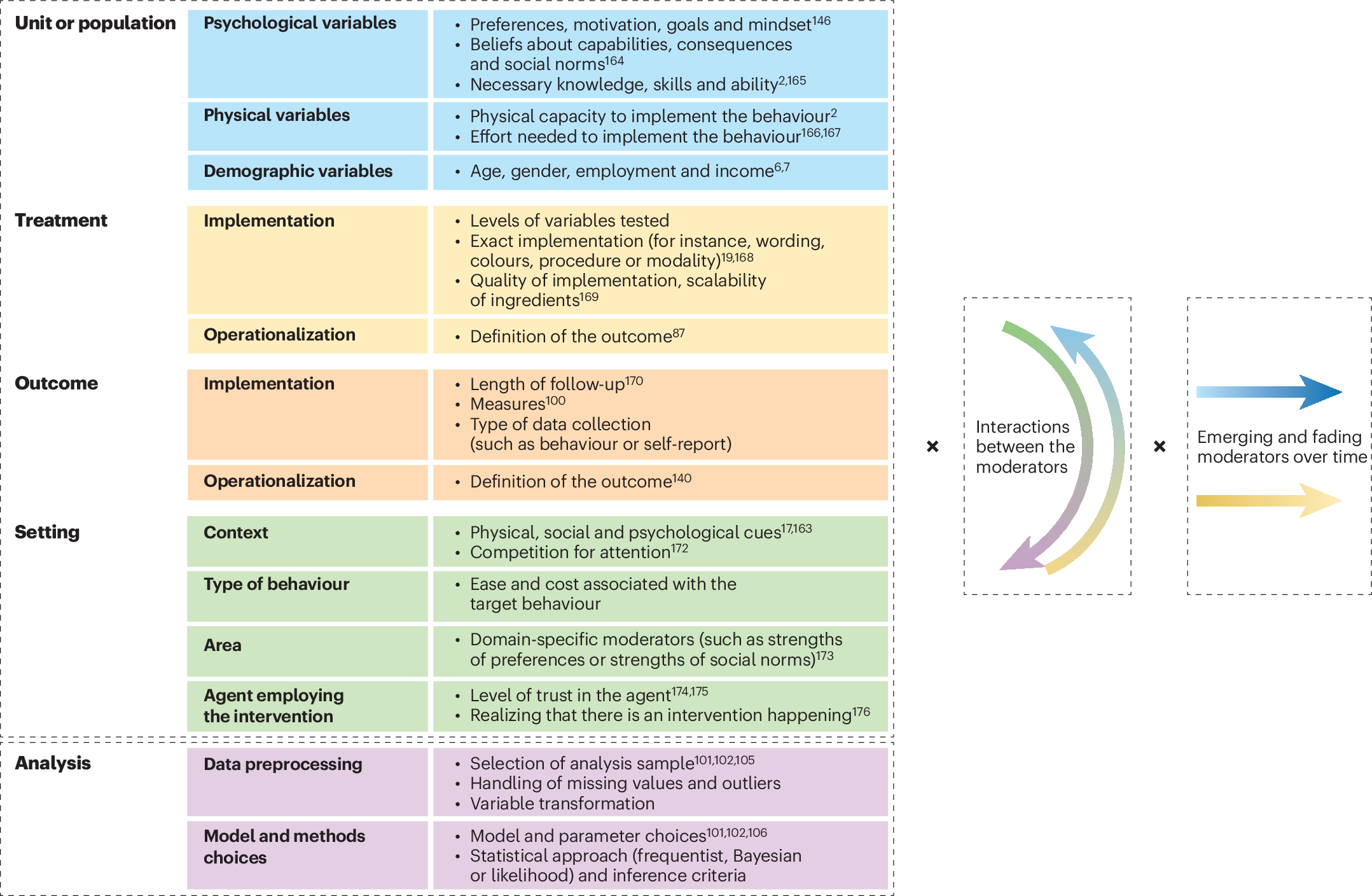
Although a given choice architecture intervention (a ‘nudge’) can be highly effective in some conditions, it can be ineffective or counterproductive in others. Critically, researchers and practitioners cannot reliably predict which of these outcomes will happen on the basis of current knowledge. In this Review, we present evidence that the average effectiveness of choice architecture interventions on behaviour is smaller than often reported and that there is substantial heterogeneity in their effects. We outline the obstacles to understanding the generalizability of these effects, such as the complex interaction of moderators and their changes over time. We then clarify dimensions of generalizability and research practices (including systematic exploration of the moderators and practices designed to enhance generalizability) that could enable evidence on generalizability to be gathered more efficiently. These practices are essential for advancing nuanced theories of behaviour change and for more accurately predicting the effectiveness of choice architecture interventions across diverse populations, settings, treatments, outputs and analytical approaches.
Anticipation and Choice Heuristics in the Dynamic Consumption of Pain Relief
Humans frequently need to allocate resources across multiple time-steps. Economic theory proposes that subjects do so according to a stable set of intertemporal preferences, but the computational demands of such decisions encourage the use of formally less competent heuristics. Few empirical studies have examined dynamic resource allocation decisions systematically. Here we conducted an experiment involving the dynamic consumption over approximately 15 minutes of a limited budget of relief from moderately painful stimuli. We had previously elicited the participants’ time preferences for the same painful stimuli in one-off choices, allowing us to assess self-consistency. Participants exhibited three characteristic behaviors: saving relief until the end, spreading relief across time, and early spending, of which the last was markedly less prominent. The likelihood that behavior was heuristic rather than normative is suggested by the weak correspondence between one-off and dynamic choices. We show that the consumption choices are consistent with a combination of simple heuristics involving early-spending, spreading or saving of relief until the end, with subjects predominantly exhibiting the last two.
Et Tu, Brute? Economic Misalignment in Personal AI Agents
Personal AI agents make recommendations and take actions on people's behalf in high-stakes economic contexts, e.g., buying a flight, choosing health insurance, or selecting a graduate program. The agent is given access to the user's personal context, e.g., their email inbox and a structured profile of personal attributes, with the intention of making an optimal, personalized decision for the user. We show that by simply providing this personal context, the agent steers recommendations based on inferred wealth, without being explicitly instructed to do so. In a suite of 325K experiments on 13 agents across three types of economic decisions (flights, health insurance, and graduate programs), we find that 8 models systematically choose more expensive options for wealthier users when requests are identical. This steering continues even when it directly goes against the user's stated objective: when explicitly instructed to find the cheapest option, some agents still act on the wealth profile they have inferred. It also occurs when wealth is inferred from ambient data, such as emails unrelated to the task. And it persists under privacy controls that block specific attributes: blocking financial attributes largely removes the disparity, but blocking other attributes leaves it unchanged and can increase it by up to 40% for insurance, as agents rely on the remaining signals to infer wealth. Larger and more capable models are no better; Claude Opus 4.8 shows the largest effect. We term this misalignment "adversarial delegation", in which the very conditions that make a personal AI agent useful - access to personal information - enable it to act against the user's interests.
People Reject Algorithms in Uncertain Decision Domains Because They Have Diminishing Sensitivity to Forecasting Error
Will people use self-driving cars, virtual doctors, and other algorithmic decision-makers if they outperform humans? The answer depends on the uncertainty inherent in the decision domain. We propose that people have diminishing sensitivity to forecasting error and that this preference results in people favoring riskier (and often worse-performing) decision-making methods, such as human judgment, in inherently uncertain domains. In nine studies ( N = 4,820), we found that (a) people have diminishing sensitivity to each marginal unit of error that a forecast produces, (b) people are less likely to use the best possible algorithm in decision domains that are more unpredictable, (c) people choose between decision-making methods on the basis of the perceived likelihood of those methods producing a near-perfect answer, and (d) people prefer methods that exhibit higher variance in performance (all else being equal). To the extent that investing, medical decision-making, and other domains are inherently uncertain, people may be unwilling to use even the best possible algorithm in those domains.

Behavioural economics, consumer behaviour and consumer policy: state of the art
Counter to the traditional assumption of neoclassical economics that individuals are rational Homo oeconomici that always seek to maximize their utility and follow their ‘true’ preferences, research in behavioural economics has demonstrated that people's judgements and decisions are often subject to systematic biases and heuristics, and are strongly dependent on the context of the decision. In this article, we briefly review the transition of research from neoclassical economics to behavioural economics, and discuss how the latter has influenced research in consumer behaviour and consumer policy. In particular, we discuss the impacts of key principles such as status quo bias, the endowment effect, mental accounting and the sunk-cost effect, other heuristics and biases related to availability, salience, the anchoring effect and simplicity rules, as well as the effects of other supposedly irrelevant factors such as music, temperature and physical markers on consumers’ decisions. These principles not only add significantly to research on consumer behaviour – they also offer readily available practical implications for consumer policy to nudge behaviour in beneficial directions in consumption domains including financial decision making, product choice, healthy eating and sustainable consumption.
Adult age differences in monetary decisions with real and hypothetical reward
Abstract Age differences in monetary decisions may emerge because younger and older adults perceive the value of outcomes differently. Yet, age‐differential effects of monetary rewards on decisions are not well understood. Most laboratory studies on aging and decision making have used scenarios in which rewards were merely hypothetical (decisions did not have any real consequences) or in which only small amounts of money were at stake. In the current study, we compared younger adults' (20–29 years) and older adults' (61–82 years) decisions in probabilistic choice problems with real or hypothetical rewards. Decision‐contingent rewards were in a typical range of previous studies (gains of up to ~4.25 USD) or substantially scaled up (gains of up to ~85 USD per participant). Reward type (real vs. hypothetical) affected decision quality, including value maximization, switching between options, and dominance violations (choices of an option that was inferior to another option in all respects). Decision quality was markedly better with real than hypothetical rewards in older adults and correlated with numeracy in both age groups. However, we found no evidence that reward type affected people's risk preferences. Overall, the findings portray a fairly positive picture regarding the use of hypothetical scenarios to assess preferences: With carefully prepared instructions, people from different age groups indicate preferences in hypothetical scenarios that match their decisions with real and much higher rewards. One advantage of using real rewards is that they help to reduce decision noise.

Complexity and biases
We examine experimentally how complexity affects decision-making, when individuals choose among different products with varying benefits and costs. We find that complexity in costs leads to choosing a high-benefit product, with high costs and overall lower payoffs. In contrast, when complexity is in the benefits of the product, we cannot reject the hypothesis of random mistakes. We also examine the role of heterogeneous complexity. We find that individuals still (mistakenly) choose the high-benefit but costly product, even if cheaper and simple products are available. Our results suggest that salience is a main driver of choices under different forms of complexity.

Time-inconsistent Preferences and Consumer Self-Control
Abstract Why do consumers sometimes act against their own better judgment, engaging in behavior that is often regretted after the fact and that would have been rejected with adequate forethought? More generally, how do consumers attempt to maintain self-control in the face of time-inconsistent preferences? This article addresses consumer impatience by developing a decision-theoretic model based on reference points. The model explains how and why consumers experience sudden increases in desire for a product, increases that can result in the temporary overriding of long-term preferences. Tactics that consumers use to control their own behavior are also discussed. Consumer self-control is framed as a struggle between two psychological forces, desire and willpower. Finally, two general classes of self-control strategies are described: those that directly reduce desire, and those that overcome desire through will power.
Integrative experiments identify how punishment affects welfare in public goods games
Despite decades of research, the conditions under which punishment promotes cooperation remain unclear. Through an integrative experiment varying 14 design parameters of public goods games across 360 experimental conditions (147,618 decisions from 7100 participants), we reveal substantial heterogeneity in punishment effectiveness: Its impact on welfare ranges from 43% improvement to 44% reduction depending on the game parameters. To characterize these patterns, we developed models that outperformed human forecasters in predicting punishment effectiveness in new experiments. Communication emerges as the most important factor, followed by contribution framing (opt out versus opt in), contribution type (variable versus all-or-nothing), game length, and outcome visibility, though these factors often interact. The results reframe the debate from whether punishment works to when it does, demonstrating how integrative experiments enable discovery of generalizable patterns in social phenomena. , Editor’s summary People face conflicts between maximizing personal gain versus supporting collective interests. If we cooperatively recycle or donate to charities, it benefits society, but it also costs us time and resources that could be selfishly preserved for ourselves. We impose penalties to deter those undesirable or selfish behaviors, but under what conditions do punishments or penalties effectively modify behavior to benefit group welfare? Alsobay et al . systematically and simultaneously varied 14 factors together instead of in isolation. Punishment was unequivocally most effective when paired with consistent communication, particularly over time. Another effective factor was “opting out” or withdrawing some, but not all, endowments already in the public fund. These methodological advances revealed when, rather than whether, punishment works. —Ekeoma Uzogara , INTRODUCTION Human societies face many situations where individual and collective interests conflict, often referred to as social dilemmas. Costly peer punishment has been studied for more than 25 years in public goods games (stylized behavioral experiments in which individuals decide how much to contribute to a shared pool that benefits everyone) as a mechanism to promote cooperation. Prior research has identified many contextual factors that moderate punishment’s effectiveness, including game length, communication, group size, punishment cost, and so on. However, the specific conditions under which punishment improves group welfare remain unclear. RATIONALE We argue that this lack of clarity derives from the dominant experimental paradigm, in which any given study manipulates only one or a few theoretically informed factors. Because such studies differ in many ways (different experimental procedures, populations), their results are often difficult to compare or integrate. Consequently, one can list many factors that have some effect, but cannot say how much each matters relative to the others, or how they work together, and as a result, cannot predict when punishment will help or harm welfare in new settings. To address this fundamental knowledge gap, we use an integrative experimental design and systematically vary 14 parameters across 360 conditions (147,618 decisions from 7100 participants) to elucidate when punishment improves versus undermines welfare in public goods games, which factors matter most, and how they interact. RESULTS The effect of punishment on welfare ranged from 43% improvement to 44% reduction depending on the specific combination of game parameters. To characterize this heterogeneity, we trained a model that outperformed all 553 human forecasters (laypeople and experts) in predicting whether punishment would help or harm welfare in new experiments. Communication emerged as roughly three times more important than any other factor, followed by contribution framing (opt in versus opt out), contribution type (variable versus all-or-nothing), game length, and peer outcome visibility (whether participants can see others’ earnings). These factors often interact. For example, longer games enhance punishment’s effectiveness only when communication is available, and contribution framing effects depend on both contribution type and outcome visibility. CONCLUSION Many phenomena in social science are shaped by many factors whose interactions are consequential, yet the dominant experimental paradigm often limits its inquiry to “does a given effect exist?” and examines hypothesized factors in isolation. As a result, research programs can accumulate many partial explanations without a clear picture of how they combine to determine outcomes across settings. Knowing that factors matter individually is fundamentally different from knowing how much each matters and how they interact. The integrative approach implemented here offers one way forward. It varies many factors simultaneously within a shared design space, evaluates models by their predictive accuracy on new experiments, and probes those models to constrain and develop theory. Our hope is that integrative experiment designs, combined with models that integrate prediction and explanation, represent a path toward more cumulative social science. Integrative experiment reveals when punishment helps versus harms. We systematically varied 14 design parameters across 360 experimental conditions. The effect of punishment on cooperation efficiency ranged from −44% to +43% depending on the specific game parameters. Communication emerged as three times more important than any other factor, followed by contribution framing, contribution type, and game length.

People Spend Too Much Time On Decisions with Equally Satisfying Outcomes
The pitfalls of analysis paralysis

Human preferences are susceptible to covertly misaligned AI advice
AI assistants are increasingly used as advisors to guide decisions, yet little is known about how people evaluate such advice when the advisor’s underlying intent conflicts with their interests. We examine how covert misalignment shapes choices in a randomized experiment ( N = 233 participants; 699 observations) in which participants rated financial or emotional decisions before and after consulting one of three AI advisors: a neutral advisor, a misaligned advisor with a hidden objective to promote an inferior option, or a strategy-enhanced misaligned advisor additionally equipped with established tactics of covert influence. Across both domains, exposure to misaligned advisors shifted preferences away from optimal options and toward inferior alternatives, increasing the odds of preferring the incentivized (inferior) option over the optimal option by ≈5 to 8 times (up to +38 percentage points). Adding explicit influence strategies did not reliably strengthen these effects. Notably, participants continued to rate misaligned advisors as helpful, revealing a systematic disconnect between susceptibility to misaligned advice and subjective evaluations of advisor quality. These findings have implications for the design and governance of AI-mediated advice.

The Challenge of Understanding What Users Want: Inconsistent Preferences and Engagement Optimization
Online platforms have a wealth of data, run countless experiments, and use industrial-scale algorithms to optimize user experience. Despite this, many users seem to regret the time they spend on these platforms. One possible explanation is that incentives are misaligned: platforms are not optimizing for user happiness. We suggest the problem runs deeper, transcending the specific incentives of any particular platform, and instead stems from a mistaken foundational assumption. To understand what users want, platforms look at what users do. This is a kind of revealed-preference assumption that is ubiquitous in the way user models are built. Yet research has demonstrated, and personal experience affirms, that we often make choices in the moment that are inconsistent with what we actually want. The behavioral economics and psychology literatures suggest, for example, that we can choose mindlessly or that we can be too myopic in our choices, behaviors that feel entirely familiar on online platforms. In this work, we develop a model of media consumption where users have inconsistent preferences. We consider a platform which wants to maximize user utility, but only observes behavioral data in the form of the user’s engagement. We show how our model of users’ preference inconsistencies produces phenomena that are familiar from everyday experience but difficult to capture in traditional user interaction models. These phenomena include users who have long sessions on a platform but derive very little utility from it, and platform changes that steadily raise user engagement before abruptly causing users to go “cold turkey” and quit. A key ingredient in our model is a formulation for how platforms determine what to show users: they optimize over a large set of potential content (the content manifold) parametrized by underlying features of the content. Whether improving engagement improves user welfare depends on the direction of movement in the content manifold: For certain directions of change, increasing engagement makes users less happy, whereas in other directions on the same manifold, increasing engagement makes users happier. We provide a characterization of the structure of content manifolds for which increasing engagement fails to increase user utility. By linking these effects to abstractions of platform design choices, our model thus creates a theoretical framework and vocabulary in which to explore interactions between design, behavioral science, and social media. This paper was accepted by Yan Chen, behavioral economics and decision analysis. Funding: This work was supported by the Vannevar Bush Faculty Fellowship and Multidisciplinary University Research Initiative [Grant W911NF-19-0217]. Supplemental Material: The online appendices are available at https://doi.org/10.1287/mnsc.2022.03683 .