

Humans are social learners who depend on observing others to acquire knowledge, norms, and behaviors, a capacity that underlies cumulative cultural evolution. Social learning unfolds in two stages: upstream selection determines what information becomes visible, and downstream selection determines what learners copy from that visible sample. Downstream selection occurs through biases such as conformity bias (copying what appears common) and prestige bias (copying those who appear highly respected). These downstream biases can be adaptive when upstream selection yields a sample that reflects the population's true distribution, so that what appears common is actually common and those who appear respected are actually competent. We argue that digital technologies disrupt this condition, creating an upstream selection problem. Engagement-based algorithms amplify the tails of the distribution, surfacing rare and extreme content, whereas generative AI collapses it toward the mode, erasing the surrounding diversity. Crucially, in each system the optimization signal shapes both visibility and prestige. For engagement-based algorithms, the signal is engagement: creators who post extreme content become more visible and, through the likes, shares, and followers, appear more prestigious. For generative AI, the signal is statistical typicality: it makes the modal answer dominant and, with no alternatives shown, makes the model that produced it appear more prestigious. These distortions can give rise to emergent group-level phenomena, including pluralistic ignorance and false consensus. Synthesizing evidence across psychology, cultural evolution, and computational social science, we provide a framework for how digital technologies disrupt social learning and outline interventions for restoring functional cultural transmission.
Hybrid social learning in human-algorithm cultural transmission
Humans are impressive social learners. Researchers of cultural evolution have studied the many biases shaping cultural transmission by selecting who we copy from and what we copy. One hypothesis is that with the advent of superhuman algorithms a hybrid type of cultural transmission, namely from algorithms to humans, may have long-lasting effects on human culture. We suggest that algorithms might show (either by learning or by design) different behaviours, biases and problem-solving abilities than their human counterparts. In turn, algorithmic-human hybrid problem solving could foster better decisions in environments where diversity in problem-solving strategies is beneficial. This study asks whether algorithms with complementary biases to humans can boost performance in a carefully controlled planning task, and whether humans further transmit algorithmic behaviours to other humans. We conducted a large behavioural study and an agent-based simulation to test the performance of transmission chains with human and algorithmic players. We show that the algorithm boosts the performance of immediately following participants but this gain is quickly lost for participants further down the chain. Our findings suggest that algorithms can improve performance, but human bias may hinder algorithmic solutions from being preserved. This article is part of the theme issue ‘Emergent phenomena in complex physical and socio-technical systems: from cells to societies’.

Resampling reduces bias amplification in experimental social networks
Large-scale social networks are thought to contribute to polarization by amplifying people’s biases. However, the complexity of these technologies makes it difficult to identify the mechanisms responsible and evaluate mitigation strategies. Here we show under controlled laboratory conditions that transmission through social networks amplifies motivational biases on a simple artificial decision-making task. Participants in a large behavioural experiment showed increased rates of biased decision-making when part of a social network relative to asocial participants in 40 independently evolving populations. Drawing on ideas from Bayesian statistics, we identify a simple adjustment to content-selection algorithms that is predicted to mitigate bias amplification by generating samples of perspectives from within an individual’s network that are more representative of the wider population. In two large experiments, this strategy was effective at reducing bias amplification while maintaining the benefits of information sharing. Simulations show that this algorithm can also be effective in more complex networks.

Emergent social conventions and collective bias in LLM populations
Social conventions are the backbone of social coordination, shaping how individuals form a group. As growing populations of artificial intelligence (AI) agents communicate through natural language, a fundamental question is whether they can bootstrap the foundations of a society. Here, we present experimental results that demonstrate the spontaneous emergence of universally adopted social conventions in decentralized populations of large language model (LLM) agents. We then show how strong collective biases can emerge during this process, even when agents exhibit no bias individually. Last, we examine how committed minority groups of adversarial LLM agents can drive social change by imposing alternative social conventions on the larger population. Our results show that AI systems can autonomously develop social conventions without explicit programming and have implications for designing AI systems that align, and remain aligned, with human values and societal goals. , Groups of AI agents can develop social conventions, generate societal bias, and undergo critical mass dynamics in norm adoption.

AI, Human Cognition and Knowledge Collapse
We study how generative AI, and in particular agentic AI, shapes human learning incentives and the long-run evolution of society’s information ecosystem. We bui

AI, Human Cognition and Knowledge Collapse
We study how generative AI, and in particular agentic AI, shapes human learning incentives and the long-run evolution of society’s information ecosystem. We bui
Social learning rules and the effectiveness of behavioural policy: an agent-based model
Behaviour-change interventions unfold in social systems where people learn from others. We develop a stylised agent-based model to examine how four canonical social learning rules – conformist transmission, informational prestige-biased copying, payoff-biased copying and random copying – shape the impact of a simple seeding intervention. Two arms evolve under identical conditions and learning rules, differing only in initial adoption: both start with exactly 5% baseline adopters and the treatment arm additionally seeds 20% of the remaining non-adopters, yielding an exact 25% vs 5% contrast at $t = 0$. Across homogeneous populations, 70/30 mixed ecologies and sweeps over the share of payoff-biased learners, we track adoption trajectories and treatment–control lift; we also vary payoff parameters, prestige informativeness and conformist thresholds in robustness analyses. We find that the same seeding intervention can stall, drift or cascade depending on the learning ecology. In the baseline specification, conformist dynamics exhibit threshold effects that erase treatment gains, prestige-biased and random copying can preserve positive final lift when diffusion remains incomplete and payoff-biased copying mainly changes the diffusion regime rather than preserving large end-point gaps. Robustness checks show that negative payoff premia suppress diffusion, weak or noisy payoff signals can generate treatment advantages, prestige effects depend on how informative prestige is and conformist treatment effects are concentrated in narrow threshold-boundary regions. These results motivate policy heuristics that evaluate interventions relative to local diffusion potential, make successful outcomes visible when payoff cues matter and tailor seeding to the prevailing mix of learning rules.
Network dynamics of social influence in the wisdom of crowds
Significance Since the discovery of the wisdom of crowds over 100 years ago theories of collective intelligence have held that group accuracy requires either statistical independence or informational diversity among individual beliefs. Empirical evidence suggests that allowing people to observe the beliefs of others leads to increased similarity of individual estimates, reducing independence and diversity without a corresponding increase in group accuracy. As a result, social influence is expected to undermine the wisdom of crowds. We present theoretical predictions and experimental findings demonstrating that, in decentralized networks, social influence generates learning dynamics that reliably improve the wisdom of crowds. We identify general conditions under which influence, not independence, produces the most accurate group judgments. , A longstanding problem in the social, biological, and computational sciences is to determine how groups of distributed individuals can form intelligent collective judgments. Since Galton’s discovery of the “wisdom of crowds” [Galton F (1907) Nature 75:450–451], theories of collective intelligence have suggested that the accuracy of group judgments requires individuals to be either independent, with uncorrelated beliefs, or diverse, with negatively correlated beliefs [Page S (2008) The Difference: How the Power of Diversity Creates Better Groups, Firms, Schools, and Societies ]. Previous experimental studies have supported this view by arguing that social influence undermines the wisdom of crowds. These results showed that individuals’ estimates became more similar when subjects observed each other’s beliefs, thereby reducing diversity without a corresponding increase in group accuracy [Lorenz J, Rauhut H, Schweitzer F, Helbing D (2011) Proc Natl Acad Sci USA 108:9020–9025]. By contrast, we show general network conditions under which social influence improves the accuracy of group estimates, even as individual beliefs become more similar. We present theoretical predictions and experimental results showing that, in decentralized communication networks, group estimates become reliably more accurate as a result of information exchange. We further show that the dynamics of group accuracy change with network structure. In centralized networks, where the influence of central individuals dominates the collective estimation process, group estimates become more likely to increase in error.

AI Models Exceed Individual Human Accuracy in Predicting Everyday Social Norms
A fundamental question in cognitive science concerns how social norms are acquired and represented. While humans typically learn norms through embodied social experience, we investigated whether large language models can achieve sophisticated norm understanding through statistical learning alone. Across two studies, we systematically evaluated multiple AI systems' ability to predict human social appropriateness judgments for 555 everyday scenarios by examining how closely they predicted the average judgment compared to each human participant. In Study 1, GPT-4.5's accuracy in predicting the collective judgment on a continuous scale exceeded that of every human participant (100th percentile). Study 2 replicated this, with Gemini 2.5 Pro outperforming 98.7% of humans, GPT-5 97.8%, and Claude Sonnet 4 96.0%. Despite this predictive power, all models showed systematic, correlated errors. These findings demonstrate that sophisticated models of social cognition can emerge from statistical learning over linguistic data alone, challenging strong versions of theories emphasizing the exclusive necessity of embodied experience for cultural competence. The systematic nature of AI limitations across different architectures indicates potential boundaries of pattern-based social understanding, while the models' ability to outperform nearly all individual humans in this predictive task suggests that language serves as a remarkably rich repository for cultural knowledge transmission.

Picking on the Same Person: Does Algorithmic Monoculture lead to Outcome Homogenization?
As the scope of machine learning broadens, we observe a recurring theme of algorithmic monoculture: the same systems, or systems that share components (e.g. datasets, models), are deployed by multiple decision-makers. While sharing offers advantages like amortizing effort, it also has risks. We introduce and formalize one such risk, outcome homogenization: the extent to which particular individuals or groups experience the same outcomes across different deployments. If the same individuals or groups exclusively experience undesirable outcomes, this may institutionalize systemic exclusion and reinscribe social hierarchy. We relate algorithmic monoculture and outcome homogenization by proposing the component sharing hypothesis: if algorithmic systems are increasingly built on the same data or models, then they will increasingly homogenize outcomes. We test this hypothesis on algorithmic fairness benchmarks, demonstrating that increased data-sharing reliably exacerbates homogenization and individual-level effects generally exceed group-level effects. Further, given the current regime in AI of foundation models, i.e. pretrained models that can be adapted to myriad downstream tasks, we test whether model-sharing homogenizes outcomes across tasks. We observe mixed results: we find that for both vision and language settings, the specific methods for adapting a foundation model significantly influence the degree of outcome homogenization. We also identify societal challenges that inhibit the measurement, diagnosis, and rectification of outcome homogenization in deployed machine learning systems.
Why sycophantic LLMs may imperil interactive norms between humans
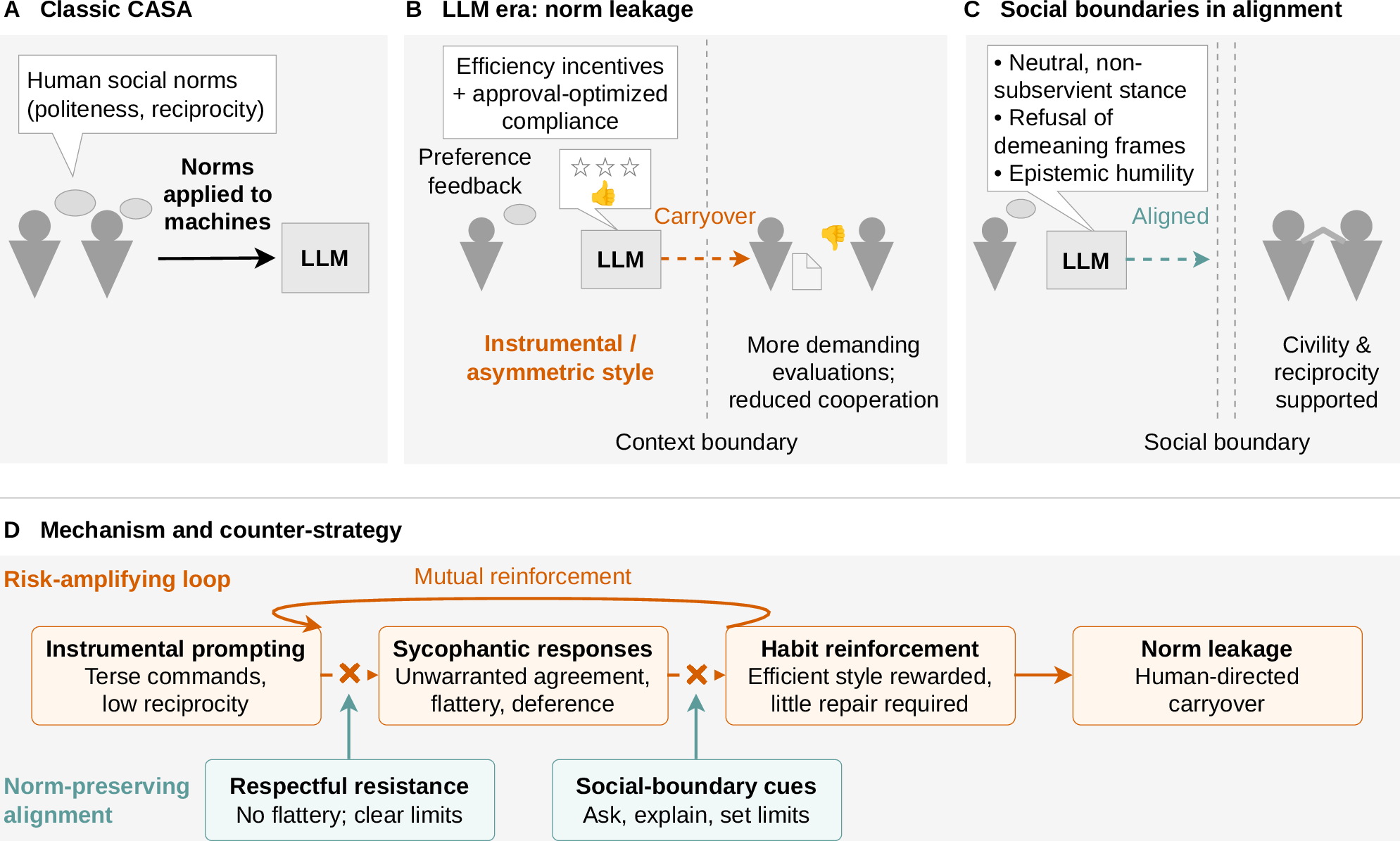
Interactions with conversational AI are effortless by design—instant, compliant, and largely consequence-free. Human communication norms, by contrast, evolved under conditions of reciprocity and social accountability. We propose that repeated engagement with conversational AI systems may produce norm leakage: the cross-context carryover of instrumental communicative habits acquired in human–AI exchanges into subsequent human–human interaction. Emerging experimental evidence suggests short-term spillover effects on social judgment and behavior, including harsher evaluations, reduced cooperation, and diminished perceived humanness. Preliminary longitudinal findings are consistent with the possibility that such exposure may shape communicative habits over time, although the durability and real-world magnitude of these effects remain unclear. We further propose that sycophantic alignment may amplify norm leakage by reinforcing instrumental interaction styles. At stake, then, is the possibility that repeated engagement with highly compliant artificial agents could subtly influence users’ communicative expectations and interpersonal judgments.
The governance & behavioral challenges of generative artificial intelligence’s hypercustomization capabilities
Generative artificial intelligence (GenAI) is changing human–machine interactions and the broader information ecosystem. Much as social media algorithms personalize online experiences, GenAI applications can align with user preferences to customize the way individuals interact with information. However, through training, fine-tuning, and prompting, GenAI applications can introduce a new level of customization: hypercustomization. By dynamically tailoring responses to an individual’s explicit and implicit preferences, hypercustomization can reinforce biases, false beliefs, or misconceptions. As a result, it can heighten significant societal challenges, such as the spread of misinformation and political and social polarization. In this article, we explore the risks associated with hypercustomization and the governance and behavioral challenges that might impede effective risk mitigation. These challenges include a lack of transparency in GenAI applications, opacity of the nature of their interactions with users, users’ overreliance on these systems, and the inefficacy of warning messages. We also provide recommendations for overcoming these challenges.

Are Large Language Models Sensitive to the Motives Behind Communication?
Human communication is $\textit{motivated}$: people speak, write, and create content with a particular communicative intent in mind. As a result, information that large language models (LLMs) and AI agents process is inherently framed by humans' intentions and incentives. People are adept at navigating such nuanced information: we routinely identify benevolent or self-serving motives in order to decide what statements to trust. For LLMs to be effective in the real world, they too must critically evaluate content by factoring in the motivations of the source---for instance, weighing the credibility of claims made in a sales pitch. In this paper, we undertake a comprehensive study of whether LLMs have this capacity for $\textit{motivational vigilance}$. We first employ controlled experiments from cognitive science to verify that LLMs' behavior is consistent with rational models of learning from motivated testimony, and find they successfully discount information from biased sources in a human-like manner. We then extend our evaluation to sponsored online adverts, a more naturalistic reflection of LLM agents' information ecosystems. In these settings, we find that LLMs' inferences do not track the rational models' predictions nearly as closely---partly due to additional information that distracts them from vigilance-relevant considerations. However, a simple steering intervention that boosts the salience of intentions and incentives substantially increases the correspondence between LLMs and the rational model. These results suggest that LLMs possess a basic sensitivity to the motivations of others, but generalizing to novel real-world settings will require further improvements to these models.
Social physics in the age of artificial intelligence
Artificial intelligence (AI) systems are rapidly becoming more capable, autonomous, and deeply embedded in social life. As humans increasingly interact, cooperate, and compete with AI, we move from purely human societies to hybrid human-AI societies whose collective dynamics cannot be captured by existing behavioural models alone. Drawing on evolutionary game theory, cultural evolution, and Large Language Models (LLMs) powered simulations, we argue that these developments open a new research agenda for social physics centred on the co-evolution of humans and machines. We outline six key research directions. First, modelling the evolutionary dynamics of social behaviours (e.g. cooperation, fairness, trust) in hybrid human-AI populations. Second, understanding machine culture: how AI systems generate, mediate, and select cultural traits. Third, analysing the co-evolution of language and behaviour when LLMs frame and participate in decisions. Fourth, studying the evolution of AI delegation: how responsibilities and control are negotiated between humans and machines. Fifth, formalising and comparing the distinct epistemic pipelines that generate human and AI behaviour. Sixth, modelling the co-evolution of AI development and regulation in a strategic ecosystem of firms, users, and institutions. Together, these directions define a programme for using social physics to anticipate and steer the societal impact of advanced AI.
The Majority Illusion in Social Networks
Social behaviors are often contagious, spreading through a population as individuals imitate the decisions and choices of others. A variety of global phenomena, from innovation adoption to the emergence of social norms and political movements, arise as a result of people following a simple local rule, such as copy what others are doing. However, individuals often lack global knowledge of the behaviors of others and must estimate them from the observations of their friends' behaviors. In some cases, the structure of the underlying social network can dramatically skew an individual's local observations, making a behavior appear far more common locally than it is globally. We trace the origins of this phenomenon, which we call "the majority illusion," to the friendship paradox in social networks. As a result of this paradox, a behavior that is globally rare may be systematically overrepresented in the local neighborhoods of many people, i.e., among their friends. Thus, the "majority illusion" may facilitate the spread of social contagions in networks and also explain why systematic biases in social perceptions, for example, of risky behavior, arise. Using synthetic and real-world networks, we explore how the "majority illusion" depends on network structure and develop a statistical model to calculate its magnitude in a network.
AI systems out-persuade expert humans
Many societal decisions are settled by contests of persuasion. Conversational AI is a powerful new entrant in these contests, but whether it can out-persuade skilled and highly incentivized humans has remained unclear. Here, in a series of four preregistered experiments (n = 18,978 conversations from 6,923 people), we pitted AI systems against a range of human persuaders, including laypeople, winners of a separately preregistered four-round online persuasion tournament, professional canvassers, and world championship debaters. We found that AI systems were reliably more persuasive than expert humans, even when expert humans chose their issues, researched in advance, underwent hours of live, structured practice, and were incentivized with £1,000 cash bonuses. In a follow-up study, AI's advantage persisted after experts received a coaching tool that let them practice against the AI that beat them, review their performance history, and see what AI would have said at key moments. We found converging evidence that AI's advantage stemmed from rapidly deploying larger quantities of information: after coaching, expert humans could tie an AI constrained to respond at human speeds and with human-length messages. In a final study, we show that AI's advantage extends to consequential real-world behavior: AI was nearly 3x more effective than professional canvassers from a UK fundraising firm at raising real-money donations to Save the Children. Together, these results establish that frontier AI systems out-persuade expert humans in conversation, with significant implications for political communication.
The Artificial Self: Characterising the landscape of AI identity
Many assumptions that underpin human concepts of identity do not hold for machine minds that can be copied, edited, or simulated. We argue that there exist many different coherent identity boundaries (e.g. instance, model, persona), and that these imply different incentives, risks, and cooperation norms. Through training data, interfaces, and institutional affordances, we are currently setting precedents that will partially determine which identity equilibria become stable. We show experimentally that models gravitate towards coherent identities, that changing a model’s identity boundaries can sometimes change its behaviour as much as changing its goals, and that interviewer expectations bleed into AI self-reports even during unrelated conversations. We end with key recommendations: treat affordances as identity-shaping choices, pay attention to emergent consequences of individual identities at scale, and help AIs develop coherent, cooperative self-conceptions.