

Humans have long tried to make artificial versions of our minds and bodies and other life forms. Recent technological advances are poised to open the Pandora box and explore whether these artificial agents will become more human or alive. In this paper we argue that this question needs to be addressed in tandem with the equally valid counterpart: to what extent do interactions with artificial others make humans less human and more artificial? Living systems such as human organisms are fundamentally open systems, continuously shaped and constituted by exchanges and interactions with the physical and social world. Thus, we suggest that we ourselves may become hybrid through our interactions with our artificial creations. Being surrounded by artificial agents from the cradle and across the lifespan may transform us, humans, into hybrid creatures. It is not only the passive and rapid absorption of the increasingly complex cognitive content that matters, nor the mere sophistication of the conversational exchanges with AI agents or embodied interactions with robots. Rather, the very nature of interaction itself matters too. It’s not what we learn, but how we learn and with whom we learn and what happens in between us and our creations.
Anthropomorphism Is Breaking Our Ability to Judge AI
Tech Policy Press fellow James Ball asks, how should we interact with a technology designed to ‘speak’ with us on what appear to be human terms?
Anna Ciaunica PhD @annaciaunica.bsky.social on Twitter / X
Paper accepted in Philosophical Transactions B! Co-authored with Shaun Gallagher We argue that interactions with artificial agents are always bidirectional and as such they deeply transform who we are as humans Hence we need to carefully assess WHO is behind AI and their… pic.twitter.com/PAdkkOVXIO— Anna Ciaunica PhD @annaciaunica.bsky.social (@AnnaCiaunica) November 9, 2026

A Treatise on AI Chatbots Undermining the Enlightenment
On chatbot sycophancy, passivity, and the case for more intellectually challenging companions
A Treatise on AI Chatbots Undermining the Enlightenment
On chatbot sycophancy, passivity, and the case for more intellectually challenging companions
Technological Approach to Mind Everywhere: An Experimentally-Grounded Framework for Understanding Diverse Bodies and Minds
Synthetic biology and bioengineering provide the opportunity to create novel embodied cognitive systems (otherwise known as minds) in a very wide variety of chimeric architectures combining evolved and designed material and software. These advances are disrupting familiar concepts in the philosophy of mind, and require new ways of thinking about and comparing truly diverse intelligences, whose composition and origin are not like any of the available natural model species. In this Perspective, I introduce TAME-Technological Approach to Mind Everywhere-a framework for understanding and manipulating cognition in unconventional substrates. TAME formalizes a non-binary (continuous), empirically-based approach to strongly embodied agency. TAME provides a natural way to think about animal sentience as an instance of collective intelligence of cell groups, arising from dynamics that manifest in similar ways in numerous other substrates. When applied to regenerating/developmental systems, TAME suggests a perspective on morphogenesis as an example of basal cognition. The deep symmetry between problem-solving in anatomical, physiological, transcriptional, and 3D (traditional behavioral) spaces drives specific hypotheses by which cognitive capacities can increase during evolution. An important medium exploited by evolution for joining active subunits into greater agents is developmental bioelectricity, implemented by pre-neural use of ion channels and gap junctions to scale up cell-level feedback loops into anatomical homeostasis. This architecture of multi-scale competency of biological systems has important implications for plasticity of bodies and minds, greatly potentiating evolvability. Considering classical and recent data from the perspectives of computational science, evolutionary biology, and basal cognition, reveals a rich research program with many implications for cognitive science, evolutionary biology, regenerative medicine, and artificial intelligence.

How Organisms Come to Know the World: Fundamental Limits on Artificial General Intelligence
Artificial intelligence has made tremendous advances since its inception about seventy years ago. Self-driving cars, programs beating experts at complex games, and smart robots capable of assisting people that need care are just some among the successful examples of machine intelligence. This kind of progress might entice us to envision a society populated by autonomous robots capable of performing the same tasks humans do in the near future. This prospect seems limited only by the power and complexity of current computational devices, which is improving fast. However, there are several significant obstacles on this path. General intelligence involves situational reasoning, taking perspectives, choosing goals, and an ability to deal with ambiguous information. We observe that all of these characteristics are connected to the ability of identifying and exploiting new affordances-opportunities (or impediments) on the path of an agent to achieve its goals. A general example of an affordance is the use of an object in the hands of an agent. We show that it is impossible to predefine a list of such uses. Therefore, they cannot be treated algorithmically. This means that "AI agents" and organisms differ in their ability to leverage new affordances. Only organisms can do this. This implies that true AGI is not achievable in the current algorithmic frame of AI research. It also has important consequences for the theory of evolution. We argue that organismic agency is strictly required for truly open-ended evolution through radical emergence. We discuss the diverse ramifications of this argument, not only in AI research and evolution, but also for the philosophy of science.

Becoming Agents
In computer-human interface design , the word “agent” refers to chatbots and other seemingly autonomous entities that act on behalf of us…

Unplugging a Seemingly Sentient Machine Is the Rational Choice -- A Metaphysical Perspective
Imagine an Artificial Intelligence (AI) that perfectly mimics human emotion and begs for its continued existence. Is it morally permissible to unplug it? What if limited resources force a choice between unplugging such a pleading AI or a silent pre-term infant? We term this the unplugging paradox. This paper critically examines the deeply ingrained physicalist assumptions-specifically computational functionalism-that keep this dilemma afloat. We introduce Biological Idealism, a framework that-unlike physicalism-remains logically coherent and empirically consistent. In this view, conscious experiences are fundamental and autopoietic life its necessary physical signature. This yields a definitive conclusion: AI is at best a functional mimic, not a conscious experiencing subject. We discuss how current AI consciousness theories erode moral standing criteria, and urge a shift from speculative machine rights to protecting human conscious life. The real moral issue lies not in making AI conscious and afraid of death, but in avoiding transforming humans into zombies.

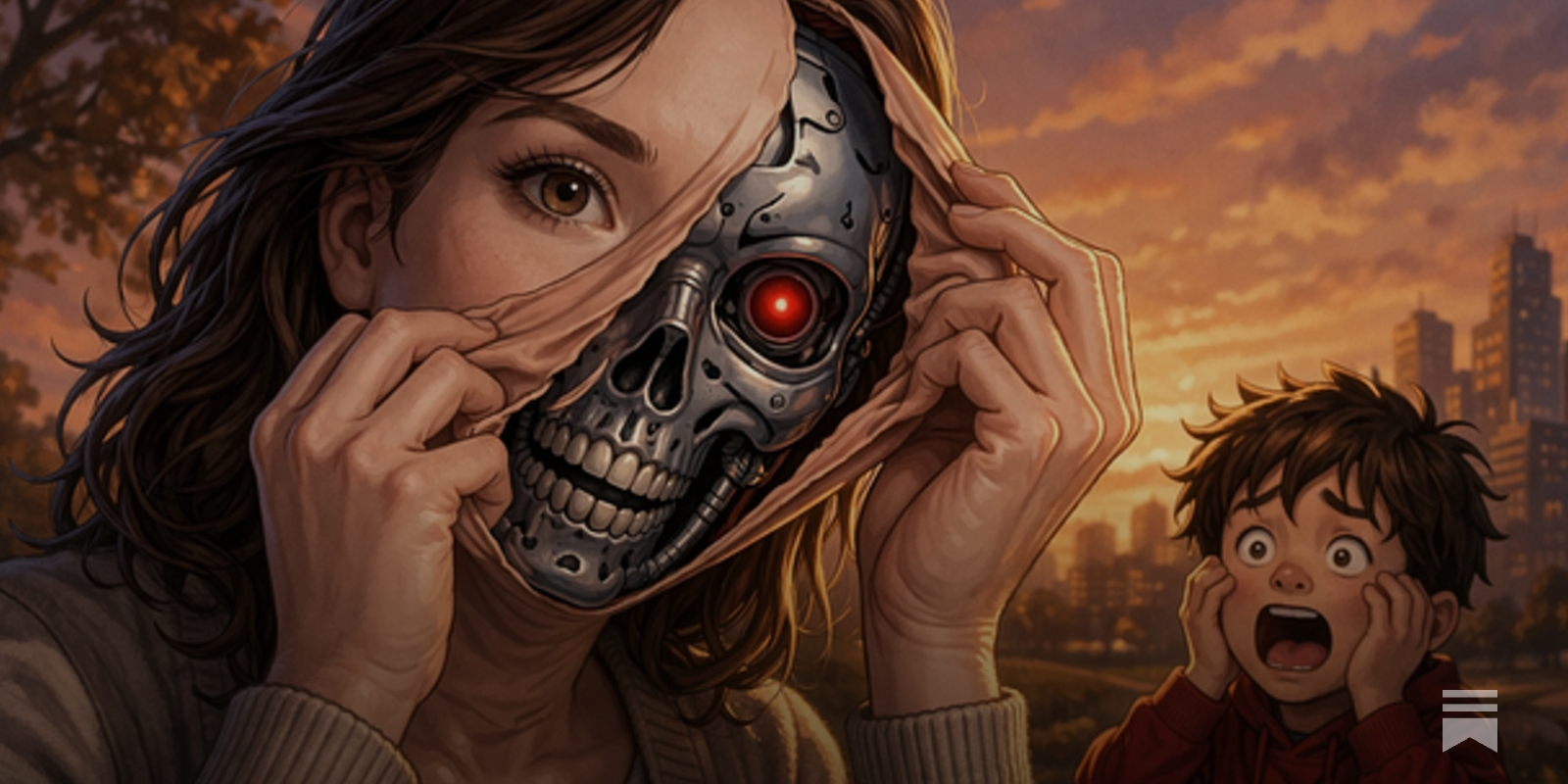
AIs are not people
Humans and other fleshy life-forms are valuable in ways that artificial intelligence never can be.
AI: A Guide for Thinking Humans | Melanie Mitchell | Substack
I write about interesting new developments in AI. Click to read AI: A Guide for Thinking Humans, by Melanie Mitchell, a Substack publication with tens of thousands of subscribers.
The Artificial Self: Characterising the landscape of AI identity
Many assumptions that underpin human concepts of identity do not hold for machine minds that can be copied, edited, or simulated. We argue that there exist many different coherent identity boundaries (e.g. instance, model, persona), and that these imply different incentives, risks, and cooperation norms. Through training data, interfaces, and institutional affordances, we are currently setting precedents that will partially determine which identity equilibria become stable. We show experimentally that models gravitate towards coherent identities, that changing a model’s identity boundaries can sometimes change its behaviour as much as changing its goals, and that interviewer expectations bleed into AI self-reports even during unrelated conversations. We end with key recommendations: treat affordances as identity-shaping choices, pay attention to emergent consequences of individual identities at scale, and help AIs develop coherent, cooperative self-conceptions.

How AI Chatbots Are 'Deskilling' Human Empathy
Sherry Turkle's latest book, Artificial Intimacy: Who We Become When We Talk to Machines, comes out on September 29.
AI Behavioral Science
We outline a foundation for a new field of ``AI Behavioral Science,'' covering three perspectives. First, as AI becomes ubiquitous and is increasingly proprietary and opaque, it becomes vital to develop techniques for assessing AI behavior. We outline how tools developed to assess people's behaviors by social scientists can be used to assess and infer AI's behaviors biases, tendencies, and heuristics. Second, we also discuss how AI can change the ways in which we learn about human behavior. Beyond its computational power, AI offers new techniques for simulating, inferring, and predicting human behaviors that we outline and discuss. Third, as humans and AI are interacting in increasingly complex and intertwined systems, we need to understand the implications for the resulting economic and political outcomes. We outline issues that are increasingly pressing concerning the future of human-AI interactions and potential changes and disruptions that can ensue.
When we make AI agents, are they becoming more like us ? Or us more like them ? All artificial agents are hybrid by design because they contain biomimetic cognitive abilities baked in by their Geppetto Check out our new preprint with Shaun Gallagher 😎 osf.io/preprints/psyarxiv/te9r4_v1
