

How do humans learn from experience? Traditionally, cognitive scientists have assumed that discovering generalizable patterns requires that humans compress rich and noisy experiences. However, recent computer science results suggest otherwise — systems can learn by ‘overfitting’ and expanding all the details of their experiences. We offer a new perspective on learning based on a cognitive system’s representational capacity, which can be constrained (forcing the system to compress details of past experiences), sufficient (to memorize past experiences), or excess (allowing the system to expand on the details of past experiences). This framework has implications for understanding learning across cognitive, clinical, and developmental contexts.
Excess Capacity Learning
We introduce a new framework for understanding how cognitive systems (e.g., humans) learn from experience, based on the concept of representational capacity—the relative amount of representational resources devoted to encoding past experiences. Most paradigms in cognitive science have operated under the assumption that these resources are constrained, forcing cognitive systems to compress rich and noisy experiences to effectively generalize to new situations. We leverage recent advances in computer science to outline the implications of learning with excess capacity, or applying even more representational resources than needed to perfectly memorize all the details of one’s past experiences. In particular, we review evidence suggesting that excess capacity systems can exhibit many of the characteristics of human learning, such as the simultaneous ability to memorize individual experiences and generalize knowledge to new situations. We define and differentiate between constrained (not enough), sufficient (just enough), and excess (more than enough to perfectly capture all the details of one’s past experiences) capacity. We derive empirical properties of learning in each of these capacity regimes, and compare these predictions to effects documented for human learning. We highlight the broad implications of this framework for advancing theoretical and empirical work across cognitive, clinical, and developmental psychology.
Addressing the Precision-Breadth-Simplicity Impossible Trinity in Psychological Research: A Comprehensive Exploration Approach
Psychological research faces a fundamental challenge—the Precision-Breadth-Simplicity (PBS) impossible trinity. While experimental findings are often precise and simple, they tend to be narrow in scope. Conversely, broad-and-simple concepts frequently lack precision. Developing theories that are both precise and broad is scientifically valuable but inevitably introduces complexity, which conflicts with humans’ cognitive limitations in processing complexity. To address this impossible trinity, I propose a comprehensive exploration (CE) approach—a data-guided theory-building framework that involves: (1) designing experimental conditions in a stimulus-driven way, with minimal upfront theoretical specification; (2) conducting experiments with tens of millions of observations (e.g., 40 million responses in Huang, 2025a); (3) modeling the results through iterative improvements; and (4) producing the outcome: a moderately complex quantitative information-processing model to integrate diverse empirical findings. Inspired by similar strategies that drove breakthroughs in artificial intelligence (e.g., ImageNet’s role in advancing object recognition), the CE approach offers a promising path toward more integrative psychological theories. Initial implementations in visual working memory research demonstrate both its practicality and potential to transform how we study mental processes.

Cognitive Load Theory and its Applications for Learning - Scott H Young
What makes learning hard? How can we make it easier? Cognitive load theory explains how we learn and how to do it better.
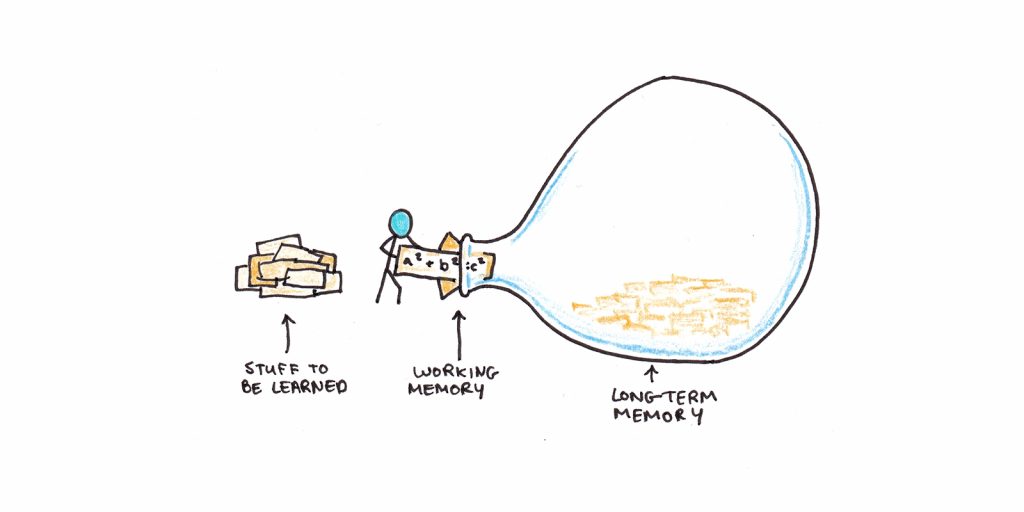
Learning How to Learn (And 20+ Studies) – Max's Two Cents
I have been interested in cognitive science and effective learning methods for years. I’ve read multiple books and articles and put many ideas to test. In this post, I aim to synthesize my notes and provide references to scientific studies.
Learning Outside the Brain: Integrating Cognitive Science and Systems Biology
Learning is commonplace in organisms such as ourselves and even in organisms as far distant as the bee and the octopus. Such learning is implemented by brains, or neuronal networks, and has been extensively studied within ethology, psychology, cognitive science, and neuroscience. Whether learning also takes place in nonneuronal settings has remained a matter of sustained controversy, too often dominated by ideological views. In this survey, I will explain how learning can be rigorously interpreted as a form of information processing and then explore the evidence for whether learning also takes place in organismal contexts outside the brain, such as physiology, development, and individual cells. I will try to explain why it is important to build bridges in this way between cognitive science and systems biology, why concepts and methods from various branches of engineering may be helpful in this task, and what the eventual impact may be on how we think about the organism.
The Busy Person's Guide to Thinking
Thinking better isn't about learning more; it's about doing a few simple things that really help create unstoppable progress.
Memory Models: Towards Agents That Learn
Agents that truly learn from experience will be powered by memory models: models that create and curate token-space memory across model generations, trained with memory-native RL.
The Personalized Learning Revolution
The allure of AI lies predominantly in its unmatched potential for efficiency, convenience, and accuracy. However, this unprecedented convenience brings with it a hidden yet profound threat: the subtle erosion of human capacity for critical thinking through cognitive offloading.
Verbalizable Representations Form a Global Workspace in Language Models
If the mind is an ocean, we spend our lives floating at the surface. Beneath us, an enormous amount of processing takes place without our knowledge: our visual systems parsing the contours of a face, our motor circuits maintaining our posture. At any given moment, only a small fraction of this neural activity is accessible to us. Yet it is this privileged sliver of activity that we rely on to reason deliberately: to plan what ingredients to buy for a recipe, or to puzzle out why an engine won’t start. Such thoughts can be articulated out loud, deliberately held in mind, and brought to bear on whatever task the moment demands. This distinction, between our accessible thoughts and our unconscious processing, is perhaps the most striking feature of human cognition.
Verbalizable Representations Form a Global Workspace in Language Models
If the mind is an ocean, we spend our lives floating at the surface. Beneath us, an enormous amount of processing takes place without our knowledge: our visual systems parsing the contours of a face, our motor circuits maintaining our posture. At any given moment, only a small fraction of this neural activity is accessible to us. Yet it is this privileged sliver of activity that we rely on to reason deliberately: to plan what ingredients to buy for a recipe, or to puzzle out why an engine won’t start. Such thoughts can be articulated out loud, deliberately held in mind, and brought to bear on whatever task the moment demands. This distinction, between our accessible thoughts and our unconscious processing, is perhaps the most striking feature of human cognition.
Capacities
Capacities turns your ideas into connected objects. Think naturally, find everything instantly.
Cognitive Load | Laws of UX
The amount of mental resources needed to understand and interact with an interface.

Lossy communication constrains iterated learning
Humans' distinctive role in the world can largely be attributed to our capacity for iterated learning, a process by which knowledge is expanded and refined over generations. A range of theories seek to explain why humans are so adept at iterated learning, many positing substantial evolutionary discontinuities in communication or cognition. Is it necessary to posit large differences in abilities between humans and other species, or could small differences in communication ability produce large differences in what a species can learn over generations? We investigate this question through a formal model based on information theory. We manipulate how much information individual learners can send each other and observe the effect on iterated learning performance. Incremental changes to the channel rate can lead to dramatic, non-linear changes to the eventual performance of the population. We complement this model with a theoretical result that describes how individual lossy communications constrain the global performance of iterated learning. Our results demonstrate that incremental, quantitative changes to communication abilities could be sufficient to explain large differences in what can be learned over many generations.

Exploring Psychology in the Field: Steps and Examples From the Used‐Car Market
Abstract The growing availability of large datasets in a variety of domains presents an opportunity for researchers to use field data to better understand psychological concepts. I discuss, from an empirical economics point of view, steps for how to study cognition in large datasets. I use two recent papers that explore psychology in the used‐car market as motivating examples. These examples help illustrate the potential importance of big data as a way to explore human psychology and cognition. , The growing availability of large datasets in a variety of domains presents an opportunity for researchers to use field data to better understand psychological concepts. I discuss from an empirical economics point of view, steps for how to study cognition in large datasets and illustrate these steps with recent empirical papers.

A Definition of AGI
The lack of a concrete definition for Artificial General Intelligence (AGI) obscures the gap between today's specialized AI and human-level cognition. This paper introduces a quantifiable framework to address this, defining AGI as matching the cognitive versatility and proficiency of a well-educated adult. To operationalize this, we ground our methodology in Cattell-Horn-Carroll theory, the most empirically validated model of human cognition. The framework dissects general intelligence into ten core cognitive domains-including reasoning, memory, and perception-and adapts established human psychometric batteries to evaluate AI systems. Application of this framework reveals a highly "jagged" cognitive profile in contemporary models. While proficient in knowledge-intensive domains, current AI systems have critical deficits in foundational cognitive machinery, particularly long-term memory storage. The resulting AGI scores (e.g., GPT-4 at 27%, GPT-5 at 57%) concretely quantify both rapid progress and the substantial gap remaining before AGI.
Ever thought we acquire generalizable knowledge by discarding details and compressing our experiences? In a new BBS paper, @sabinasloman.bsky.social and I argue otherwise, proposing a novel way of studying human learning inspired by double descent in ML. Disagree? Propose a commentary by May 15 :)
