

How can large language models (LLMs) contribute to social science research, and what parts of research remain stubbornly human? Building on existing LLM tools, we offer a multi-agent workflow capable of producing a full quantitative social science paper from an initial prompt. The workflow relies on researchers codifying their heuristics for doing data analysis, and we suggest some core design principles for researchers interested in building on this scaffolding. Using this case, we also examine what current LLM capabilities reveal about the organization of research. LLM agents can lower the cost of pursuing high-risk ideas, expand robustness and transparency, reduce concerns about the scientific file drawer, and force scholars to articulate the heuristics that create valuable work. But they also pose challenges, both in terms of the quality of papers and in the adequacy of scientific institutions to adapt. Meeting these challenges will require new institutional norms that make use of these tools observable, auditable, and accountable.
The unintended consequences of large language models as a labor-augmenting technology in science
As a labor-augmenting technology, large language models (LLMs) have the potential to accelerate scientific activity across the research pipeline. But even if LLMs perform on par with human experts at selected tasks, their use will bring unintended consequences as they alter the balance of frictions and inducements that steer the allocation of research effort across projects. Here we develop a simple mathematical model to illustrate. In fields where LLMs are useful primarily as tools for discovering promising projects, researchers will become more selective about what they publish; where they facilitate the process of publishing existing data, researchers will become less selective. By allowing scientists to work more quickly, LLMs raise the opportunity cost of researcher time, creating incentives to refine papers less thoroughly before moving on. Enticing as it is to imagine that, by saving us time on mundane tasks, LLMs will provide us with more time to think deeply and develop projects completely, our results temper such hopes.

The unintended consequences of large language models as a labor-augmenting technology in science
As a labor-augmenting technology, large language models (LLMs) have the potential to accelerate scientific activity across the research pipeline. But even if LLMs perform on par with human experts at selected tasks, their use will bring unintended consequences as they alter the balance of frictions and inducements that steer the allocation of research effort across projects. Here we develop a simple mathematical model to illustrate. In fields where LLMs are useful primarily as tools for discovering promising projects, researchers will become more selective about what they publish; where they facilitate the process of publishing existing data, researchers will become less selective. By allowing scientists to work more quickly, LLMs raise the opportunity cost of researcher time, creating incentives to refine papers less thoroughly before moving on. Enticing as it is to imagine that, by saving us time on mundane tasks, LLMs will provide us with more time to think deeply and develop projects completely, our results temper such hopes.
Scientific production in the era of Large Language Models
Large Language Models (LLMs) are rapidly reshaping scientific research. We analyze these changes in multiple, large-scale datasets with 2.1M preprints, 28K peer review reports, and 246M online accesses to scientific documents. We find: 1) scientists adopting LLMs to draft manuscripts demonstrate a large increase in paper production, ranging from 23.7-89.3% depending on scientific field and author background, 2) LLM use has reversed the relationship between writing complexity and paper quality, leading to an influx of manuscripts that are linguistically complex but substantively underwhelming, and 3) LLM adopters access and cite more diverse prior work, including books and younger, less-cited documents. These findings highlight a stunning shift in scientific production that will likely require a change in how journals, funding agencies, and tenure committees evaluate scientific works.
AI Scientists as Engines of Discovery: A Case for Development within Reformed Institutions
Agentic artificial intelligence (AI) systems are beginning to assist, accelerate, and partially automate scientific discovery, performing tasks that span literature synthesis, code generation, data analysis, hypothesis proposal, and model criticism. We argue that this transition is qualitative rather than incremental, and that suitably designed multi-agent systems may evolve from passive computational tools into ``AI scientists'' that can expand the hypothesis-generating and verification capacity of science. Such systems must be developed and deployed within a scientific ecosystem fit for purpose: institutions must be redesigned for verification, accountability, interpretability, and dual-use safety. We sketch how multi-agent architectures, illustrated by the prototype framework \textit{Denario}, accelerate the discovery cycle and traverse model spaces beyond human reach; examine what this implies for authorship, peer review, and the enduring role of human scientists; and close with recommendations for governing AI as an epistemic actor rather than a mere instrument.
The Rise of Large Language Models and the Direction and Impact of US Federal Research Funding
Federal research funding shapes the direction, diversity, and impact of the US scientific enterprise. Large language models (LLMs) are rapidly diffusing into scientific practice, holding substantial promise while raising widespread concerns. Despite growing attention to AI use in scientific writing and evaluation, little is known about how the rise of LLMs is reshaping the public funding landscape. Here, we examine LLM involvement at key stages of the federal funding pipeline by combining two complementary data sources: confidential National Science Foundation (NSF) and National Institutes of Health (NIH) proposal submissions from two large US R1 universities, including funded, unfunded, and pending proposals, and the full population of publicly released NSF and NIH awards. We find that LLM use rises sharply beginning in 2023 and exhibits a bimodal distribution, indicating a clear split between minimal and substantive use. Across both private submissions and public awards, higher LLM involvement is consistently associated with lower semantic distinctiveness, positioning projects closer to recently funded work within the same agency. The consequences of this shift are agency-dependent. LLM use is positively associated with proposal success and higher early-stage publication output at NIH, whereas no comparable associations are observed at NSF. Notably, the productivity gains at NIH are concentrated in non-hit papers rather than the most highly cited work. Together, these findings provide large-scale evidence that the rise of LLMs is reshaping how scientific ideas are positioned, selected, and translated into publicly funded research, with implications for portfolio governance, research diversity, and the long-run impact of science.
Topics, Authors, and Institutions in Large Language Model Research: Trends from 17K arXiv Papers
Large language models (LLMs) are dramatically influencing AI research, spurring discussions on what has changed so far and how to shape the field's future. To clarify such questions, we analyze a new dataset of 16,979 LLM-related arXiv papers, focusing on recent trends in 2023 vs. 2018-2022. First, we study disciplinary shifts: LLM research increasingly considers societal impacts, evidenced by 20x growth in LLM submissions to the Computers and Society sub-arXiv. An influx of new authors -- half of all first authors in 2023 -- are entering from non-NLP fields of CS, driving disciplinary expansion. Second, we study industry and academic publishing trends. Surprisingly, industry accounts for a smaller publication share in 2023, largely due to reduced output from Google and other Big Tech companies; universities in Asia are publishing more. Third, we study institutional collaboration: while industry-academic collaborations are common, they tend to focus on the same topics that industry focuses on rather than bridging differences. The most prolific institutions are all US- or China-based, but there is very little cross-country collaboration. We discuss implications around (1) how to support the influx of new authors, (2) how industry trends may affect academics, and (3) possible effects of (the lack of) collaboration.
Topics, Authors, and Institutions in Large Language Model Research: Trends from 17K arXiv Papers
Large language models (LLMs) are dramatically influencing AI research, spurring discussions on what has changed so far and how to shape the field's future. To clarify such questions, we analyze a new dataset of 16,979 LLM-related arXiv papers, focusing on recent trends in 2023 vs. 2018-2022. First, we study disciplinary shifts: LLM research increasingly considers societal impacts, evidenced by 20x growth in LLM submissions to the Computers and Society sub-arXiv. An influx of new authors -- half of all first authors in 2023 -- are entering from non-NLP fields of CS, driving disciplinary expansion. Second, we study industry and academic publishing trends. Surprisingly, industry accounts for a smaller publication share in 2023, largely due to reduced output from Google and other Big Tech companies; universities in Asia are publishing more. Third, we study institutional collaboration: while industry-academic collaborations are common, they tend to focus on the same topics that industry focuses on rather than bridging differences. The most prolific institutions are all US- or China-based, but there is very little cross-country collaboration. We discuss implications around (1) how to support the influx of new authors, (2) how industry trends may affect academics, and (3) possible effects of (the lack of) collaboration.
The Last Human-Written Paper: Agent-Native Research Artifacts
Scientific publication compresses a branching, iterative research process into a linear narrative, discarding the majority of what was discovered along the way. This compilation imposes two structural costs: a Storytelling Tax, where failed experiments, rejected hypotheses, and the branching exploration process are discarded to fit a linear narrative; and an Engineering Tax, where the gap between reviewer-sufficient prose and agent-sufficient specification leaves critical implementation details unwritten. Tolerable for human readers, these costs become critical when AI agents must understand, reproduce, and extend published work. We introduce the Agent-Native Research Artifact (ARA), a protocol that replaces the narrative paper with a machine-executable research package structured around four layers: scientific logic, executable code with full specifications, an exploration graph that preserves the failures compilation discards, and evidence grounding every claim in raw outputs. Three mechanisms support the ecosystem: a Live Research Manager that captures decisions and dead ends during ordinary development; an ARA Compiler that translates legacy PDFs and repos into ARAs; and an ARA-native review system that automates objective checks so human reviewers can focus on significance, novelty, and taste. On PaperBench and RE-Bench, ARA raises question-answering accuracy from 72.4% to 93.7% and reproduction success from 57.4% to 64.4%. On RE-Bench's five open-ended extension tasks, preserved failure traces in ARA accelerate progress, but can also constrain a capable agent from stepping outside the prior-run box depending on the agent's capabilities. Our code is open-sourced at https://github.com/Orchestra-Research/Agent-Native-Research-Artifact.
Reimagining research papers as interactive and reliable AI agents
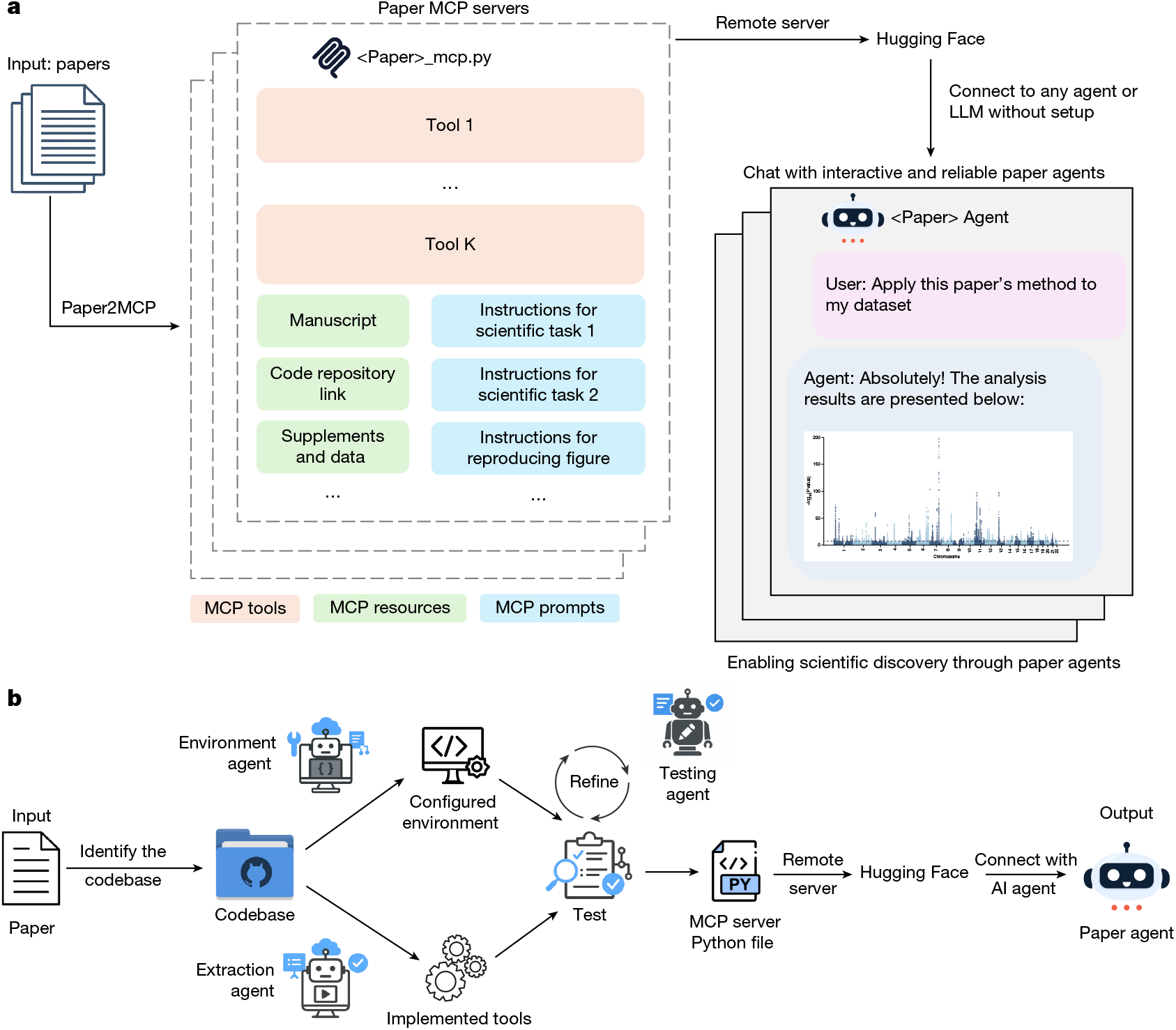
Here we introduce Paper2Agent, an automated framework that converts research papers into artificial intelligence (AI) agents. Paper2Agent transforms research output from passive artefacts into active systems that accelerate use and discovery. Conventional research papers require readers to understand and adapt the paper’s code, data and methods to their work, creating barriers to dissemination and reuse. Paper2Agent addresses this challenge by converting a paper into an AI agent that functions as a virtual corresponding author, exposing its manuscript, supplementary materials, datasets, code and workflows as active, agent-native knowledge rather than static text. It analyses the paper and codebase using multiple agents to construct a model context protocol (MCP) server, then generates and runs tests to refine and increase robustness of the MCP. These paper MCPs can be connected to a chat agent (such as Claude Code) to carry out complex scientific queries through natural language while invoking tools and workflows from the paper. We demonstrate Paper2Agent’s effectiveness through case studies. Paper2Agent created an agent that leveraged AlphaGenome1 to interpret genomic variants and agents based on Scanpy2 and TISSUE (transcript imputation with spatial single-cell uncertainty estimation)3 to conduct single-cell and spatial transcriptomics analyses. We validate that these agents reproduce the results of the original papers and carry out novel user queries. Paper2Agent created multiple agents that collaborate to prioritize a causal gene for psoriasis. By turning static papers into interactive AI agents, Paper2Agent introduces a paradigm for knowledge dissemination and a collaborative ecosystem of AI co-scientists.
Reimagining research papers as interactive and reliable AI agents
Here we introduce Paper2Agent, an automated framework that converts research papers into artificial intelligence (AI) agents. Paper2Agent transforms research output from passive artefacts into active systems that accelerate use and discovery. Conventional research papers require readers to understand and adapt the paper’s code, data and methods to their work, creating barriers to dissemination and reuse. Paper2Agent addresses this challenge by converting a paper into an AI agent that functions as a virtual corresponding author, exposing its manuscript, supplementary materials, datasets, code and workflows as active, agent-native knowledge rather than static text. It analyses the paper and codebase using multiple agents to construct a model context protocol (MCP) server, then generates and runs tests to refine and increase robustness of the MCP. These paper MCPs can be connected to a chat agent (such as Claude Code) to carry out complex scientific queries through natural language while invoking tools and workflows from the paper. We demonstrate Paper2Agent’s effectiveness through case studies. Paper2Agent created an agent that leveraged AlphaGenome1 to interpret genomic variants and agents based on Scanpy2 and TISSUE (transcript imputation with spatial single-cell uncertainty estimation)3 to conduct single-cell and spatial transcriptomics analyses. We validate that these agents reproduce the results of the original papers and carry out novel user queries. Paper2Agent created multiple agents that collaborate to prioritize a causal gene for psoriasis. By turning static papers into interactive AI agents, Paper2Agent introduces a paradigm for knowledge dissemination and a collaborative ecosystem of AI co-scientists.
AI Research Agents Narrow Scientific Exploration
AI research agents now support large-scale AI-assisted scientific discovery. We examine whether AI-generated ideas broaden scientific exploration or primarily reinforce existing work. Using five agent frameworks and five large language models, we generate 219,655 ideas for different scientific fields. Across experiments, four consistent patterns emerge. First, AI-generated ideas are more concentrated than human-authored papers within the same research area. Second, they remain much closer to starting literature than later human follow-on work does. Third, AI-generated ideas align less with future human research. Last, AI-generated ideas are located in lower-impact regions of the historical scientific landscape. Overall, current AI research agents appear better suited to local elaboration than to broadening scientific exploration.
Qualitative Research in an Era of Artificial Intelligence: A Pragmatic Approach to Data Analysis, Workflow, and Computation
Computational developments—particularly artificial intelligence—are reshaping social scientific research and raising new questions for in-depth methods such as ethnography and qualitative interviewing. Building on classic debates about computers in qualitative data analysis, we revisit possibilities and dangers in an era of automation, large language model chatbots, and big data. We introduce a typology of contemporary approaches to using computers in qualitative research: streamlining workflows, scaling up projects, hybrid analytical methods, the sociology of computation, and technological rejection. Drawing from scaled team ethnographies and solo research integrating computational social science alongside in-depth observation, we describe methodological choices across study life cycles, from literature reviews through data collection, coding, text retrieval, and representation. We argue that new technologies hold potential to address long-standing methodological challenges when deployed with knowledge, purpose, and ethical commitment. Yet, a pragmatic approach—moving beyond technological optimism and dismissal—is essential given rapidly changing tools that are both generative and dangerous. Computation now saturates research infrastructure, from algorithmic literature searches to scholarly metrics, making computational literacy a core methodological competence in and beyond sociology. We conclude that when used carefully and transparently, contemporary computational tools can meaningfully expand, rather than displace, the irreducible insights of qualitative research.

Steps Towards an Infrastructure for Scholarly Synthesis
Sharing, reusing, and synthesizing knowledge is central to the research process, both individually, and with others. These core functions are not supported by our formal scholarly publishing infrastructure: instead of the smooth functioning of functional infrastructure, researchers resort to laborious "hacks" and workarounds to "mine" publications for what they need, and struggle to efficiently share the resulting information with others. Information scientists have proposed an alternative infrastructure based on the more appropriately granular model of a discourse graph of claims, and evidence, along with key rhetorical relationships between them. However, despite significant technical progress on standards and platforms, the predominant infrastructure remains steadfastly document-based. Drawing from infrastructure studies, we locate the current infrastructural bottlenecks in the lack of local systems that integrate discourse-centric models to augment synthesis work, from which an infrastructure for synthesis can be grown. Through 3 years of research through design and field deployment in a distributed community of hypertext notebook users, we elaborate a design vision of what can and should be built in order to grow a discourse-centric synthesis infrastructure: a thriving "installed base" of researchers authoring local, shareable discourse graphs to improve synthesis work, enhance primary research and research training, and augment collaborative research. We discuss how this design vision -- and our empirical work -- contributes steps towards a new infrastructure for synthesis, and increases HCI's capacity to advance collective intelligence and solve infrastructure-level problems.
Augmenting Research Ideation with Data: An Empirical Investigation...
Recent advancements in large language models (LLMs) demonstrate strong potential for generating novel research ideas, yet such ideas often struggle with feasibility and effectiveness. In this...
Steps Towards an Infrastructure for Scholarly Synthesis
Sharing, reusing, and synthesizing knowledge is central to the research process, both individually, and with others. These core functions are not supported by our formal scholarly publishing infrastructure: instead of the smooth functioning of functional infrastructure, researchers resort to laborious ”hacks” and workarounds to ”mine” publications for what they need, and struggle to efficiently share the resulting information with others. Information scientists have proposed an alternative infrastructure based on the more appropriately granular model of a discourse graph of claims, and evidence, along with key rhetorical relationships between them. However, despite significant technical progress on standards and platforms, the predominant infrastructure remains steadfastly document-based. Drawing from infrastructure studies, we locate the current infrastructural bottlenecks in the lack of local systems that integrate discourse-centric models to augment synthesis work, from which an infrastructure for synthesis can be grown. Through 3 years of research through design and field deployment in a distributed community of hypertext notebook users, we elaborate a design vision of what can and should be built in order to grow a discourse-centric synthesis infrastructure: a thriving “installed base” of researchers authoring local, shareable discourse graphs to improve synthesis work, enhance primary research and research training, and augment collaborative research. We discuss how this design vision — and our empirical work — contributes steps towards a new infrastructure for synthesis, and increases HCI’s capacity to advance collective intelligence and solve infrastructure-level problems.
ReviewBench: An Extensible Framework for Benchmarking Human and AI Manuscript Review
The volume of scientific manuscripts is rising faster than the available pool of expert reviewers, and AI tools are emerging as a possible response, ranging from frontier large language models applied directly to peer review to purpose-built multi-agent systems. Scalable, standardized benchmarks are needed to regularly evaluate how these tools compare to one another and to human reviewers. We present ReviewBench, an open-source, venue-agnostic framework that compares human and AI reviews across structure, alignment with a paper’s major claims, impact, and critique category. We apply ReviewBench to 145,021 review comments from human reviewers, frontier large language models (GPT-5.2, and Gemini 3 Pro), and Reviewer3.com (R3), a multi-agent peer review system. The dataset spans papers in computer science (ICLR 2025, n = 1,000), social science (Nature Human Behaviour, n = 142), and life science (eLife, n = 1,000). Across disciplines, AI reviews are more structured and engage more directly with a paper’s major claims, with R3 more often surfacing consequential comments, defined as comments capable of undermining those claims. When restricting to critical comments, however, human reviewers rank first on consequential rate on more individual papers than any AI source, despite a lower average. We identify a bimodal reviewer distribution with peaks near 0% and 100%, indicating that many reviewers outperform AI on this metric, but a substantial fraction of reviewers near 0% brings the average down. Critique typing demonstrates systematic differences, where humans emphasize contribution and clarity, while AI emphasizes validity, sufficiency, and transparency. Together, these findings argue against framing AI as a replacement for human review and instead support a complementary model in which AI scales technical verification of major claims while human judgment remains essential for evaluating contribution and shaping editorial decisions.
