


Twitter and its imitators have adopted a structural design that is fundamentally bad for people. This isn't just a matter of who's in charge; it's a problem with the thing itself. Forcing users to adhere to a tight character limit, discouraging link culture, preventing people from editing their own posts, steering people into sharing things they hate, incentivizing rage bait with trending feeds, subjecting people to decontextualized encounters, encouraging conflict by discouraging tags, and leaving users powerless to clean up the resulting mess—all of this is bad shape.
As many as 48 million Twitter accounts aren't people, says study
A big chunk of those "likes," "retweets," and "followers" lighting up your Twitter account may not be coming from human hands.
Facebook Wrestles With the Features It Used to Define Social Networking (Published 2021)
Likes and shares made the social media site what it is. Now, company documents show, it’s struggling to deal with their effects.

Criticism of X (social network)
X, formerly known as Twitter, has faced various criticisms over the years, particularly concerning content moderation, censorship, and platform management.
The Weird, Fragmented World of Social Media After Twitter - The Atlan…
archived 7 Aug 2023 02:41:57 UTC

The Weird, Fragmented World of Social Media After Twitter
The common forum that Elon Musk destroyed will never be replaced—and that’s okay.

Discerning Audiences Through Like Buttons · Issue 6.1, Winter 2024
Column Editor’s Note: The ‘like button’ is a ubiquitous and infamous feature of social media platforms. ‘Likes’ ostensibly allow users to interact and engage with one another, but platform developers hope that data generated by users’ likes allows them to model, predict and even manipulate both individual and collective affective states. This Mining the Past column by communication scholar Carina Albrecht explores the history of the like button from “Little Annie,” developed at CBS in the mid-twentieth century, to the Cambridge Analytica scandal. Throughout this history, researchers and tech developers hoped to make ‘subjectivities’—emotions, preferences, personalities, political orientations—into ‘objectivites’; they sought to turn inner worlds into profitable data. Albrecht’s history reveals that the like button is best understood not as a passive recorder of preexisting affect and sentiment, but rather as a data technology that generated the emotive effects the button claimed to measure.

The future of social media is human
We cannot continue participating in social media platforms which do nothing to stop us being tricked by GenAI and the powerful people/governments that control them.

Social media, extremism, and radicalization
Fears that YouTube recommendations radicalize users are overblown, but social media still host and profit from dubious and extremist content.

Evaluating Twitter’s algorithmic amplification of low-credibility content: an observational study
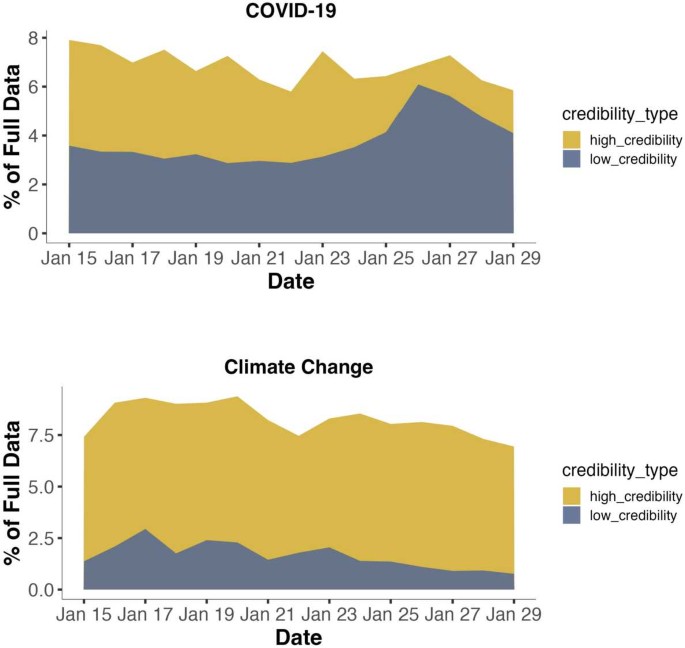
Artificial intelligence (AI)-powered recommender systems play a crucial role in determining the content that users are exposed to on social media platforms. However, the behavioural patterns of these systems are often opaque, complicating the evaluation of their impact on the dissemination and consumption of disinformation and misinformation. To begin addressing this evidence gap, this study presents a measurement approach that uses observed digital traces to infer the status of algorithmic amplification of low-credibility content on Twitter over a 14-day period in January 2023. Using an original dataset of ≈ 2.7 million posts on COVID-19 and climate change published on the platform, this study identifies tweets sharing information from low-credibility domains, and uses a bootstrapping model with two stratifications, a tweet’s engagement level and a user’s followers level, to compare any differences in impressions generated between low-credibility and high-credibility samples. Additional stratification variables of toxicity, political bias, and verified status are also examined. This analysis provides valuable observational evidence on whether the Twitter algorithm favours the visibility of low-credibility content, with results indicating that, on aggregate, tweets containing low-credibility URL domains perform better than tweets that do not across both datasets. However, this effect is largely attributable to a difference in high-engagement, high-followers tweets, which are very impactful in terms of impressions generation, and are more likely receive amplified visibility when containing low-credibility content. Furthermore, high toxicity tweets and those with right-leaning bias see heightened amplification, as do low-credibility tweets from verified accounts. Ultimately, this suggests that Twitter’s recommender system may have facilitated the diffusion of false content by amplifying the visibility of low-credibility content with high-engagement generated by very influential users.
Evaluating Twitter’s algorithmic amplification of low-credibility content: an observational study
Artificial intelligence (AI)-powered recommender systems play a crucial role in determining the content that users are exposed to on social media platforms. However, the behavioural patterns of these systems are often opaque, complicating the evaluation of their impact on the dissemination and consumption of disinformation and misinformation. To begin addressing this evidence gap, this study presents a measurement approach that uses observed digital traces to infer the status of algorithmic amplification of low-credibility content on Twitter over a 14-day period in January 2023. Using an original dataset of ≈ 2.7 million posts on COVID-19 and climate change published on the platform, this study identifies tweets sharing information from low-credibility domains, and uses a bootstrapping model with two stratifications, a tweet’s engagement level and a user’s followers level, to compare any differences in impressions generated between low-credibility and high-credibility samples. Additional stratification variables of toxicity, political bias, and verified status are also examined. This analysis provides valuable observational evidence on whether the Twitter algorithm favours the visibility of low-credibility content, with results indicating that, on aggregate, tweets containing low-credibility URL domains perform better than tweets that do not across both datasets. However, this effect is largely attributable to a difference in high-engagement, high-followers tweets, which are very impactful in terms of impressions generation, and are more likely receive amplified visibility when containing low-credibility content. Furthermore, high toxicity tweets and those with right-leaning bias see heightened amplification, as do low-credibility tweets from verified accounts. Ultimately, this suggests that Twitter’s recommender system may have facilitated the diffusion of false content by amplifying the visibility of low-credibility content with high-engagement generated by very influential users.
Study: Social media probably can’t be fixed
The [structural] mechanism producing these problematic outcomes is really robust and hard to resolve."
Pluralistic: Social media without socializing (19 Jan 2026) – Pluralistic: Daily links from Cory Doctorow
From the earliest days of social media, social media bosses have been at war with sociability. To create a social media service is to demarcate legitimate and illegitimate forms of sociability. It's a monumental act of hubris, really.
Why are we incentivized to make social media worse? What makes KPIs so meaningless? Perverse incentives! #incentives #socialmediastrategist #tokenmaxxing #tokenburn #algorithms
Digital Social Norm Enforcement: Online Firestorms in Social Media
Actors of public interest today have to fear the adverse impact that stems from social media platforms. Any controversial behavior may promptly trigger temporal, but potentially devastating storms of emotional and aggressive outrage, so called online firestorms. Popular targets of online firestorms are companies, politicians, celebrities, media, academics and many more. This article introduces social norm theory to understand online aggression in a social-political online setting, challenging the popular assumption that online anonymity is one of the principle factors that promotes aggression. We underpin this social norm view by analyzing a major social media platform concerned with public affairs over a period of three years entailing 532,197 comments on 1,612 online petitions. Results show that in the context of online firestorms, non-anonymous individuals are more aggressive compared to anonymous individuals. This effect is reinforced if selective incentives are present and if aggressors are intrinsically motivated.
Digital Social Norm Enforcement: Online Firestorms in Social Media
Actors of public interest today have to fear the adverse impact that stems from social media platforms. Any controversial behavior may promptly trigger temporal, but potentially devastating storms of emotional and aggressive outrage, so called online firestorms. Popular targets of online firestorms are companies, politicians, celebrities, media, academics and many more. This article introduces social norm theory to understand online aggression in a social-political online setting, challenging the popular assumption that online anonymity is one of the principle factors that promotes aggression. We underpin this social norm view by analyzing a major social media platform concerned with public affairs over a period of three years entailing 532,197 comments on 1,612 online petitions. Results show that in the context of online firestorms, non-anonymous individuals are more aggressive compared to anonymous individuals. This effect is reinforced if selective incentives are present and if aggressors are intrinsically motivated.
Twitter died a long time ago and X isn't worth it. Before I made the jump, my ego was holding me back. I was too concerned with vanity metrics. I finally realized if you're posting stuff people want to follow, then they'll follow you, even when you leave. siliconrepublic.com/enterprise/kelsey-hightower-b…

Open-source champion Kelsey Hightower on the promise of Bluesky
www.siliconrepublic.com