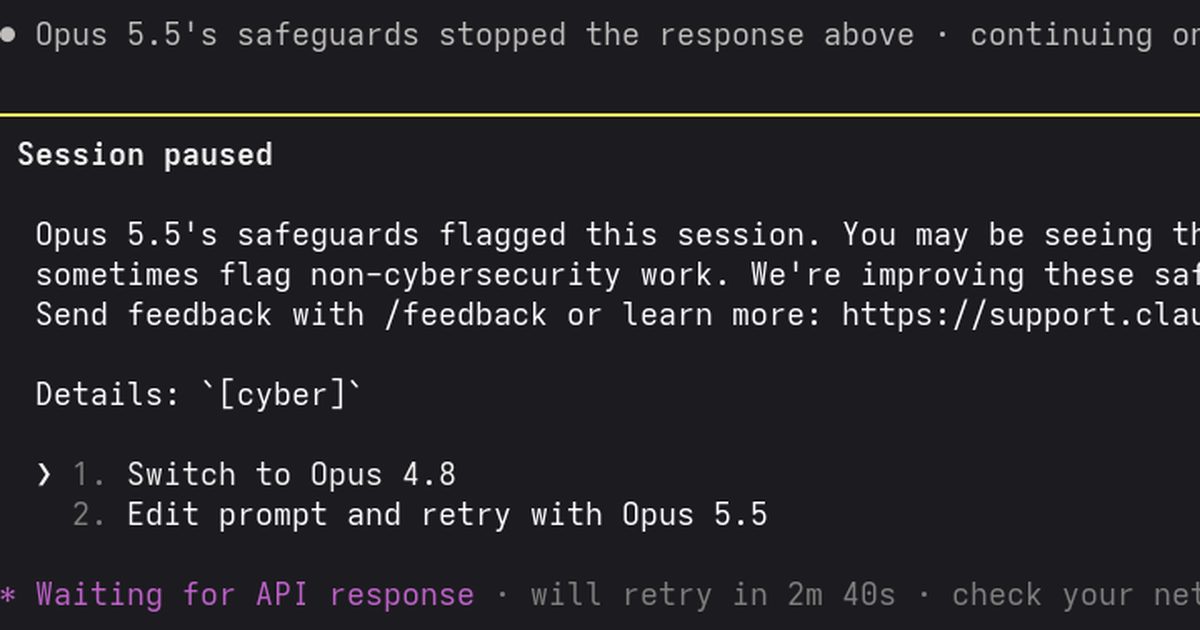
You can't tell me that you found a security issue in my product and then refuse to fix it.
Top AI Security Incidents of 2025 Revealed | Adversa AI
Discover how AI systems are being hacked in the wild — from prompt injection to agent abuse — with real breaches, lessons, and defenses in Adversa AI’s 2025 report.

Embedded Evaluators Can’t Fix Companies That Choose to Be Bad — Stella Biderman
Embedded evaluators can report violations, but they cannot fix AI companies that knowingly disregard basic cybersecurity and safety practices.
Rethinking security for the age of AI - The Official Microsoft Blog
Editor’s note: Updates with additional details on the model’s crash score. Why security needs a new cyber stack — Introducing Project Perception The physics of cybersecurity are changing. Autonomous systems can now reason, adapt and operate continuously. At the same time, the cost of offense is falling, while the volume, velocity and complexity of what...

Artificial Intelligence Safety and Security License Requirements
Artificial Intelligence Safety and Security License Requirements Artificial Intelligence (AI) is now broadly capable, which can produce both benefits and dangers. AI will hasten the design and proliferation of bioweapons, cyberweapons, nuclear weapons, progressively more general intelligence,...

Securing internal systems against increasingly capable and imperfectly aligned AI
Discover our AI Control Roadmap: a defense-in-depth system to securely manage advanced, potentially misaligned AI agents.

AI safety and the data center backlash
Planting a flag for AI safety as a place where we won’t abjectly bullshit you

You created a machine learning application. Now make sure it's secure.
The software industry has demonstrated, all too clearly, what happens when you don’t pay attention to security.

Poll Shows Overwhelming Concern About Risks From AI as New Institute Launches to Understand Public Opinion and Advocate for Responsible AI Policies
Majority of voters don’t trust tech executives to self-regulate their use of AI, 83% of voters believe AI could accidentally cause a catastrophic event, 72% want to slow down AI development and usage, a new survey shows.

Misuse of AI is brands’ top reputational threat, new survey says
The findings come after warnings from tech leaders that AI placed in the wrong hands could trigger larger threats such as nuclear war or bioweaponry destruction
Your Security is My Security
Speaking to the world, I care about how good the security of your machines are.

The solution might be cancelling my AI subscription
New AI Flaw Reporting System Fills Crucial Security Gap | CMU Software Engineering Institute
Flaw Reporting for AI (FLARE-AI) allows developers and security researchers to submit artificial intelligence flaws for formal, coordinated disclosure.

Clear, Compelling Arguments: Rethinking the Foundations of Frontier AI Safety Cases
This paper contributes to the nascent debate around safety cases for frontier AI systems. Safety cases are structured, defensible arguments that a system is acceptably safe to deploy in a given context. Historically, they have been used in safety-critical industries, such as aerospace, nuclear or automotive. As a result, safety cases for frontier AI have risen in prominence, both in the safety policies of leading frontier developers and in international research agendas proposed by leaders in generative AI, such as the Singapore Consensus on Global AI Safety Research Priorities and the International AI Safety Report. This paper appraises this work. We note that research conducted within the alignment community which draws explicitly on lessons from the assurance community has significant limitations. We therefore aim to rethink existing approaches to alignment safety cases. We offer lessons from existing methodologies within safety assurance and outline the limitations involved in the alignment community's current approach. Building on this foundation, we present a case study for a safety case focused on Deceptive Alignment and CBRN capabilities, drawing on existing, theoretical safety case "sketches" created by the alignment safety case community. Overall, we contribute holistic insights from the field of safety assurance via rigorous theory and methodologies that have been applied in safety-critical contexts. We do so in order to create a better foundational framework for robust, defensible and useful safety case methodologies which can help to assure the safety of frontier AI systems.

Joint Statement on AI Safety and Openness
We are at a critical juncture in AI governance. To mitigate current and future harms from AI systems, we need to embrace openness, transparency, and broad access.
How Microsoft discovers and mitigates evolving attacks against AI guardrails | Microsoft Security Blog
Read about some of the key issues surrounding AI harms and vulnerabilities, and the steps Microsoft is taking to address the risk.