

Explore data on how energy production and use varies across the world.
Does that use a lot of energy?
Compare the daily energy consumption of different products and activities
Share of electricity in total final energy consumption
Get the present share of electricity statistics in total final energy consumption mix by country or region.
US data centers’ energy use amid the artificial intelligence boom
Data centers accounted for 4% of total U.S. electricity use in 2024. Their energy demand is expected to more than double by 2030.

A Reality Check on Our ‘Energy Transition’ | The Tyee
To our peril, there’s been no green revolution. Just green addition to rising fossil fuel use.

The Impact of Digital Business on Energy Efficiency in EU Countries
Digital business plays a crucial role in driving energy efficiency and sustainability by enabling innovative solutions such as smart grid technologies, data analytics for energy optimization, and remote monitoring and control systems. Through digitalization, businesses can streamline processes, minimize energy waste, and make informed decisions that lead to more efficient resource utilization and reduced environmental impact. This paper aims at analyzing the character of digital business� impact on energy efficiency to outline the relevant instruments to unleash EU countries� potential for attaining sustainable development. The study applies the panel-corrected standard errors technique to check the effect of digital business on energy efficiency for the EU countries in 2011�2020. The findings show that digital business has a significant negative effect on energy intensity, implying that increased digital business leads to decreased energy intensity. Additionally, digital business practices positively contribute to reducing CO2 emissions and promoting renewable energy, although the impact on final energy consumption varies across different indicators. The findings underscore the significance of integrating digital business practices to improve energy efficiency, lower energy intensity, and advance the adoption of renewable energy sources within the EU. Policymakers and businesses should prioritize the adoption of digital technologies and e-commerce strategies to facilitate sustainable energy transitions and accomplish environmental objectives.

AI’s energy usage is less than previously thought | Waterloo News
Contrary to popular belief, new research finds that the use of artificial intelligence has a minimal effect on global greenhouse gas emissions and may actually benefit the environment and the
The Profit Paradox
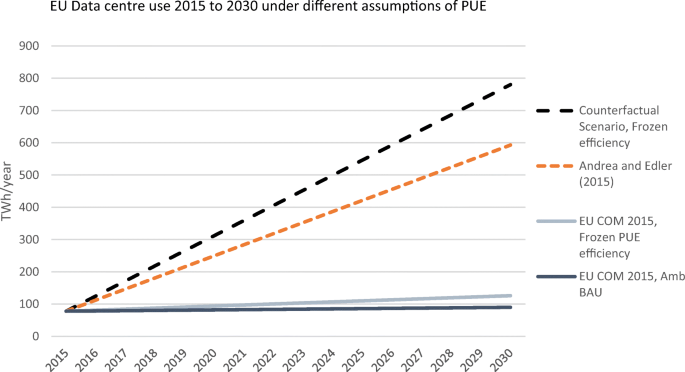
Data centres in future European energy systems—energy efficiency, integration and policy
End-use efficiency, demand response and coupling of different energy vectors are important aspects of future renewable energy systems. Growth in the number of data centres is leading to an increase in electricity demand and the emergence of a new electricity-intensive industry. Studies on data centres and energy use have so far focused mainly on energy efficiency. This paper contributes with an assessment of the potential for energy system integration of data centres via demand response and waste heat utilization, and with a review of EU policies relevant to this. Waste heat utilization is mainly an option for data centres that are close to district heating systems. Flexible electricity demand can be achieved through temporal and spatial scheduling of data centre operations. This could provide more than 10 GW of demand response in the European electricity system in 2030. Most data centres also have auxiliary power systems employing batteries and stand-by diesel generators, which could potentially be used in power system balancing. These potentials have received little attention so far and have not yet been considered in policies concerning energy or data centres. Policies are needed to capture the potential societal benefits of energy system integration of data centres. In the EU, such policies are in their nascent phase and mainly focused on energy efficiency through the voluntary Code of Conduct and criteria under the EU Ecodesign Directive. Some research and development in the field of energy efficiency and integration is also supported through the EU Horizon 2020 programme. Our analysis shows that there is considerable potential for demand response and energy system integration. This motivates greater efforts in developing future policies, policy coordination, and changes in regulation, taxation and electricity market design.
Climate change
Present-day climate change includes both global warming—the ongoing increase in global average temperature—and its wider effects on Earth's climate system. Climate change in a broader sense also includes previous long-term changes to Earth's climate. The modern-day rise in global temperatures is driven by human activities, especially fossil fuel burning since the Industrial Revolution. Fossil fuel use, deforestation, and some agricultural and industrial practices release greenhouse gases. These gases absorb some of the heat that the Earth radiates after it warms from sunlight, warming the lower atmosphere. Earth's atmosphere now has roughly 50% more carbon dioxide, the main gas driving global warming, than it did at the end of the pre-industrial era, reaching levels not seen for millions of years.

We did the math on AI’s energy footprint. Here’s the story you haven’t heard.
The emissions from individual AI text, image, and video queries seem small—until you add up what the industry isn’t tracking and consider where it’s heading next.

Shifting the Suburbs: How to talk with suburban Australians about climate and energy
This guide is for communicators talking about climate and energy with suburban audiences. This guide primarily draws on 2026 research by RedBridge Group for the Climate Council: a survey of 2009 voters across the middle and outer suburbs of Sydney, Melbourne and Brisbane, plus focus groups, against a backdrop of war in Iran, fuel price […]

AI’s climate impact is much smaller than many feared
New findings challenge the widespread belief that AI is an environmental villain. By analyzing U.S. economic data and AI usage across industries, researchers discovered that AI’s energy consumption—while significant locally—barely registers at national or global scales. Even more surprising, AI could help accelerate green technologies rather than hinder them.
Oil and Gas=Peril and Poverty/ Solar and Wind=Prosperity and Protection
2026 has changed the psychological meaning of energy forever

Putting solar panels on land used for biofuels would produce enough electricity for all cars and trucks to go electric
The world dedicates a Poland-sized area of land to liquid biofuels. Is there a more efficient way to generate energy?
Electrification | Ember
Electrification can refer to different processes depending on the context. For example, increasing electricity access in emerging economies. At Ember, we focus on a specific type of electrification: replacing fossil fuels with electricity in sectors like transport, heating and industry. This kind of electrification cuts emissions and improves energy efficiency by replacing fossil fuels with clean power.

How does food get traded around the world?
Our interactive tool helps you see where food is exported from and where it goes.