

You can just prove things, apparently.
Terence Tao (@tao@mathstodon.xyz)
In traditional mathematics (or "Math 1.0"), a breakthrough proof of a long-standing open conjecture generates a large amount of subsequent activity and excitement in the field. The authors of the proof are invited to give many talks, and meet with other experts in the area. Workshops are set up to discuss the proof, as well as other recent developments. As a result, new connections and collaborations are formed, followup problems are shared, and other mathematicians (both junior and senior) are attracted to the field (including in some cases the authors themselves, if they initially came from a different subject). As a result of all this activity, the proofs naturally become digested, streamlined, placed in context with other results in the field, and ultimately become part of the textbooks and lecture notes for the next generation of mathematicians in the field. (1/4)
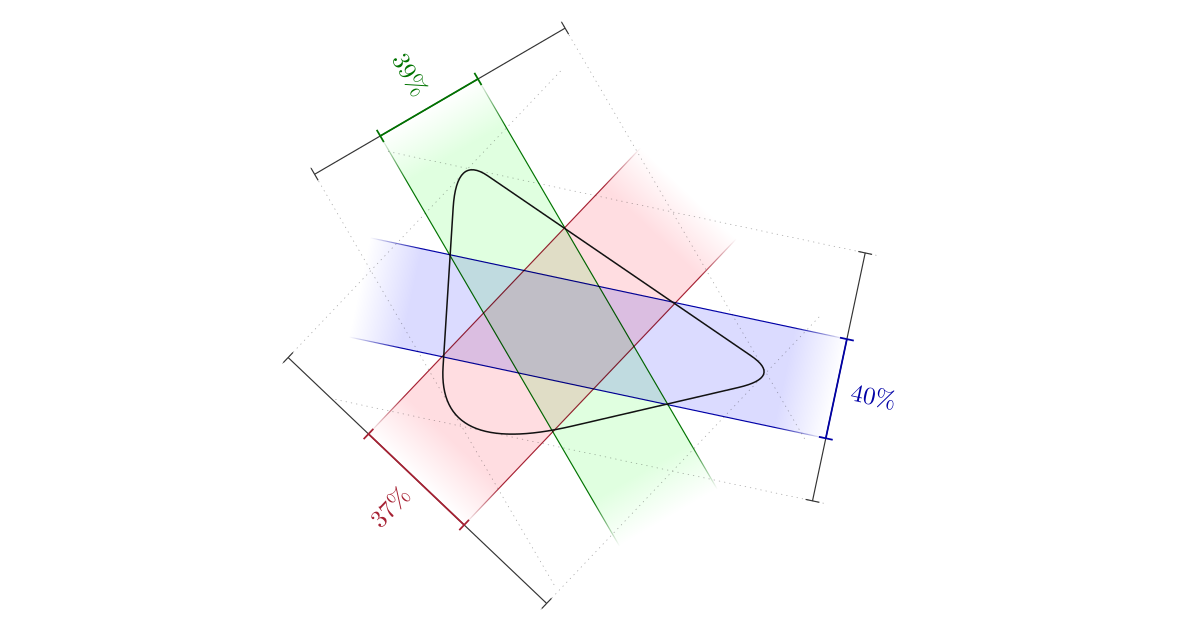
The Affine Plank Conjecture | Zaz Brown
An illustrated explanation of relative plank widths, an interactive visualization, and proofs for three planks.
Bartosz Naskręcki on Twitter / X
Congrats to @LechMazur for the solution and to Terence Tao for the digestion and storytelling. You see the trend. Mathematicians are still needed if we want to make any sense of the formal proofs. For now... Maybe the next gen LLMs will simply read allthe blogs of Terry and… https://t.co/yXiISCrNAF— Bartosz Naskręcki (@nasqret) August 13, 2026
If math is more than proof, we need to better celebrate the rest of it
[This is a guest post by Grant Sanderson. This blog post was initially written in a different file format and converted using AI. — T.] A sentiment echoing throughout the mathematics communit…

Mathematics with large language models as provers and verifiers
During 2024 and 2025 the discussion about the theorem-proving capabilities of large language models started reporting interesting success stories, mostly to do with difficult exercises (such as problems from the International Mathematical Olympiad), but also with conjectures [Feldman & Karbasi, arXiv:2509.18383v1] formulated for the purpose of verifying whether the artificial intelligence could prove it. In this paper we report a theorem proving feat achieved by ChatGPT by using a protocol involving different prover and verifier instances of the gpt-5 model working collaboratively. To make sure that the produced proofs do not suffer from hallucinations, the final proof is formally verified by the lean proof assistant, and the conformance of premises and conclusion of the lean code is verified by a human. Our methodology is by no means complete or exact. It was nonetheless able to solve five out of six 2025 IMO problems, and close about a third of the sixty-six number theory conjectures in [Cohen, Journal of Integer Sequences, 2025].
Tony Feng on Twitter / X
I am a mathematician but I avoided commenting on this because the problems are (far) outside my domain. Even if I sat down to read the technical details (which I have not), it would be hard to appreciate the context of prior work, etc. But I've gotten enough sense of things… https://t.co/VZzosBYFto— Tony Feng (@tonylfeng) August 5, 2026
Junyu Ren on Twitter / X
How we solved the 70-year-old Pierce–Birkhoff conjecture in real algebraic geometry with $400.One thing we kept noticing: models from different families (including the latest public models from GPT and Claude) seemed to complement each other, even when they were independently… pic.twitter.com/7MzWstXfy6— Junyu Ren (@junyu_r) September 9, 2026

Przemek Chojecki | PC on Twitter / X
The Growing Map of Open Mathematical Problems.We mapped 15,000+ conjectures from UnsolvedMath to show potential links between concepts.It also shows how under formalized the frontier is (less than 10%). pic.twitter.com/nm0PCpXVPf— Przemek Chojecki | PC (@prz_chojecki) August 28, 2026

AI's solution to 87-year-old riddle takes mathematicians by surprise | New Scientist
Mathematicians have been trying to prove the Jacobian conjecture for nearly a century, but now the Claude Fable 5 AI has apparently found a counterexample that disproves it

levent on Twitter / X
hello there the jacobian conjecture is false thanx to my close friend akhil for asking about it and my other close friend fable for working during the world cup final((1+xy)^3 z + y^2 (1+xy) (4+3xy), y + 3 x (1+xy)^2 z + 3 x y^2 (4+3xy), 2 x - 3 x^2 y - x^3 z): \C^3\to \C^3,…— levent (@__alpoge__) July 20, 2026
AI helped produce two proofs for the same cryptography problem
Last Thursday Massachusetts Institute of Technology graduate student Seyoon Ragavan sent a new quantum cryptography proof to his friend Yao-Ting Lin, a doctoral student at the University of California...

