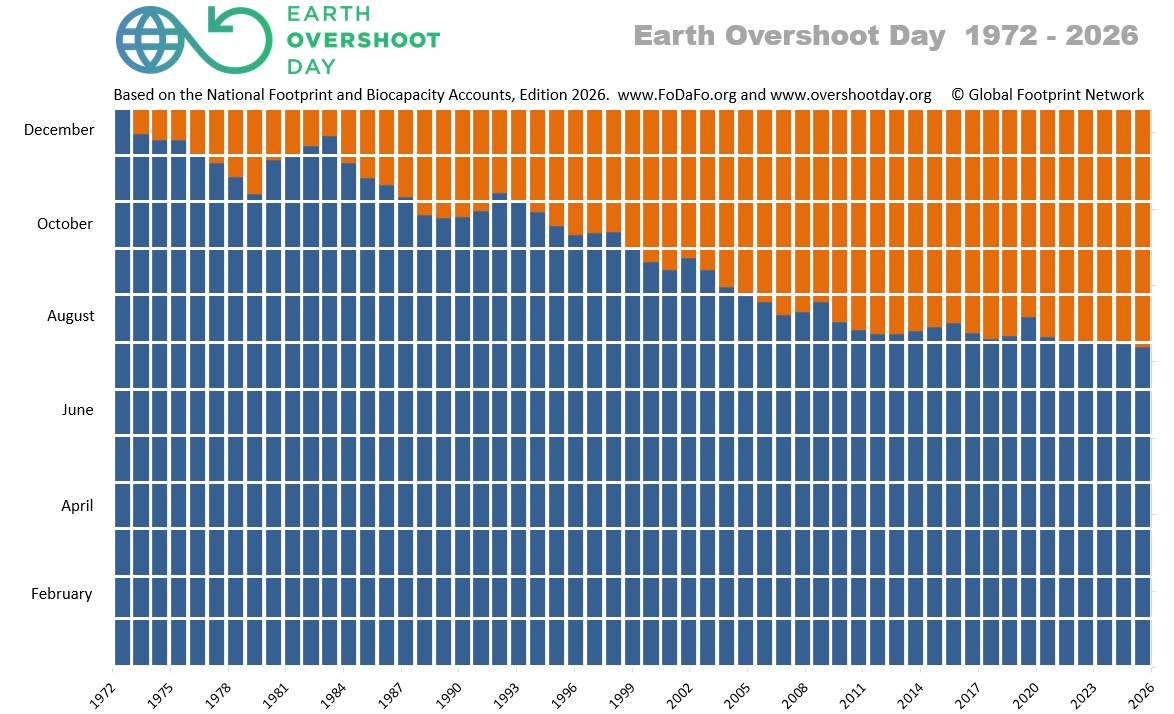
Overshoot occurs when humanity's demand on nature exceeds Earth's biocapacity. In 2026, Earth Overshoot Day fell on July 30th.
Earth on verge of five catastrophic climate tipping points, scientists warn
Humanity faces ‘devastating domino effects’ including mass displacement and financial ruin as planet warms
Mammals’ Time on Earth Is Half Over, Scientists Predict (Published 2023)
A new model suggests that in 250 million years, all land will collide into a supercontinent that boosts warming and pushes mammals to extinction.

Chart of the day: Scientists slam emissions reduction "flatline," say warming overshoot imminent
The world's carbon emissions will be slightly lower than 2025 but you have to squint to see the difference.

Chart of the day: Scientists slam emissions reduction "flatline," say warming overshoot imminent
The world's carbon emissions will be slightly lower than 2025 but you have to squint to see the difference.
BREAKING: the world's most conservative scientists have changed their minds and now say they agree species like humans face catastrophically extreme global ecological and climate chaos impacts that will be beyond our ability to adapt within 15 years - give or take a decade 🧵
BREAKING: the world's most conservative scientists have changed their minds and now say they agree species like humans face catastrophically extreme global ecological and climate chaos impacts that will be beyond our ability to adapt within 15 years - give or take a decade 🧵— Ben See (@ClimateBen) June 14, 2024
With four more years like 2023, carbon emissions will blow past 1.5° limit
With each passing year, it gets harder to reach net zero quickly enough.

Social tipping dynamics for stabilizing Earth’s climate by 2050 | PNAS
Safely achieving the goals of the Paris Climate Agreement requires a worldwide transformation to carbon-neutral societies within the next 30 y. Acc...

changelog.earth | Planetary release notes
New species. Balance changes. Unresolved bugs. An unofficial changelog for Earth.
Earth Rotation Records Spur October Vote to Avert Negative Leap Second
Negative leap second risk is driving an October 2026 CGPM vote to replace the 54-year-old leap second with a leap hour. Earth set rotation speed records in 2024 and 2025, and timekeepers estimate a 30% chance the unprecedented event could hit before 2035 — an outcome with no software patch history

Doughnut of social and planetary boundaries monitors a world out of balance
The doughnut-shaped framework of social and planetary boundaries (the ‘Doughnut’) provides a concise visual assessment of progress towards the goal of meeting the needs of all people within the means of the living planet1–3. Here we present a renewed Doughnut framework with a revised set of 35 indicators that monitor trends in social deprivation and ecological overshoot over the 2000–2022 period. Although global gross domestic product (GDP) has more than doubled, our median results show a modest achievement in reducing human deprivation that would have to accelerate fivefold to meet the needs of all people by 2030. Meanwhile, the increase in ecological overshoot would have to stop immediately and accelerate nearly two times faster towards planetary boundaries to safeguard Earth-system stability by 2050. Disaggregating these global findings shows that the richest 20% of nations, with 15% of the global population, contribute more than 40% of annual ecological overshoot, whereas the poorest 40% of countries, with 42% of the global population, experience more than 60% of the social shortfall. These trends and inequalities reaffirm the case for overcoming the dependence of nations on perpetual GDP growth4,5 and reorienting towards regenerative and distributive economic activity—within and between nations—that assigns priority to human needs and planetary integrity.

Beyond Catastrophe: A New Climate Reality Is Coming Into View (Published 2022)
There's plenty of bad news. But thanks to real progress, we're headed toward a less apocalyptic future.

ATmosphereConf 2026 Is Not Over | Offprint
A not-retrospective of ATmosphereConf 2026

Countering misuse of AI: September 2026 / Anthropic
Case studies from threat actors disrupted between December 2025 and August 2026 across seven areas of harm, from cyber operations to biological misuse.

Manage derailment risks to avoid Hothouse Earth
The risk of a ‘Hothouse Earth’ trajectory has become increasingly prominent in debates about Earth system stability and climate overshoot. Existing analyses primarily focus on biophysical feedbacks that may amplify warming beyond direct anthropogenic forcing. We argue the concept has not previously incorporated how social destabilisation lowers the effective threshold at which biophysical tipping dynamics become self-sustaining, independently of further anthropogenic forcing and so undermines the capacity for planetary stewardship. We define ‘derailment risk’ as the possibility that escalating Earth system disruption weakens the social, political, and economic conditions required to sustain mitigation, adaptation, and ecological restoration. Such risks emerge when climate impacts contribute to a wide range of challenges, including debt crises, institutional erosion, political fragmentation, supply-chain instability, and declining public support for environmental action. These reinforcing feedbacks may reduce humanity’s capacity to respond even before biophysical tipping thresholds are crossed. We therefore extend the Hothouse Earth framework by incorporating social dynamics into the Earth system stability landscape. We propose a three-stage framework for assessing and managing derailment risks: conceptual mapping of socio-biophysical feedbacks; anticipatory resilience-building interventions; responsive governance strategies for periods of escalating instability. We conclude that planetary stewardship should prioritise maintaining and expanding collective agency under worsening Earth system stress.
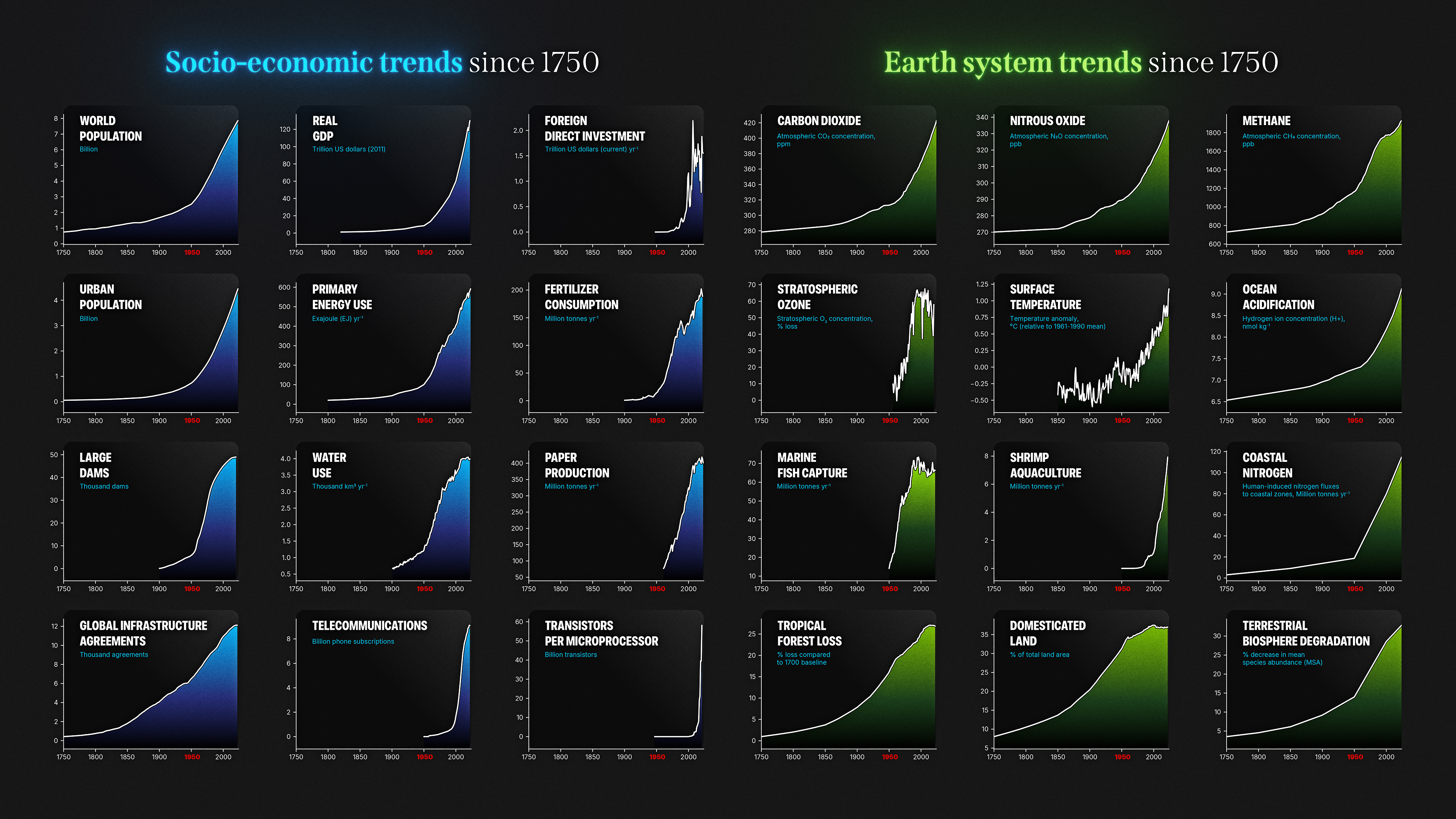
The Great Acceleration: How Humanity Changed Earth
Explore the Great Acceleration — the explosive post-1950 surge in human activity reshaping Earth's climate, biodiversity, and ocean systems.
The Gargantuan Lie That is Collapsing The World’s Climate
Thinking we have time left to address climate change, or that “Net Zero by 2050” will save us, is driving us toward full social collapse in ways that become more obvious with every new broken temperature record.