

Server Side Request Forgery on the main website for The OWASP Foundation. OWASP is a nonprofit foundation that works to improve the security of software.
Protecting gRPC Against OWASP’s Top Ten API Risks | Nordic APIs |
We review the OWASP top ten API list from the perspective of gRPC. Here's how the API vulnerabilities arise in gRPC and ways to respond.

ForgeFed
ForgeFed is a federation protocol for software forges and code collaboration tools for the software development lifecycle and ecosystem. This includes repository hosting websites, issue trackers, code review applications, and more. ForgeFed provides a common substrate for people to create interoperable code collaboration websites and applications.
Unforgeable Endorsements Technical Deep-Dive - Nick's Blog
Deep technical implementation of the unforgeable endorsement system. Covers step-by-step CID computation, complete code for the endorsement workflow, validation algorithms, firehose event processing, and detailed security analysis of attack vectors. Includes working code examples, lexicon definitions, and the cryptographic mechanisms that make forgery mathematically impossible.
OWSAR
OWSAR is a technology company that creates interactive tools to look inside AI models.
OWID Homepage
Research and data to make progress against the world’s largest problems.

Surveillance Self-Defense
We’re the Electronic Frontier Foundation, a member-supported non-profit working to protect online privacy for over thirty-five years. This is Surveillance Self-Defense: our expert guide to protecting you and your friends from online spying. Read the BASICS to find out how online surveillance works. Dive into our TOOL GUIDES for instructions...
Building Unforgeable Professional Endorsements with ATProtocol - Nick's Blog
Traditional professional endorsements on platforms like LinkedIn lack cryptographic proof—anyone could forge them, and the platform controls the truth. This article introduces a two-record architecture using ATProtocol's Content Identifiers (CIDs) and Decentralized Identifiers (DIDs) to create mathematically unforgeable mutual attestations. By separating proof creation from endorsement acceptance and leveraging the firehose for distributed validation, we build a system where both parties cryptographically consent and no central authority can manipulate the record.
OAuth scopes (#3806) · bluesky-social/atproto@1899b1f
* style: prefix `id` and `uri` with `request` where applicable * Dynamically validate OAuth scopes * Allow configuring trusted OAuth clients * Improve client validation * Rework authorization t...
Building AIP: An ATProtocol Authorization Gateway - Nick's Blog
OAuth is the first challenge developers face in the atmosphere. This post is about AIP, the authorization gateway we built at Graze Social to alleviate some of the pain.
Authenticated Transfer: Architecture Overview
Authenticated Transfer (AT) is a collection of protocol components that together provide a generic framework for interoperable social web applications, using global aggregations of interlinked, self-certifying data records. This informational document provides an overview of the entire system, as implemented in late 2025. Some of those components may be in scope as work for the IETF, while other components may not. Many components are general-purpose and may find use outside of the context of AT. The intent of this document is to provide context for how all the components can fit together for certain use cases.
Computer Fraud and Abuse Act
The Computer Fraud and Abuse Act of 1986 (CFAA) is a United States cybersecurity bill that was enacted in 1986 as an amendment to existing computer fraud law, which had been included in the Comprehensive Crime Control Act of 1984. Prior to computer-specific criminal laws, computer crimes were prosecuted as mail and wire fraud, but the applying law was often insufficient.

ATProtocol Attestations: Cryptographic Signatures for the Decentralized Web - Nick's Blog
This post introduces the formal ATProtocol attestation specification, a framework for adding cryptographic signatures to ATProto records through two complementary patterns: inline attestations that embed signatures directly in records, and remote attestations that store proof in separate repository records. The specification prevents replay attacks through repository binding, uses CID-based content addressing for integrity, and provides the cryptographic foundation for verified credentials, trusted content, and authenticated interactions in the decentralized ATProtocol ecosystem.
CSP Bypass Search
A tool designed to help ethical hackers bypass restrictive Content Security Policies

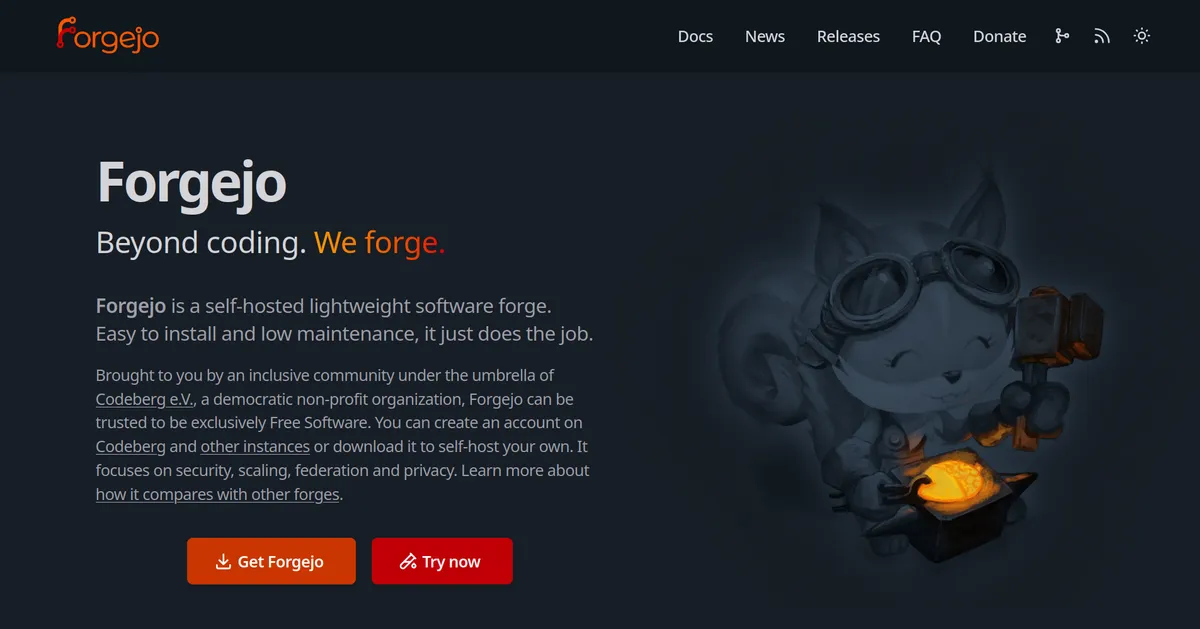
Forgejo – Beyond coding. We forge.
Forgejo is a self-hosted lightweight software forge. Easy to install and low maintenance, it just does the job.
Security Verification
Security verification page to protect against malicious bots.
It looks like W Identity, the part of @wsocial.eu that checks your papers before you go in, has a very basic XSS on its admin backend, found hours after launch. This seems almost too predictable... Cyberfriends, any thoughts on how bad? 23.social/@kantorkel/116767220594438841
kantorkel (@kantorkel@23.social)
23.social