

Scientific communication still privileges narrative over utility, while the data, code, protocols, and computation that underpin modern research are pushed into hard-to-access supplements. Rowan Cockett introduces the Open Exchange Architecture (OXA), an emerging, community-driven standard designed to unbundle research from its paper-shaped container and expose the rich evidence underneath it.
Towards Modular Open Science
Science is trapped in a paper-shaped box. In this talk at the ATProto community, Rowan Cockett introduces the structural states of scientific components — the floor, the buckets, and the shelf — and makes the case for a second wave of modular science where modularity emerges from packaging rather than being imposed as a precondition. The talk introduces the Open Exchange Architecture (OXA), a new standard for modular and composable scientific content.
Open Exchange Architecture
A specification for representing scientific documents and their components as structured objects.
Open Exchange Architecture
A specification for representing scientific documents and their components as structured objects.
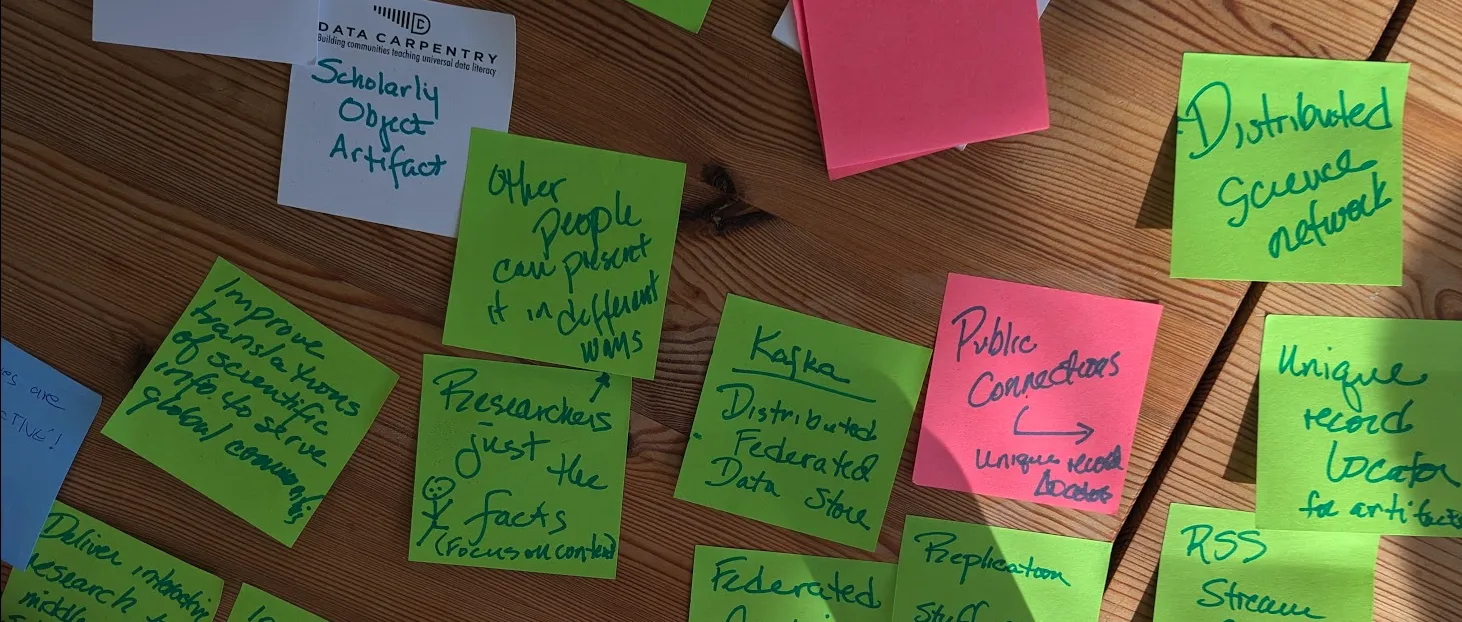
Open Exchange Architecture
A specification for representing scientific documents and their components as structured objects.
rfc/content/RFC0005/index.md at 7a977ec6723ffe8cf10add493279b75fa62a5701 · oxa-dev/rfc
Request for Comments for the Open Exchange Architecture (OXA) project. - oxa-dev/rfc
Scientific Documents as First-Class Objects on AT Protocol
OXA now defines an AT Protocol lexicon for publishing scientific documents to the Atmosphere. The `pub.oxa.*` namespace lets documents live in any Personal Data Server, making scientific content user-owned, portable, and discoverable alongside social interactions, feeds, and moderation infrastructure.
Scientific Documents as First-Class Objects on AT Protocol
OXA now defines an AT Protocol lexicon for publishing scientific documents to the Atmosphere. The `pub.oxa.*` namespace lets documents live in any Personal Data Server, making scientific content user-owned, portable, and discoverable alongside social interactions, feeds, and moderation infrastructure.
OME Project — open-metadata-exchange documentation
OME enables open educational resources to create, publish, and update their metadata on a peer-to-peer network. By solving authoring, publishing, and discovery issues, this network will provide broad visibility to current islands of OER information.
Open-Source EDA Birds-of-a-Feather: Open-Source EDA, Data and Collaboration Summit
This “Open-Source EDA, Data and Collaboration” Birds-of-a-Feather session is the seventh in a series that began at DAC 2018. As semiconductor design confronts the mounting complexities of advanced nodes, Augmented AI is transitioning from an experimental concept to an indispensable engineering co-pilot. The DAC 2026 session explores the transformative intersection of AI, open-source software and hardware, and the engineers who build them, serving as an informal forum for anyone to share ideas and the latest updates on our open-source ecosystem.
eLife Pathways home page
Moving beyond legacy publishing requires interoperable open-source infrastructure. With Wellcome’s support, we are evolving eLife’s technology to anchor a collaborative network, partnering with the open science community to reshape the communication and assessment of global research.
From Albums to Streams: How Modularity Changes Systems
Scientific publishing is breaking under document-centric formats designed for a physical world. Borrowing from music’s shift from albums to streaming, we make the case that open access alone cannot deliver reuse, trust, or scale. The future of science depends on modular, interoperable research components that move across tools, enabling new workflows, tools, and ecosystems.
Platform Cooperativism as a Critique of Open-Source
I am a pretty assiduous digital commoner, for what it’s worth. I almost exclusively use free/libre/open-source software (hereafter FLOSS), evangelistically so. I try to practice open journali…
Protocols for Publishers
A series bringing together publishers, developers, and researchers to explore open protocols for a sustainable agentic web.
Beyond Articles: Rethinking Diamond Open Access for a Data-Driven Research Future | CODATA Blog
What would it take for Diamond OA to evolve into a holistic, equitable, and data-rich scholarly ecosystem — one that meaningfully includes early-career researchers?
Bryan Newbold: Protocol engineering
A protocol engineer at the social-media platform Bluesky describes building an open protocol around a fast-growing social media platform.
I've been thinking about the beauty of open data and how the AT Protocol and wider Atmosphere ecosystem has been recapturing that open data environment that once defined the web. It really does feel special. vale.rocks/posts/atproto-ethos #atproto #ATProtocol

The AT Protocol Harkens An Old Web Ethos
vale.rocks