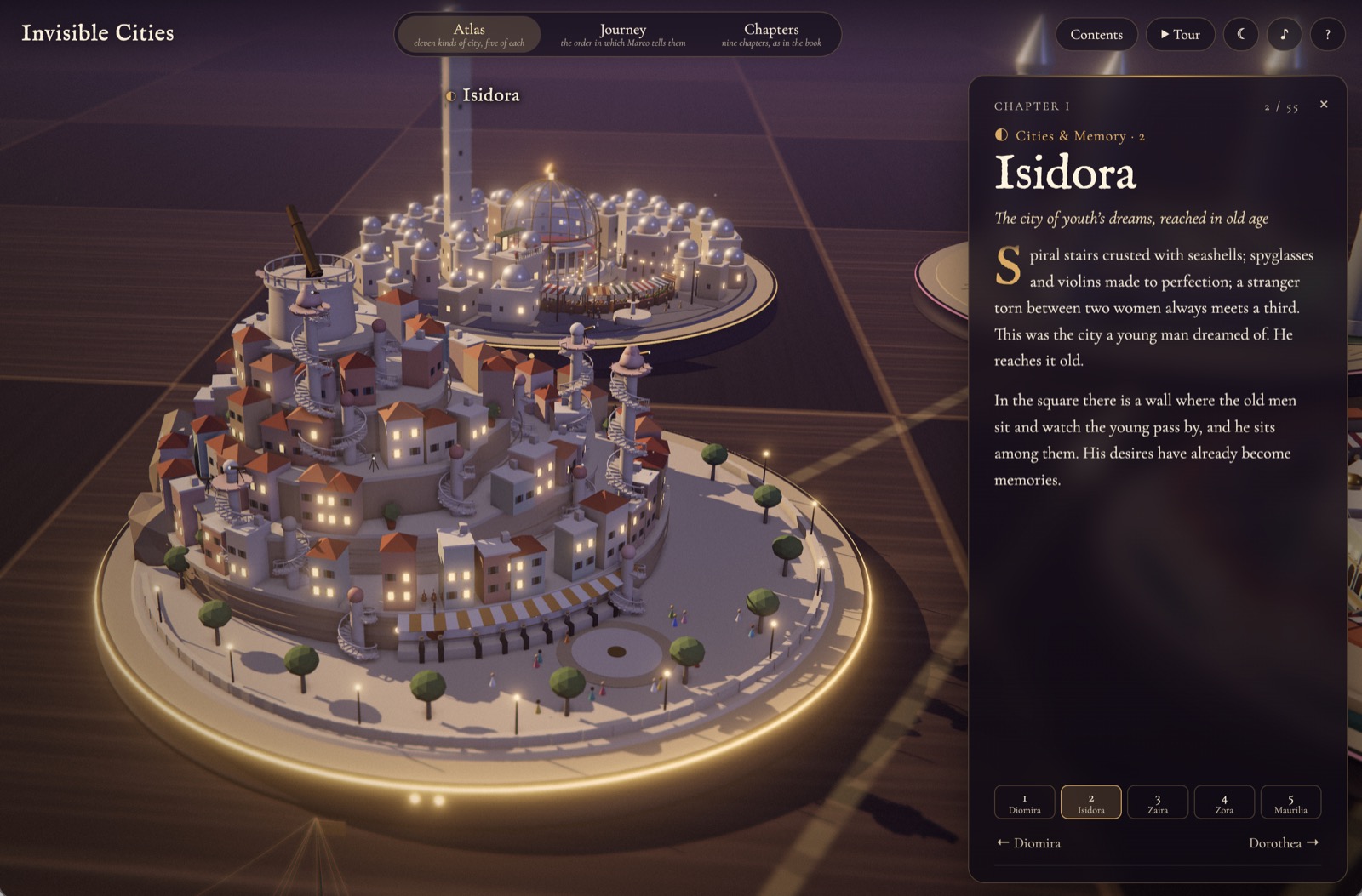
A three.js atlas of the fifty-five cities Marco Polo describes to Kublai Khan in Italo Calvino’s Invisible Cities.
I gave Opus 5.5 one prompt and six hours to visualize Invisible Cities - Quesma Blog
Claude Opus 5.5 vs GPT-6 Astra one-shot Invisible Cities by Italo Calvino in Three.js: AI design, UX, data visualization and explorable explanations.
Atlas Obscura - Curious and Wondrous Travel Destinations
Explore hidden wonders, unusual places, and fascinating stories from around the world.

Home | Urban Nomad Adventures
Walled Haven
《Walled Haven》An open world action-adventure set in the Walled City, a dystopian metropolis where Kung Fu decides all.

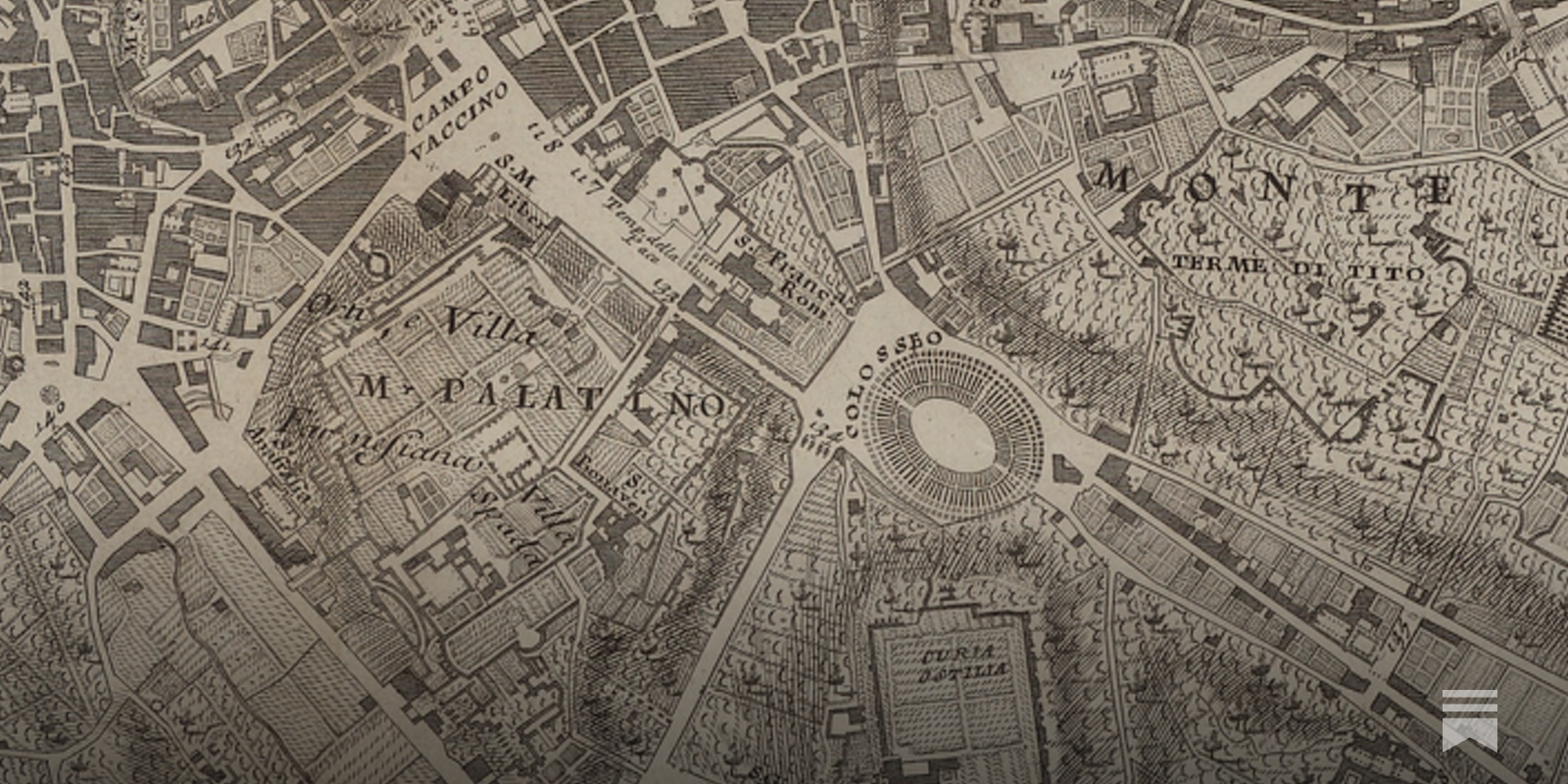
OldMapsOnline
The easy-to-use getaway to historical maps in libraries around the world.

Intranational International Boulevard: A Street's Atlas - Oakland - LocalWiki
The Intranational International Boulevard: A Street's Atlas is a cool mapping project done by students in the UC Berkeley’s Cartography and GIS Education (CAGE) Lab. It maps International Blvd. in a variety of hyper-local ways.

We Are Living in Pinocchio’s World
I have always wanted to own a Montblanc Writers Edition dedicated to Carlo Collodi, the Italian author whose real name was Carlo Lorenzini. He took his pen name from the Tuscan village where his mo…

Катя Гущина - writer and illustrator in Russian Federation
Traveller, train and sketching addicted girl. Interested in mapmaking, illustrated biographies and picturebooks.

Small worlds — Stylized dioramas
Six interactive miniature worlds. Wander through an Italian harbor, a Japanese garden, a tropical island, a neon alley, forest ruins, and a sunken garden.
A City Is Not a Computer: Other Urban Intelligences
<strong>A bold reassessment of "smart cities" that reveals what is lost when we conceive of our urban spaces as computers</strong> Computational models of urbanism—smart cities that use data-driven planning and algorithmic administration—promise to deliver new urban efficiencies and conveniences. Yet these models limit our understanding of what we can know about a city. <i>A City Is Not a Computer</i> reveals how cities encompass myriad forms of local and indigenous intelligences and knowledge institutions, arguing that these resources are a vital supplement and corrective to increasingly prevalent algorithmic models. Shannon Mattern begins by examining the ethical and ontological implications of urban technologies and computational models, discussing how they shape and in many cases profoundly limit our engagement with cities. She looks at the methods and underlying assumptions of data-driven urbanism, and demonstrates how the "city-as-computer" metaphor, which undergirds much of today's urban policy and design, reduces place-based knowledge to information processing. Mattern then imagines how we might sustain institutions and infrastructures that constitute more diverse, open, inclusive urban forms. She shows how the public library functions as a steward of urban intelligence, and describes the scales of upkeep needed to sustain a city's many moving parts, from spinning hard drives to bridge repairs. Incorporating insights from urban studies, data science, and media and information studies, <i>A City Is Not a Computer</i> offers a visionary new approach to urban planning and design.
Reinventing Explanation
The Babylonian Map of the World is one of the world's oldest extant maps, dating to 600 BCE. It's a crude map, difficult to read at a glance, but fortunately an accompanying cuneiform text describes the features on the map, including Babylon, seven other cities, a canal, and a mountain: Modern maps are, of course, far better than this early map. They improve on it by taking advantage of the many map-making techniques developed since 600 BCE, such as: surveying to get proportions correct; projections to correct for the curvature of the Earth; methods to depict topographic features; and so on. Even ideas such as showing roads and nautical routes were not a priori obvious, but had to be invented.
Summary of Capital in the Twenty-First Century: by Thom…
Summary of Capital in the Twenty-First Century by Thoma…