

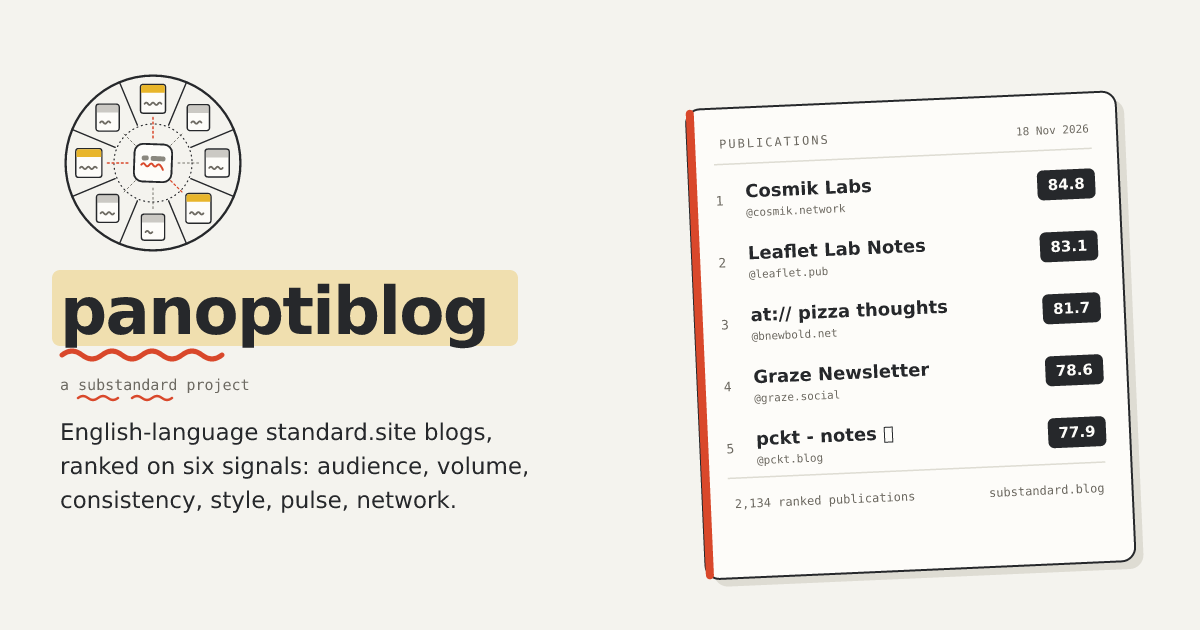
Percentile rankings for English-language standard.site publications.
Are you Slop??
Are you Slop? Analyze your 'slop score' - a measure of how generic or unique your text appears to language models.

Standard Reader · blog index
Bridging-Based Ranking
There is significant concern about the engagement-based ranking systems used by TikTok, Facebook, YouTube, etc. to recommend content. Bridging-based ranking systems can address one of the most dangerous aspects of such algorithmic recommendations—the push toward polarization and divisiveness that is tearing nations apart—and do so without reducing anonymity or increasing censorship. This report explores what bridging-based ranking is, how it helps (overcoming downsides of chronological feeds and middleware), addresses common objections, and provides early examples of its use and benefits in the wild. The report concludes by providing next steps for platforms, governments, funders, and researchers in order to accelerate the deployment of bridging.

homepages.news — News Homepages documentation
An open-source archive that gathers, saves, shares and analyzes news homepages
Marginalia: a reading shelf for papers
Readwise: Get the most out of what you read
Easily revisit and learn from your highlights and annotations.

Wikipedia Is Nearing
Hugh Pickens writes "According to Rebecca J. Rosen, it may seem impossible for an encyclopedia of everything to ever near completion, but at least for the major articles on topics like big wars, important historical figures, and central scientific concepts, the English-language Wikipedia is pretty w...

Platform Stats — blogs.social
Discover and follow blogs across Bluesky, Mastodon, RSS, and the open social web.
substandard.blog: read. more. blogs.
A browser extension to help you find https://standard.site publishers online.

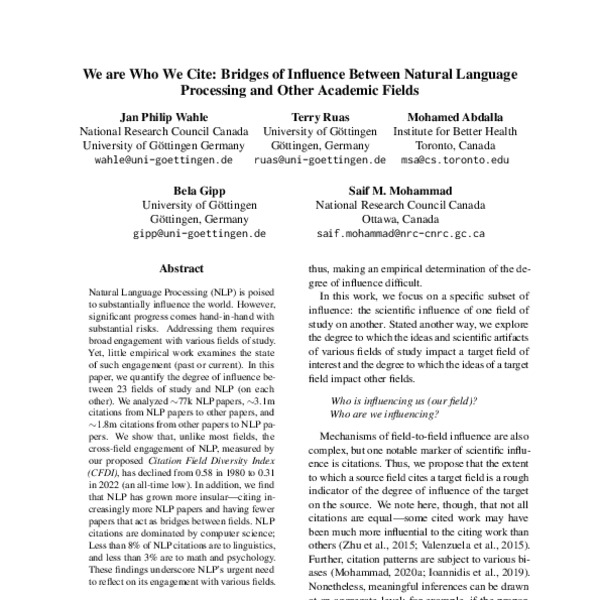
We are Who We Cite: Bridges of Influence Between Natural Language Processing and Other Academic Fields
Natural Language Processing (NLP) is poised to substantially influence the world. However, significant progress comes hand-in-hand with substantial risks. Addressing them requires broad engagement with various fields of study. Yet, little empirical work examines the state of such engagement (past or current). In this paper, we quantify the degree of influence between 23 fields of study and NLP (on each other). We analyzed \textasciitilde77k NLP papers, \textasciitilde3.1m citations from NLP papers to other papers, and \textasciitilde1.8m citations from other papers to NLP papers. We show that, unlike most fields, the cross-field engagement of NLP, measured by our proposed Citation Field Diversity Index (CFDI), has declined from 0.58 in 1980 to 0.31 in 2022 (an all-time low). In addition, we find that NLP has grown more insular—citing increasingly more NLP papers and having fewer papers that act as bridges between fields. NLP citations are dominated by computer science; Less than 8% of NLP citations are to linguistics, and less than 3% are to math and psychology. These findings underscore NLP's urgent need to reflect on its engagement with various fields.
Nathan Skene on Twitter / X
I figure it’ll be a mix of something like discourse / outcome graphs + benchmarks on key tasks + “living papers” (forkable / version controlled) on key topicsCitation counts to be replaced by metrics scoring extent of disruption to discourse graphs— Nathan Skene (@n_skene) September 19, 2026
"what standard.site publications gained the most subs this week?"

most-subscribed publications this week · pub search
pub-search.waow.tech"what standard.site publications gained the most subs this week?"
most-subscribed publications this week · pub search
pub-search.waow.tech