

The dominant sequence transduction models are based on complex recurrent orconvolutional neural networks in an encoder and decoder configuration. The best performing such models also connect the encoder and decoder through an attentionm echanisms. We propose a novel, simple network architecture based solely onan attention mechanism, dispensing with recurrence and convolutions entirely.Experiments on two machine translation tasks show these models to be superiorin quality while being more parallelizable and requiring significantly less timeto train. Our single model with 165 million parameters, achieves 27.5 BLEU onEnglish-to-German translation, improving over the existing best ensemble result by over 1 BLEU. On English-to-French translation, we outperform the previoussingle state-of-the-art with model by 0.7 BLEU, achieving a BLEU score of 41.1.
Attention Is All You Need
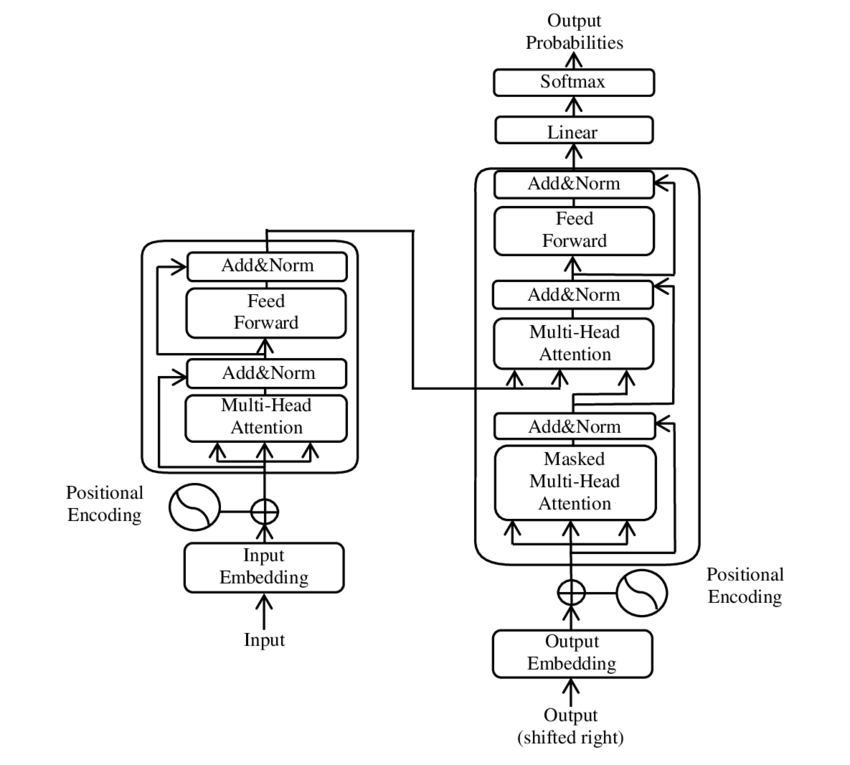
The dominant sequence transduction models are based on complex recurrent or convolutional neural networks in an encoder-decoder configuration. The best performing models also connect the encoder and decoder through an attention mechanism. We propose a new simple network architecture, the Transformer, based solely on attention mechanisms, dispensing with recurrence and convolutions entirely. Experiments on two machine translation tasks show these models to be superior in quality while being more parallelizable and requiring significantly less time to train. Our model achieves 28.4 BLEU on the WMT 2014 English-to-German translation task, improving over the existing best results, including ensembles by over 2 BLEU. On the WMT 2014 English-to-French translation task, our model establishes a new single-model state-of-the-art BLEU score of 41.8 after training for 3.5 days on eight GPUs, a small fraction of the training costs of the best models from the literature. We show that the Transformer generalizes well to other tasks by applying it successfully to English constituency parsing both with large and limited training data.

Attention Is All You Need
"Attention Is All You Need" is a 2017 research paper in machine learning authored by eight scientists and engineers working at Google. The paper introduced a new deep learning architecture known as the transformer, based on the attention mechanism proposed in 2014 by Bahdanau et al. The transformer approach it describes has become the main architecture of a wide variety of artificial intelligence systems, including large language models. At the time, the focus of the research was on improving Seq2seq techniques for machine translation, but the authors go further in the paper, foreseeing the technique's potential for other tasks like question answering and what is now known as multimodal generative AI.
The Illustrated Transformer
Discussions: Hacker News (65 points, 4 comments), Reddit r/MachineLearning (29 points, 3 comments) Translations: Arabic, Chinese (Simplified) 1, Chinese (Simplified) 2, French 1, French 2, Italian, Japanese, Korean, Persian, Russian, Spanish 1, Spanish 2, Vietnamese Watch: MIT’s Deep Learning State of the Art lecture referencing this post Featured in courses at Stanford, Harvard, MIT, Princeton, CMU and others Update: This post has now become a book! Check out LLM-book.com which contains (Chapter 3) an updated and expanded version of this post speaking about the latest Transformer models and how they've evolved in the seven years since the original Transformer (like Multi-Query Attention and RoPE Positional embeddings). In the previous post, we looked at Attention – a ubiquitous method in modern deep learning models. Attention is a concept that helped improve the performance of neural machine translation applications. In this post, we will look at The Transformer – a model that uses attention to boost the speed with which these models can be trained. The Transformer outperforms the Google Neural Machine Translation model in specific tasks. The biggest benefit, however, comes from how The Transformer lends itself to parallelization. It is in fact Google Cloud’s recommendation to use The Transformer as a reference model to use their Cloud TPU offering. So let’s try to break the model apart and look at how it functions. The Transformer was proposed in the paper Attention is All You Need. A TensorFlow implementation of it is available as a part of the Tensor2Tensor package. Harvard’s NLP group created a guide annotating the paper with PyTorch implementation. In this post, we will attempt to oversimplify things a bit and introduce the concepts one by one to hopefully make it easier to understand to people without in-depth knowledge of the subject matter. 2025 Update: We’ve built a free short course that brings the contents of this post up-to-date with animations: A High-Level Look Let’s begin by looking at the model as a single black box. In a machine translation application, it would take a sentence in one language, and output its translation in another.
EmbeddingGemma: Powerful and Lightweight Text Representations
We introduce EmbeddingGemma, a new lightweight, open text embedding model based on the Gemma 3 language model family. Our innovative training recipe strategically captures knowledge from larger models via encoder-decoder initialization and geometric embedding distillation. We improve model robustness and expressiveness with a spread-out regularizer, and ensure generalizability by merging checkpoints from varied, optimized mixtures. Evaluated on the Massive Text Embedding Benchmark (MTEB) across multilingual, English, and code domains, EmbeddingGemma (300M) achieves state-of-the-art results. Notably, it outperforms prior top models, both proprietary and open, with fewer than 500M parameters, and provides performance comparable to models double its size, offering an exceptional performance-to-cost ratio. Remarkably, this lead persists when quantizing model weights or truncating embedding outputs. This makes EmbeddingGemma particularly well-suited for low-latency and high-throughput use cases such as on-device applications. We provide ablation studies exploring our key design choices. We release EmbeddingGemma to the community to promote further research.
ST-MoE: Designing Stable and Transferable Sparse Expert Models
Scale has opened new frontiers in natural language processing -- but at a high cost. In response, Mixture-of-Experts (MoE) and Switch Transformers have been proposed as an energy efficient path to even larger and more capable language models. But advancing the state-of-the-art across a broad set of natural language tasks has been hindered by training instabilities and uncertain quality during fine-tuning. Our work focuses on these issues and acts as a design guide. We conclude by scaling a sparse model to 269B parameters, with a computational cost comparable to a 32B dense encoder-decoder Transformer (Stable and Transferable Mixture-of-Experts or ST-MoE-32B). For the first time, a sparse model achieves state-of-the-art performance in transfer learning, across a diverse set of tasks including reasoning (SuperGLUE, ARC Easy, ARC Challenge), summarization (XSum, CNN-DM), closed book question answering (WebQA, Natural Questions), and adversarially constructed tasks (Winogrande, ANLI R3).
LAION-5B: An open large-scale dataset for training next generation image-text models
Groundbreaking language-vision architectures like CLIP and DALL-E proved the utility of training on large amounts of noisy image-text data, without relying on expensive accurate labels used in standard vision unimodal supervised learning. The resulting models showed capabilities of strong text-guided image generation and transfer to downstream tasks, while performing remarkably at zero-shot classification with noteworthy out-of-distribution robustness. Since then, large-scale language-vision models like ALIGN, BASIC, GLIDE, Flamingo and Imagen made further improvements. Studying the training and capabilities of such models requires datasets containing billions of image-text pairs. Until now, no datasets of this size have been made openly available for the broader research community. To address this problem and democratize research on large-scale multi-modal models, we present LAION-5B - a dataset consisting of 5.85 billion CLIP-filtered image-text pairs, of which 2.32B contain English language. We show successful replication and fine-tuning of foundational models like CLIP, GLIDE and Stable Diffusion using the dataset, and discuss further experiments enabled with an openly available dataset of this scale. Additionally we provide several nearest neighbor indices, an improved web-interface for dataset exploration and subset generation, and detection scores for watermark, NSFW, and toxic content detection.
Overcoming Vocabulary Constraints with Pixel-level Fallback
Subword tokenization requires balancing computational efficiency and vocabulary coverage, which often leads to suboptimal performance on languages and scripts not prioritized during training. We propose to augment pretrained language models with a vocabulary-free encoder that generates input embeddings from text rendered as pixels. Through experiments on English-centric language models, we demonstrate that our approach substantially improves machine translation performance and facilitates effective cross-lingual transfer, outperforming tokenizer-based methods. Furthermore, we find that pixel-based representations outperform byte-level approaches and standard vocabulary expansion. Our approach enhances the multilingual capabilities of monolingual language models without extensive retraining and reduces decoding latency via input compression.
Exploring the Limits of Transfer Learning with a Unified Text-to-Text Transformer
Transfer learning, where a model is first pre-trained on a data-rich task before being fine-tuned on a downstream task, has emerged as a powerful technique in natural language processing (NLP). The effectiveness of transfer learning has given rise to a diversity of approaches, methodology, and practice. In this paper, we explore the landscape of transfer learning techniques for NLP by introducing a unified framework that converts all text-based language problems into a text-to-text format. Our systematic study compares pre-training objectives, architectures, unlabeled data sets, transfer approaches, and other factors on dozens of language understanding tasks. By combining the insights from our exploration with scale and our new “Colossal Clean Crawled Corpus”, we achieve state-of-the-art results on many benchmarks covering summarization, question answering, text classification, and more. To facilitate future work on transfer learning for NLP, we release our data set, pre-trained models, and code.
Natural Language Autoencoders Produce Unsupervised Explanations of LLM Activations
We introduce Natural Language Autoencoders (NLAs), an unsupervised method for generating natural language explanations of LLM activations. An NLA consists of two LLM modules: an activation verbalizer (AV) that maps an activation to a text description and an activation reconstructor (AR) that maps the description back to an activation. We jointly train the AV and AR with reinforcement learning to reconstruct residual stream activations. Although we optimize for activation reconstruction, the resulting NLA explanations read as plausible interpretations of model internals that, according to our quantitative evaluations, grow more informative over training.
DeepSeek-V4: Towards Highly Efficient Million-Token Context Intelligence
We present a preview version of DeepSeek-V4 series, including two strong Mixture-of-Experts (MoE) language models -- DeepSeek-V4-Pro with 1.6T parameters (49B activated) and DeepSeek-V4-Flash with 284B parameters (13B activated) -- both supporting a context length of one million tokens. DeepSeek-V4 series incorporate several key upgrades in architecture and optimization: (1) a hybrid attention architecture that combines Compressed Sparse Attention (CSA) and Heavily Compressed Attention (HCA) to improve long-context efficiency; (2) Manifold-Constrained Hyper-Connections (mHC) that enhance conventional residual connections; (3) and the Muon optimizer for faster convergence and greater training stability. We pre-train both models on more than 32T diverse and high-quality tokens, followed by a comprehensive post-training pipeline that unlocks and further enhances their capabilities. DeepSeek-V4-Pro-Max, the maximum reasoning effort mode of DeepSeek-V4-Pro, redefines the state-of-the-art for open models, outperforming its predecessors in core tasks. Meanwhile, DeepSeek-V4 series are highly efficient in long-context scenarios. In the one-million-token context setting, DeepSeek-V4-Pro requires only 27% of single-token inference FLOPs and 10% of KV cache compared with DeepSeek-V3.2. This enables us to routinely support one-million-token contexts, thereby making long-horizon tasks and further test-time scaling more feasible. The model checkpoints are available at https://huggingface.co/collections/deepseek-ai/deepseek-v4.
RomanSetu: Efficiently unlocking multilingual capabilities of Large Language Models via Romanization
This study addresses the challenge of extending Large Language Models (LLMs) to non-English languages, specifically those using non-Roman scripts. We propose an approach that utilizes the romanized form of text as an interface for LLMs, hypothesizing that its frequent informal use and shared tokens with English enhance cross-lingual alignment. Our approach involve the continual pretraining of a English LLM like Llama 2 on romanized text of non-English, non-Roman script languages, followed by instruction tuning on romanized data. The results indicate that romanized text not only reduces token fertility by 2x-4x but also matches if not outperforms native script representation across various NLU, NLG and MT tasks. Moreover, the embeddings computed on romanized text exhibit closer alignment with their English translations than those from the native script. Our approach presents a promising direction for leveraging the power of English LLMs in languages traditionally underrepresented in NLP research.
How memory augmentation can improve large language models
Generative AI models struggle to handle long context, but memory augmentation can reduce their memory footprint, making them more accurate and lightweight

DiffusionGemma Technical Report
We introduce DiffusionGemma, an experimental open-weight language model that uses discrete diffusion to generate text at exceptionally high speed. Rather than decoding one token at a time, DiffusionGemma iteratively refines blocks of 256 tokens in parallel, avoiding the sequential decoding bottleneck of conventional autoregressive (AR) large language models. Instead of training from scratch, we obtain DiffusionGemma by fine-tuning the mixture-of-experts Gemma 4 model with 3.8B activated and 25.2B total parameters. Our compute-efficient two-stage training pipeline uses fewer than 10% of the starting AR model's total training token budget. The first stage uses supervised fine-tuning to teach bidirectional denoising, while the second stage combines reinforcement learning with sampler distillation to jointly improve generation quality and inference efficiency. DiffusionGemma establishes a new Pareto frontier for the trade-off between generation speed and model capability. Averaged across our full evaluation suite, it generates around 20 tokens per forward pass and achieves roughly 1,500 output tokens per second on a single NVIDIA H100 GPU, which is substantially faster than AR models even with state-of-the-art speculative decoding. DiffusionGemma also retains the starting model's support for thinking mode, multimodal inputs, and long contexts. Despite diffusion fine-tuning, it remains capable of AR generation with only minor performance degradation, suggesting a path toward hybrid diffusion-AR decoding.
Wiki-40B: Multilingual Language Model Dataset
We propose a new multilingual language model benchmark that is composed of 40+ languages spanning several scripts and linguistic families. With around 40 billion characters, we hope this new resource will accelerate the research of multilingual modeling. We train monolingual causal language models using a state-of-the-art model (Transformer-XL) establishing baselines for many languages. We also introduce the task of multilingual causal language modeling where we train our model on the combined text of 40+ languages from Wikipedia with different vocabulary sizes and evaluate on the languages individually. We released the cleaned-up text of 40+ Wikipedia language editions, the corresponding trained monolingual language models, and several multilingual language models with different fixed vocabulary sizes.
Your LLM Knows the Future: Uncovering Its Multi-Token Prediction Potential
Autoregressive language models are constrained by their inherently sequential nature, generating one token at a time. This paradigm limits inference speed and parallelism, especially during later stages of generation when the direction and semantics of text are relatively certain. In this work, we propose a novel framework that leverages the inherent knowledge of vanilla autoregressive language models about future tokens, combining techniques to realize this potential and enable simultaneous prediction of multiple subsequent tokens. Our approach introduces several key innovations: (1) a masked-input formulation where multiple future tokens are jointly predicted from a common prefix; (2) a gated LoRA formulation that preserves the original LLM's functionality, while equipping it for multi-token prediction; (3) a lightweight, learnable sampler module that generates coherent sequences from the predicted future tokens; (4) a set of auxiliary training losses, including a consistency loss, to enhance the coherence and accuracy of jointly generated tokens; and (5) a speculative generation strategy that expands tokens quadratically in the future while maintaining high fidelity. Our method achieves significant speedups through supervised fine-tuning on pretrained models. For example, it generates code and math nearly 5x faster, and improves general chat and knowledge tasks by almost 2.5x. These gains come without any loss in quality.
LLM in a Flash: Efficient Large Language Model Inference with Limited Memory
Large language models (LLMs) are central to modern natural language processing, delivering exceptional performance in various tasks…
