I study ways the shift in credit price disclosures from dollar terms to interest rates has impacted consumer and firm behavior. In an experiment, I find that co
Reading the Fine Print: Information Disclosure in the Brazilian Credit Card Market
Consumer credit regulations usually require that lenders disclose interest rates. However, in the absence of specific prominence requirements, lenders can conceal the interest rate in the fine print while still complying with the law. I examine the effect of such a strategy using a field experiment in Brazil in which a credit card company offered their clients payment plans to pay off their balances. Using randomized contract interest rates and the degree of rate disclosure, I show that most clients are rate sensitive, whether or not rates are prominently disclosed. The elasticity of payment plan enrollment with respect to the interest rate ranges from −0.711 to −0.880. High-risk clients are an exception; these clients are rate sensitive only when disclosure is prominent. I also show that clients are influenced by nudges that favor longer-term contracts. Conditional on enrollment, the proportion of clients who choose a longer-term contract is 40 percentage points higher when a longer-term contract is featured in the advertisement layout. This effect, however, is weaker when stakes are higher. Data, as supplemental material, are available at http://dx.doi.org/10.1287/mnsc.2015.2281 . This paper was accepted by Wei Jiang, finance.

Disclosing the costs of co-holding liquid assets and high-interest debt has limited impact on behavior
Abstract Why do consumers simultaneously maintain low-yield liquid assets and high-interest revolving debt? This behavior, known as ``co-holding,'' affects 23\% of credit card users in our sample from a major international bank and costs the typical co-holder hundreds of dollars annually in unnecessary interest charges. Our analysis of 38 months of detailed banking records reveals that co-holding is remarkably persistent, with typical co-holders maintaining this behavior for most months observed. Our analysis also reveals that co-holding is not a static financial position: co-holders regularly deposit and withdraw from asset accounts while simultaneously making new credit card purchases. To test whether co-holding could be addressed through information disclosure, we conducted a large-scale field experiment (n = 125,328), providing clear information about co-holding behavior and its costs. Customers received targeted messages through their bank's mobile app, where they could easily transfer money from assets to pay down debt. Despite sufficient power to detect economically small effects, we found no meaningful changes in debt repayment amount, though customers did respond in other ways---making more frequent repayments and paying above required minimums. These results challenge explanations based on limited attention or information gaps and suggest that simple information disclosure, even when carefully designed and delivered through trusted channels, may not effectively address costly financial behaviors.

Are Information Disclosures Effective? Evidence from the Credit Card Market
Consumer protection in financial markets in the form of information disclosure is high on government agendas, even though there is little evidence of its effectiveness. We implement a randomized control trial in the credit card market for a large population of indebted cardholders and measure the impact of Truth-in-Lending-Act-type disclosures, de-biasing warning messages and social comparison information on default, indebtedness, account closings, and credit scores. We conduct extensive external validity exercises in several banks, with different disclosures, and with actual policy mandates. We find that providing salient interest rate disclosures had no effects, while comparisons and de-biasing messages had only modest effects at best.
The Co-Holding Puzzle: New Evidence from Transaction-Level Data
The tendency of consumers to hold low-yield liquid savings while simultaneously holding high-cost unsecured credit on revolving credit lines is a long standing
Consumer Rationality and Credit Cards
Borrowing on credit cards at high interest rates might appear irrational. However, even low transactions costs can make credit cards attractive relative to bank loans. Credit cards also provide liquidity services by allowing consumers to avoid some of the opportunity costs of holding money. The effect of alternative interest rates on the demand for card debits can explain why credit card interest rates only partially reflect changes in the cost of funds. Credit card interest rates that are inflexible relative to the cost of funds are not inconsistent with a competitive equilibrium that yields zero profits for the marginal entrant.
Information Disclosure, Cognitive Biases, and Payday Borrowing
ABSTRACT Can psychology‐guided information disclosure induce borrowers to lower their use of high‐cost debt? In a field experiment at payday stores, we find that information that makes people think less narrowly (over time) about finance costs results in less borrowing. In particular, reinforcing the adding‐up dollar fees incurred when rolling over loans reduces the take‐up of future payday loans by 11% in the subsequent 4 months. Although we remain agnostic as to the overall sufficiency of better disclosure policy to “remedy” payday borrowing, we cast the 11% reduction in borrowing in light of the relative low cost of this policy.

Borrowing on the Wrong Credit Card? Evidence from Mexico
We establish new facts about the way consumers allocate debt among their credit cards using data for a representative sample of cardholders in Mexico. We find that relative prices are weak predictors of the allocation of debt, purchases, and payments. Consumers allocate a large fraction of their debt to high-interest cards, incurring a cost of 31 percent above the minimum. Using an experiment, we find that consumers do not substitute in the price margin, although they respond to salient temporary low-interest offers. We conclude that limited attention and mental accounting best rationalize our results and discuss implications for the market.
Do Liquidity Constraints and Interest Rates Matter for Consumer Behavior? Evidence from Credit Card Data
Abstract. This paper utilizes a unique data set of credit card accounts to analyze how people respond to credit supply. Increases in credit limits generate
Consumption Response to Credit Expansions: Evidence from Experimental Assignment of 45,307 Credit Lines
In a field experiment that constructs a randomized credit limit shock, participants borrow to spend 11 cents on the dollar in the first quarter and 28 cents by the third year. Effects extend to those far from the limit, those who had the new limits as available credit, and those with a liquid asset buffer. In the short-run, flexible and installment contracts are used in tandem, with unconstrained using installments more. Long-run borrowing is predominantly using installments. Near limits, participants borrow when credit expands but save out of constraints when limits are tight. Findings support a buffer-stock interpretation emphasizing precautionary saving.
Overconfidence and the Credit Card Debt Puzzle
This article investigates the credit card debt puzzle. Simultaneously holding credit card debt and liquid assets is puzzling given the sizeable difference between interest rates of debt and assets. However, this behavior is common—about 31% of households in the 2016 Survey of Consumer Finances. The cost of co-holding may be justified if consumers anticipate future restrictions in credit or if they need to maintain liquidity. Other existing explanations for co-holding include impulsive spending and low financial literacy. This research reveals a new explanation for the credit card debt puzzle: consumers’ overconfidence of their financial knowledge. Using a Coarsened Exact Matching method, we found that overconfident consumers were 20%–40% more likely to co-hold credit card debt and liquid assets.
Unshrouding: Evidence from Bank Overdrafts in Turkey
ABSTRACT Lower prices produce higher demand… or do they? A bank's direct marketing to holders of “free” checking accounts shows that a large discount on 60% APR overdrafts reduces overdraft usage, especially when bundled with a discount on debit card or autodebit transactions. In contrast, messages mentioning overdraft availability without mentioning price increase usage. Neither change persists long after the messages stop. These results do not square easily with classical models of consumer choice and firm competition. Instead, they support behavioral models where consumers underestimate and are inattentive to overdraft costs, and firms respond by shrouding overdraft prices in equilibrium.

Do Payment Mechanisms Change the Way Consumers Perceive Products?
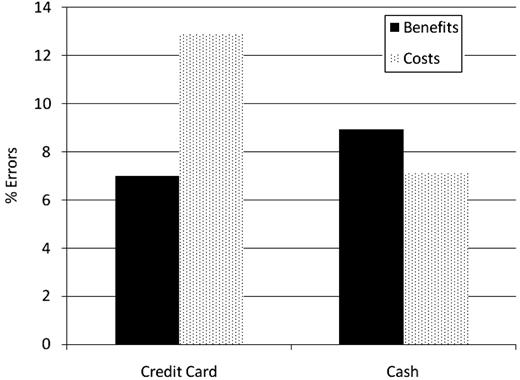
Abstract. Do payment mechanisms change the way consumers perceive products? We argue that consumers for whom credit cards (cash) have been primed focus mor
Keeping Cash and Revolving Debt: How Consumers' Preference for Spending on Debit versus Credit Influences their Decision to Co-Hold
This paper investigates "co-holding'"–whereby consumers simultaneously maintain low-yield liquid assets and high-interest revolving debt–through the l
Disclosing the costs of co-holding liquid assets and high-interest debt has limited impact on behavior
Why do consumers simultaneously maintain low-yield liquid assets and high-interest revolving debt? This behavior, known as "co-holding," affects 23% o
The Quiet Rewiring of American Finance
Stablecoins, Treasury markets, and the most significant shift in financial infrastructure that almost nobody is discussing.

The Effect of Payment Transparency on Consumption: Quasi-Experiments from the Field
Recent research suggests that the method of making a payment can influence the willingness to pay and consumption behavior. In this manuscript, we argue that payment mechanisms differ from each other along the dimensions of transparency, and that the degree of transparency correlates positively with the pain of paying using the mechanism, and negatively with consumption and spending. We replicate previous experimental results using quasi-experiments from the field, and find that the lower the payment transparency, the greater is the consumption. However, this effect is weak for products whose consumption rates are inflexible.