

FindAll turns natural-language queries into custom datasets from the web, finding and enriching entities with citations and 3x better recall than competitors.
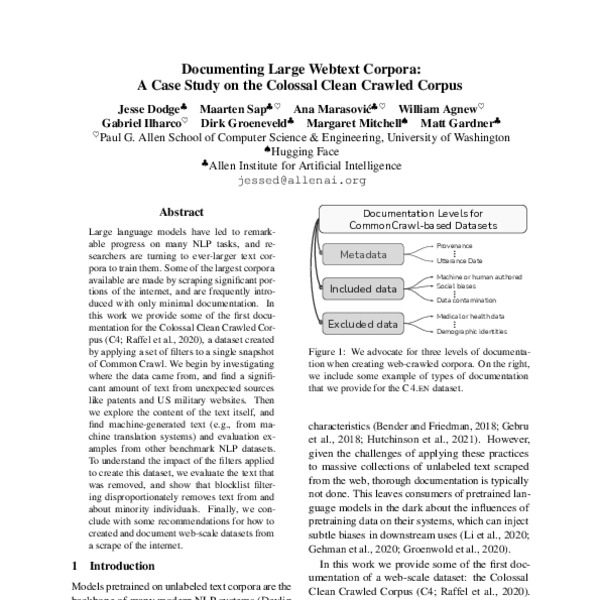
Documenting Large Webtext Corpora: A Case Study on the Colossal Clean Crawled Corpus
Large language models have led to remarkable progress on many NLP tasks, and researchers are turning to ever-larger text corpora to train them. Some of the largest corpora available are made by scraping significant portions of the internet, and are frequently introduced with only minimal documentation. In this work we provide some of the first documentation for the Colossal Clean Crawled Corpus (C4; Raffel et al., 2020), a dataset created by applying a set of filters to a single snapshot of Common Crawl. We begin by investigating where the data came from, and find a significant amount of text from unexpected sources like patents and US military websites. Then we explore the content of the text itself, and find machine-generated text (e.g., from machine translation systems) and evaluation examples from other benchmark NLP datasets. To understand the impact of the filters applied to create this dataset, we evaluate the text that was removed, and show that blocklist filtering disproportionately removes text from and about minority individuals. Finally, we conclude with some recommendations for how to created and document web-scale datasets from a scrape of the internet.
Orrery, a Knowledge Graph That Adapts to Its Corpus
Orrery is our open-source knowledge graph that gets deeper as you feed it: domains that hit critical mass earn their own custom extraction specs, agents get an API, and humans get a galaxy. The whole …

Curated retrieval versus open web search in public AI information...
Public institutions increasingly use large language models (LLMs) to answer citizens' questions, often pairing a curated knowledge base with live web search, yet whether the sources behind these...

AutoSchemaKG: Autonomous Knowledge Graph Construction through Dynamic Schema Induction from Web-Scale Corpora
In the current era of information abundance, transforming vast amounts of unstructured data into structured, machine-readable knowledge remains one of the most significant challenges in artificial intelligence. Knowledge Graphs (KGs) have emerged as the cornerstone technology for this transformation Zhao et al. (2024), providing the semantic backbone for applications ranging from search engines and question answering Wu et al. (2024); Chen et al. (2024c); Zong et al. (2024); Sun et al. (2024b) to recommendation systems Lyu et al. (2024) and complex reasoning tasks Li et al. (2024b). Yet despite their critical importance, current KG construction approaches remain hampered by an inherent paradox: they require predefined schemas created by domain experts, which fundamentally limits their scalability, adaptability, and domain coverage.
ChatGPT Gets Its “Wolfram Superpowers”!
Wolfram plugin gives computationally accurate answers to ChatGPT queries using Wolfram's data knowledgebase and language. Custom visualizations are given as well. Stephen Wolfram explains how it works.

WDC - RDFa, Microdata, and Microformat Data Sets
More and more websites have started to embed structured data describing products, people, organizations, places, and events into their HTML pages using markup standards such as Microdata, JSON-LD, RDFa, and Microformats. The Web Data Commons project extracts this data from several billion web pages. So far the project provides 12 different data set releases extracted from the Common Crawls 2010 to 2023. The project provides the extracted data for download and publishes statistics about the deployment of the different formats.
Wikidata
the free knowledge base with 120,900,955 data entities that anyone can edit.
Self-Driving Datasets: From 20 Million Papers to Nuanced Biomedical Knowledge at Scale
Manually curated biomedical repositories -- spanning bioactivity, genomics, and chemistry -- are expensive to maintain, lag behind primary literature, and discard experimental context, obscuring nuances needed to assess data correctness and coverage. We show that PubMed itself can be autonomously and cost-effectively turned into structured datasets that are larger, more nuanced, and more accurate than the curated databases they replace. We present three coupled contributions: (1) an LLM-based entity-tagging pipeline, grounded in nine biomedical ontologies, that tags 4.5B entities across 19 categories in a 22.5M-paper, 2.5T-token PubMed corpus; (2) hybrid sparse-dense retrieval supporting entity-filtered semantic queries over the tagged corpus; and (3) Starling, a multi-agent deep research system that, given only a natural-language task description, designs precision- and recall-targeted retrieval filters, induces an extraction schema, and emits structured records with nuance-rich fields and supporting passages. Across six tasks -- blood-brain barrier permeability, oral bioavailability, acute toxicity (LD50), gene-disease associations, protein subcellular localization, and chemical reactions -- Starling produces ~6.3M records (91K-3M per task); several are, to our knowledge, the largest public datasets for their property. Frontier-model rejection of our extractions is 0.6-7.7% across tasks, far below error rates we measure on widely used curated counterparts (e.g., 16.5% on BBB_Martins, 7.3% on Bioavailability_Ma). Beyond scale and accuracy, the supporting passages carry nuance tabular databases discard -- e.g., oral bioavailability may depend on fed vs. fasted state. Together, the corpus, retrieval, and agent establish a foundation for AI-driven therapeutic design. Code and datasets: https://github.com/starling-labs/starling.
Datacurve | The data engine for frontier AI
Custom data for long-horizon reasoning, software engineering, and data science.
InsightEval: An Expert-Curated Benchmark for Assessing Insight Discovery in LLM-Driven Data Agents
Data analysis has become an indispensable part of scientific research. To discover the latent knowledge and insights hidden within massive datasets, we need to perform deep exploratory analysis to realize their full value. With the advent of large language models (LLMs) and multi-agent systems, more and more researchers are making use of these technologies for insight discovery. However, there are few benchmarks for evaluating insight discovery capabilities. As one of the most comprehensive existing frameworks, InsightBench also suffers from many critical flaws: format inconsistencies, poorly conceived objectives, and redundant insights. These issues may significantly affect the quality of data and the evaluation of agents. To address these issues, we thoroughly investigate shortcomings in InsightBench and propose essential criteria for a high-quality insight benchmark. Regarding this, we develop a data-curation pipeline to construct a new dataset named InsightEval. We further introduce a novel metric to measure the exploratory performance of agents. Through extensive experiments on InsightEval, we highlight prevailing challenges in automated insight discovery and raise some key findings to guide future research in this promising direction.
DASL — Data-Addressed Structures & Links
A small set of simple, standard primitives to work on content-addressed data.

DASL — Data-Addressed Structures & Links
A small set of simple, standard primitives to work on content-addressed data.
Websets | People Search, AI SDR & B2B Lead Generation
Use Websets for people search, AI SDR discovery, lead generation, and B2B marketing. Explore sales automation tools and AI research tools in one place.
Finding real, quotable examples is key to my blog writing workflow. Because Google and the default web search produce a lot of junk, I use Exa, HackerNews, web search, what I've already written, and internal company docs to do this, and I recently added @semble.so to this stack.
