

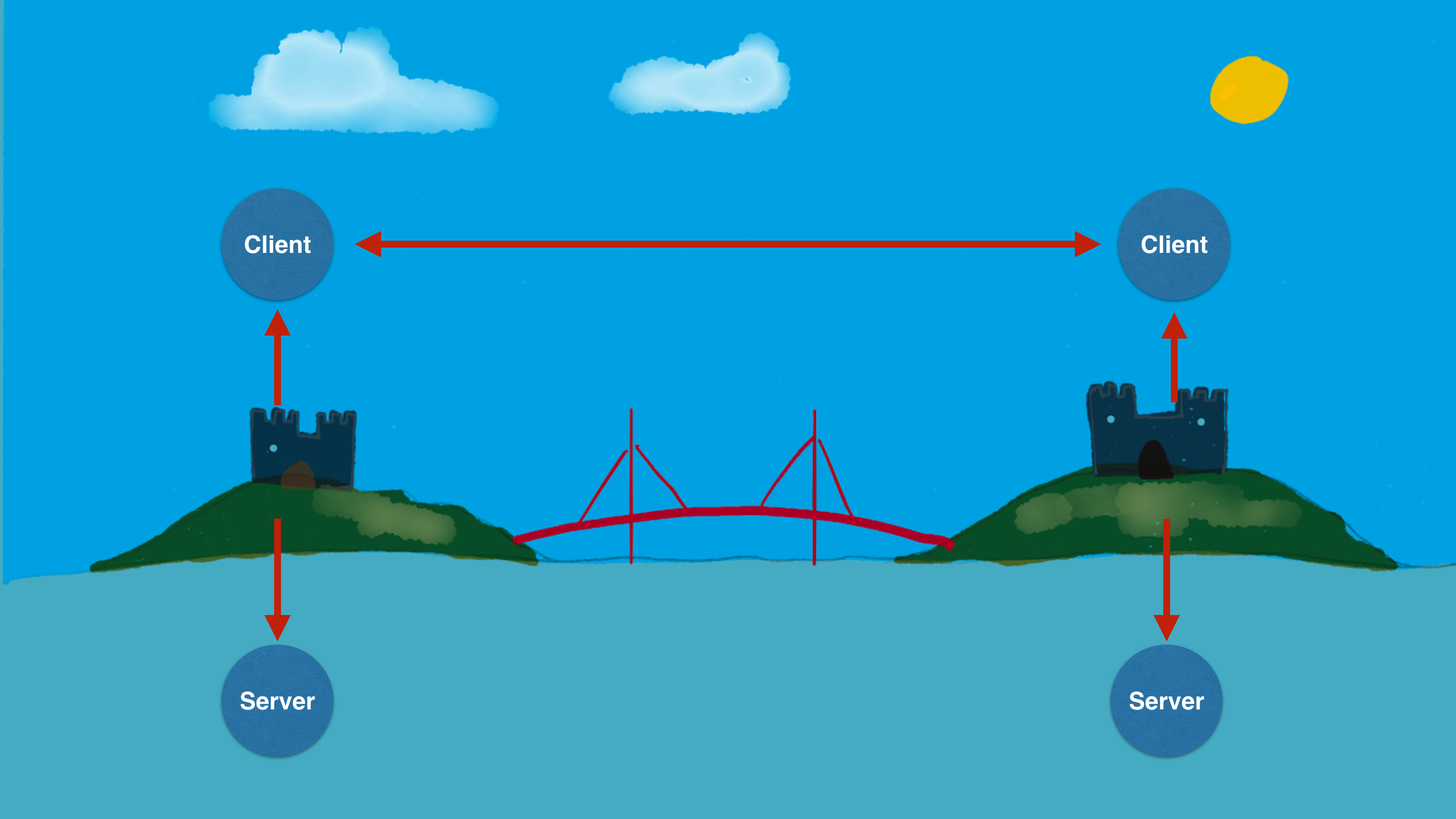
I've always been fascinated by the potential of the web as an API, an idea I first encountered through Michael Mahemoff's work with microformats and CORS. While technologies like Web Intents explored similar concepts, they proved more complex. The core idea remains powerful: enabling direct client-side interaction between websites to bypass the complexities of server-side integrations. Although CORS is widely supported, its complexity hinders adoption. With the rise of client-side generated sites, the need for decentralized integration is stronger than ever. Tools like Comlink, by abstracting the complexities of postMessage and MessageChannel, make it easier to expose and consume client-side APIs. I demonstrated this with a simple example integrating a pubsubhubbub endpoint with a push notification service. This approach offers several advantages, including simplified data transfer, offline capabilities, and secure, controlled exposure of functionality. Looking ahead, I envision a future where every website exposes a consistent, discoverable API, enabling a more interconnected and modular web experience.
RSSCloud Vs. PubSubHubbub: Why The Fat Pings Win | TechCrunch
Editor's note: With all of the debate lately between RSSCloud versus PubSubHubbub, we wanted to hear from a developer who could actually tell us which one might be better and why. The following guest post is written by Josh Fraser, the co-founder of EventVue, who is an active contributor to PubSubHubbub in his free time. He has contributed several client libraries for PubSubHubbub including a WordPress plugin. Guess which side of the debate he falls on. In the past few months, a lot of attention has been given to the rise of the real-time web. The problem is that the web wasn't designed with real-time in mind. There is a huge need for the tech community to get behind new protocols that will power this fundamental shift in how web applications work. Today I want to take a look at two of the leading protocols that enable real-time notifications on the web. While there are older protocols that enable real-time notifications like XEP-0060, PubSubHubbub (PuSH) and rssCloud are two new protocols which show a lot of promise of gaining adoption. Both PuSH and rssCloud address a fundamental flaw in the way web applications work today. Currently, getting updates on the web requires constant polling. Subscribers are forced to act like nagging children asking, "Are we there yet?" Subscribers must constantly ping the publisher to ask if there are new updates even if the answer is "no" 99% of the time. This is terribly inefficient, wastes resources, and makes it incredibly hard to find new content in as soon as it appears. Both protocols flip the current model on its head so that updates are event driven rather than request driven. By that I mean that both protocols eliminate the need for polling by essentially telling subscribers, "Don't ask us if there's anything new. We'll tell you." But if you find yourself confused about how they are different, you're not alone.
elements
As much as I struggle with on-device processing and the quality of its output compared to server models, I am excited by some of the APIs that are being built into browsers that are backed by LLMs and other AI inference models. For example, the prompt API, along with a multi-modal version that can take any arbitrary combination of text, image, and audio and run prompts against them. These APIs are neat but not yet web-exposed and many developers struggle to know what to do with a generic prompt. It’s not a solution that is natural to many people yet.

These 20 Awesome API Clients Will Change How You Work with APIs
Postman has become a staple in API development, but it’s far from the only option. As the API...

ActivityPub Client API: A Way Forward | Steve Bate
The ActivityPub Client-to-Server (C2S) protocol was envisioned as a cornerstone of the decentralized social web, along with the Server-to-Server (S2S) protocol. Standardized by the W3C in 2018, C2S defines how user-facing applications, such as mobile apps or web clients, and bots should interact with social servers using Activity Streams 2.0 and JSON-LD. In theory, it ... Read more

</> htmx ~ Hypermedia APIs vs. Data APIs
In this essay, Carson Gross explores the fundamental differences between hypermedia APIs and data APIs, He explains how hypermedia APIs, which return HTML over HTTP, can embrace frequent changes due to their self-describing nature, while data APIs require more stability and versioning to avoid breaking client code. Carson argues that these distinct characteristics should inform different design approaches for each type of API.
Generic Event Delivery Using HTTP Push
This document describes a simple protocol for the delivery of real- time events to user agents. This scheme uses HTTP/2 server push.

NEAR Intents | Simplifying Web3 Interactions
NEAR Intents let users and AI agents define what they want to do—NEAR handles the rest. A new framework for seamless, multichain execution without complexity, powered by solvers and Chain Signatures.

Sending Information to Servers | Web Browser Engineering
So far, our browser has seen the web as read-only—but when you post on Facebook, fill out a survey, or search Google, you’re sending information to servers as well as receiving information from them. In this chapter, we’ll start to transform our browser into a platform for web applications by building out support for HTML forms, the simplest way for a browser to send information to a server.
OAuth API - Home
The Apigee OAuth API gives you a keychain for authenticating to Twitter, Salesforce, Salesforce Chatter, Facebook, Flickr, and Foursquare. Thousands of developers complain about the complexity of using OAuth. Now you can easily authenticate in one consistent way across several APIs and build apps faster.
Stop Ignoring the Browser: The Biggest Frontend Shift in a Decade
Native browser APIs now provide powerful alternatives for routing, state management, and components. Never mind the frameworks, use the browser.

Web dev is fun again with ATproto · Web Dev Challenge S3.E4
Why Executive Interest In APIs Is Booming
A decade ago, API awareness was limited, with evangelists educating a mostly unaware C-suite. Today, APIs are integral to business, widely embraced by executives and developers alike, reflecting a significant shift in digital transformation strategies.

Progressive Enhancement with the WordPress REST API – Pre-Thought Listen
In a REST API discussion today, we discussed the future of the REST API. Something I touched upon briefly in that meeting is the concept of progressive enhancement with the REST API. Since this topic hasn’t been brought up much previously, I want to elaborate on how progressive enhancement works.
Why I created @skysquare.app—and why I believe the web needs it. "Decentralized protocols represent more than a technical innovation. They offer the possibility that public conversation might once again become part of the commons rather than the exclusive property of any single platform."

Why Skysquare Exists
skysquare.app
