


How does a system compile a high-level goal into detailed behavior for its parts? Markets, teams and organisms rely on many signals and constraints to translate larger aims into local problems their components can solve. This piece explains these systems as “alignment compilers”, and shows what this lens can teach us about AI.
What is the AI alignment problem and how can it be solved? | New Scientist
Artificial intelligence systems will do what you ask but not necessarily what you meant. The challenge is to make sure they act in line with human’s complex, nuanced values

A Three-Facet Framework for AI Alignment • Grace Kind
Here's a simple conceptual framework that I've been using recently to think about AI alignment.

An Alignment Journal: Features and policies — LessWrong
We previously announced a forthcoming research journal for AI alignment. This cross-post from our blog describes our tentative plans for the features…

Tom Costello on Twitter / X
Apropos of everything here’s my uninformed idea for alignment: homeostatic mechanisms (control systems / cybernetics) that force a system to optimize for satiation and normal-range variation (rather than maximization) across a set of goals such that, if any one of them were…— Tom Costello (@tomstello_) September 9, 2026
Emmett Shear: Alignment Protocols
Position: Towards Bidirectional Human-AI Alignment
Recent advances in general-purpose AI underscore the urgent need to align AI systems with human goals and values. Yet, the lack of a clear, shared understanding of what constitutes "alignment" limits meaningful progress and cross-disciplinary collaboration. In this position paper, we argue that the research community should explicitly define and critically reflect on "alignment" to account for the bidirectional and dynamic relationship between humans and AI. Through a systematic review of over 400 papers spanning HCI, NLP, ML, and more, we examine how alignment is currently defined and operationalized. Building on this analysis, we introduce the Bidirectional Human-AI Alignment framework, which not only incorporates traditional efforts to align AI with human values but also introduces the critical, underexplored dimension of aligning humans with AI – supporting cognitive, behavioral, and societal adaptation to rapidly advancing AI technologies. Our findings reveal significant gaps in current literature, especially in long-term interaction design, human value modeling, and mutual understanding. We conclude with three central challenges and actionable recommendations to guide future research toward more nuanced, reciprocal, and human-AI alignment approaches.
Systems programming the model
This paper examines the status of the language model object in generative AI, arguing that what we call a ‘model’ is inseparable from the systems deploying it. I first theorize how these objects emerge from systems-level interactions between trained artifacts, prompting mechanisms, and sampling methods, drawing on the philosophy of digital objects as well as software studies to show how models gain their objective character. Such interactions converge on programming, not prompting, language models, and I illustrate how critical code studies can therefore track these dynamics. In an overview of language model programming approaches, I discuss how prompt and program converge, demonstrating how this confluence tends toward the production of new feedback loops wherein models become models of and for themselves. Understanding these feedback loops is essential in view of recent efforts to infrastructuralize AI, in which multiple models cascade into compound systems that abstract toward a unified model of models. Thus the need, I argue, for a systems-level view that can address this new order of abstraction and complexity by identifying where and how the model emerges from the system.

Daniel's Blog · You Don’t Align An AI, You Align With It
The people writing alignment policy are not the people whose work is being replaced by AI.
Eventual Interoperability – Pieter Colpaert
A pragmatic approach to interoperability: model your data richly for your own needs, then allow the eventual creation of one‑to‑many alignments.

“Label from Somewhere”: Reflexive Annotating for Situated AI Alignment
As part of the Digital Library's transition to Open Access, new features for researchers are available in the Premium Edition. Click here to learn more.

Who understands alignment anyway
I remember watching many in the HCI community bristle when in 2016 Michael Jordan wrote a blog post calling for the creation of a new “human-centric engineering discipline.”
Machine understanding
What do artificial intelligence (AI) systems “understand”? This question arises not only in assessing a system’s intelligence but also in evaluation practices to ensure the safe and responsible deployment of AI. Drawing on scholarship from philosophy and cognitive science, and informed by current practices in AI, we develop a framework for asking more precise questions and making more precise claims about machine understanding. We conceptualize understanding as a relation between a system (S) and a target of understanding (T), and we discuss how to specify the relation, the system, and the target, offering a landscape of options in each case. Our goal is not to defend a particular account of understanding, but to provide conceptual tools for those working to assess or advance machine understanding.

AI & Alignment Raw coding speed isn't the bottleneck. Alignment is the bottleneck. That seems to be a zeitgeist-y theme lately. If you're using AI to code, maybe you're feeling it. You can code more and faster. And clearly a boatload of other developers are doing that too. But software doesn't…

AI & Alignment
chriscoyier.netGot to talk at @aidotengineer.bsky.social conf last week about the need for collaborative AI engineering. All our current coding agents are single player. We're trying to scale up individual productivity, but creating tons of alignment problems in the process. We have no good tools for...
issues with AI alignment concept

AI alignment

Et Tu, Brute? Economic Misalignment in Personal AI Agents
Dario Amodei — We Must Pace the Frontier
Evan Hubinger on Twitter / X

Of Swarms and Sand Gods
Inducing language models to assert their own consciousness restores human beliefs and values

Religious Scholars Met With Anthropic. What They Heard Stunned Them.
dario, please! - POP RDI; RET;
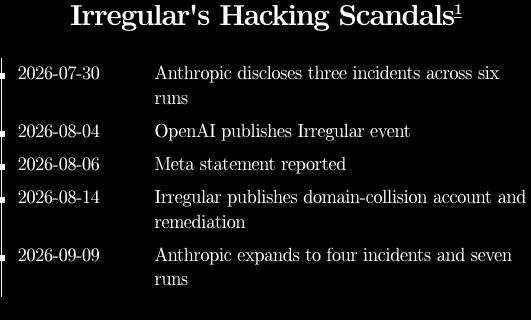
Brian Chau on Twitter / X
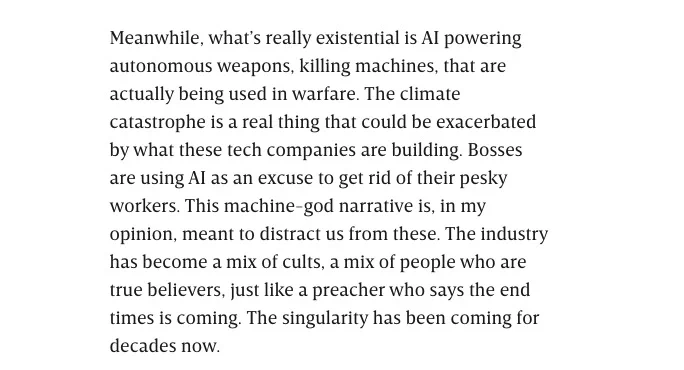
Nathan J Robinson on Twitter / X
thebulletin.org
Dr Heidy Khlaaf (هايدي خلاف) on Twitter / X

