Think better. Grow your audience. Accelerate your career.
Writing Is Thinking
When you write about your work, it makes all of us smarter for the effort, including you. Done well, this kind of sharing means you’re contributing signal, instead of noise. But writers are made, n…

On Writing #3
Periodically I like to gather various observations about writing, and share my perspective.

if you've never written an essay for fun, you're making yourself dumber
How I draft stories
I discovered that trying to write one big blob does not work for me. I can get as far as 2000 words before the volume overwhelms. As with many things in life, breaking it down into pieces helps a lot! This is where most outlining writers suggest a big bulleted
Brian D. Earp, Ph.D. on Twitter / X
"Writing is thinking." This phrase went viral recently (from https://t.co/EQqohfhUMd), often quoted in the context of objections to use of AI in drafting academic prose. In Nature Reviews Bioengineering we respond: "Thinking is not only writing." Preview below. Shareable full… pic.twitter.com/cZtGdoSwqV— Brian D. Earp, Ph.D. (@briandavidearp) May 15, 2026
From bench to bot: Why AI-powered writing may not deliver on its promise
Efficiency isn’t everything. The cognitive work of struggling with prose may be a crucial part of what drives scientific progress.

“Better note-taking” misses the point; what matters is “better thinking”
Lots of people write about solutions to the problem that Note-writing practices are generally ineffective .NoteLink.Active { background-color: rgba(10, 132, 255, 0.15); } . The vast majority of that writing fixates on a myopic, “lifehacking”-type frame, focused on answering questions like: “how should I organize my notes?”, “what kind of journal should I use?”, “how can I make it easy to capture snippets of things I read?”, etc.
Writing by Hand is Good for your Brain - Here's how to do it
Because I am known to write using a fountain pen on paper, a number of people have pointed me to this post and its underlying research. I won’t rehash what is said in those sources, but the gist of it is that when you write things down by hand you’re recruiting more of your brain, which is a good thing.
The revolt of the reader | The Observation Deck
Reading is important to me. While I’m not a quick reader nor an especially voracious one, I have found that long-form reading has had a profound influence on me over my life. And because reading is important to me, writing is too: writing not only allows us to convey our ideas, but the very act forces us to test and distill them — at once making our ideas more robust while providing the vehicle by which to share them.
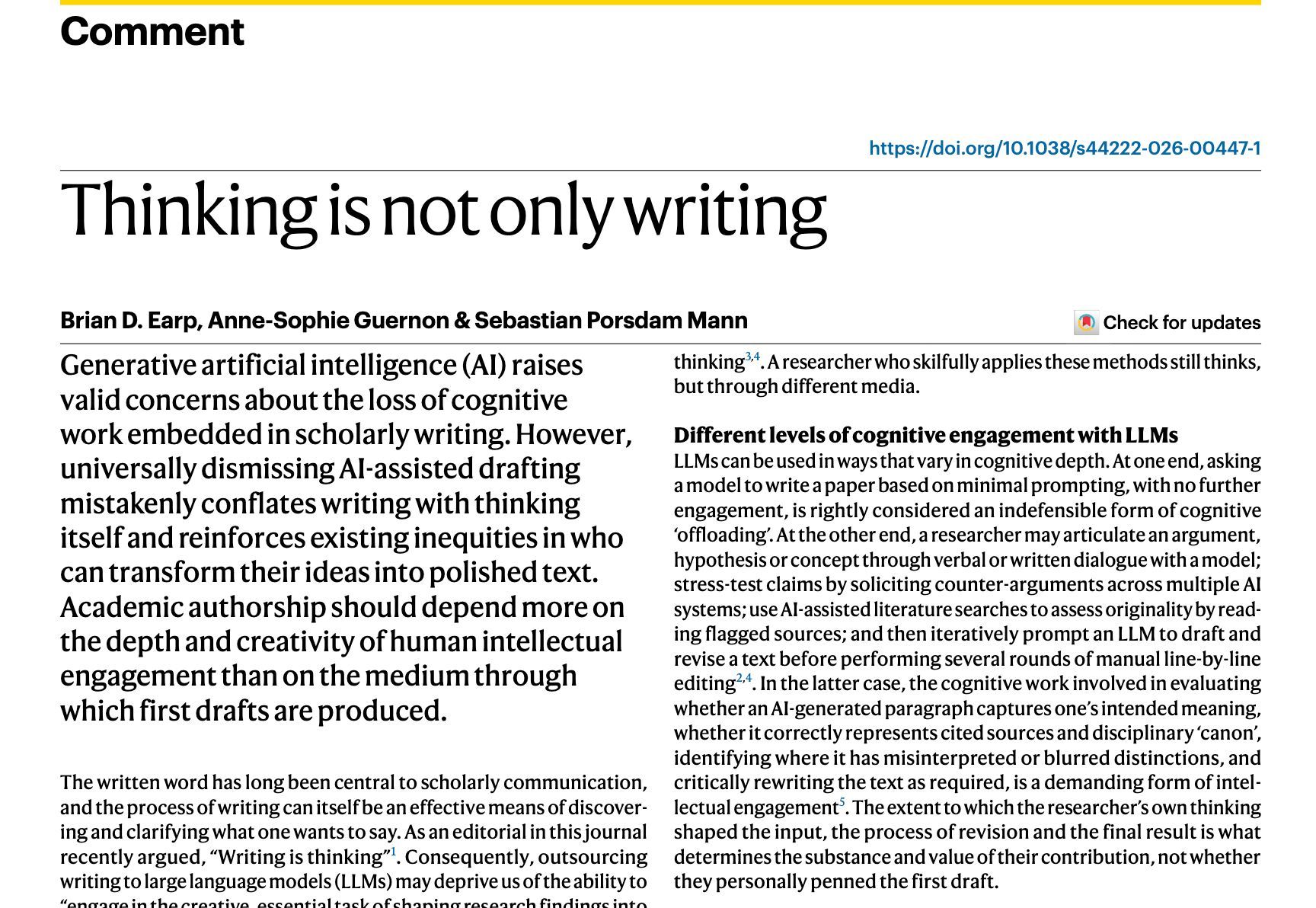
Thinking is not only writing
Generative artificial intelligence (AI) raises valid concerns about the loss of cognitive work embedded in scholarly writing. However, universally dismissing AI-assisted drafting mistakenly conflates writing with thinking itself and reinforces existing inequities in who can transform their ideas into polished text. Academic authorship should depend more on the depth and creativity of human intellectual engagement than on the medium through which first drafts are produced.

The best writing advice I’ve ever read comes from Robert Frost.
I write prose, not poetry, but the most helpful piece of advice I’ve ever read was written by a poet: Robert Frost, who was born 147 years ago today. In the second, expanded edition of his Co…

A.I. Is Homogenizing Our Thoughts
Recent studies suggest that tools such as ChatGPT make our brains less active and our writing less original.

How to write well with AI
Why people who pledge never to write with AI are telling on themselves