


Perma.cc helps scholars, journals, courts, and others create permanent records of the web sources they cite.
Steal the Internet - Archiving Everything and Sharing It With Others
2014: 70% of the links within legal journals and 50% of the URLs from Supreme Court decisions did not contain the originally cited material.
Declare and resolve website links for at:// URIs. A demo of the me.byjp.atproto.deeplink lexicons.
permadeath.com/substandard
Browser extension: detect and subscribe to standard.site publications on ATProto
On Link Rot
The web suffers from link rot: hyperlinks that were valid upon creation will often point into nothingness after some time has passed. Within the framework of the web, the typical solution is to link to a snapshot of the original page, hosted on archive.org.
On Link Rot
The web suffers from link rot: hyperlinks that were valid upon creation will often point into nothingness after some time has passed. Within the framework of the web, the typical solution is to link to a snapshot of the original page, hosted on archive.org.
What the ephemerality of the Web means for your hyperlinks
Hyperlinks are a powerful tool for journalists and their readers. Diving deep into the context of an article is just a click away. But hyperlinks are a double-edged sword; for all of the internet’s boundlessness, what’s found on the Web can also be modified, moved, or entirely vanished. The fragility of the Web poses an […]

Two billion citation links in Crossref help research travel further - Crossref
We’ve recently reached an important milestone for the research nexus: the works in our metadata corpus are now connected with over 2 billion citation links! This is a great opportunity to share a dedicated dataset and discuss why these are important for science.

Mapping web pages to canonical AT records
I’d like to use this thread to riff on a community practice of mapping web pages to their canonical AT record. This is something that standard.site already does as a way to verify publications and their documents using <link> tags. Unfortunately Rich Harris pointed out that this isn’t technically valid, so there is discussion for a breaking change for standard site to use the <meta> tag. Making this work with any lexicon/record has quite important ramifications for the entire ecosystem (I’m writ...

Mapping web pages to canonical AT records
I’d like to use this thread to riff on a community practice of mapping web pages to their canonical AT record. This is something that standard.site already does as a way to verify publications and their documents using <link> tags. Unfortunately Rich Harris pointed out that this isn’t technically valid, so there is discussion for a breaking change for standard site to use the <meta> tag. Making this work with any lexicon/record has quite important ramifications for the entire ecosystem (I’m writ...


Jared Goering on Twitter / X
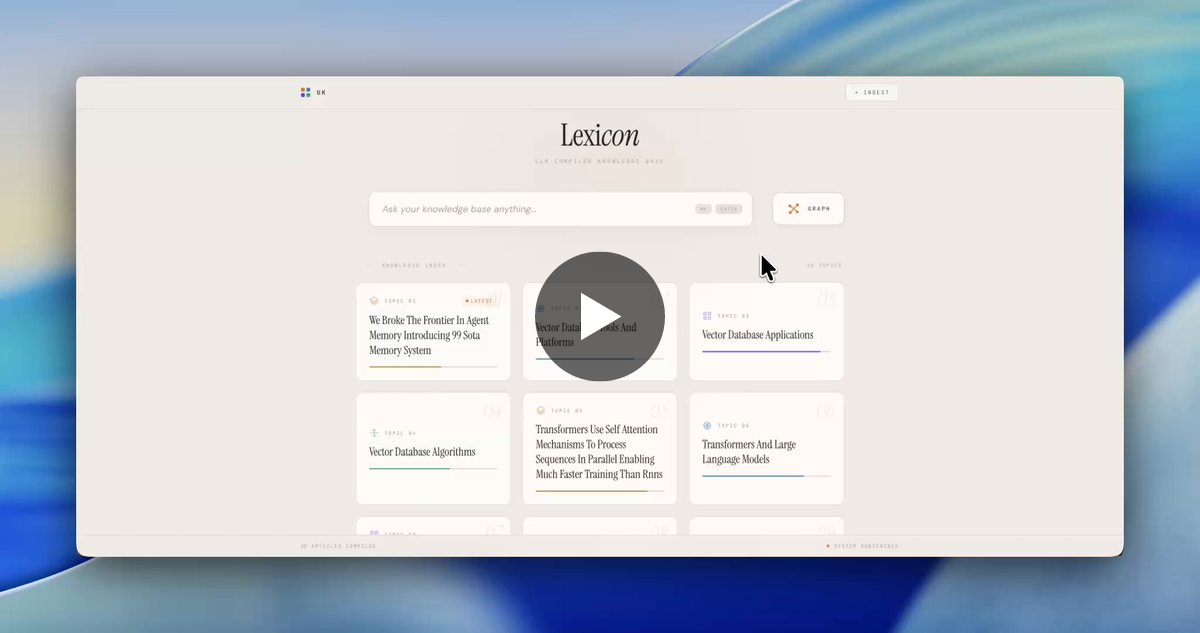
Saw this and immediately built it. Open-sourced the whole thing:Ingest URLs, PDFs, tweets, images → LLM compiles a linked markdown wiki → Q&A with citations, knowledge graph, contradiction linting, auto-research, export to HTML/PDF/slides.Been using it nonstop as a personal… https://t.co/ypaXlEA7pn pic.twitter.com/8Z2DLAyQjH— Jared Goering (@jaredgoering) April 4, 2026
Re-Decentralizing the Web, For Good This Time
Refer to this chapter in your work through its URL or by using this BibTeX fragment.
@standard.site profile record, used to build a Linktree™-type web page for every author 🤔 Is this anything?
