

Wirth's law is Niklaus Wirth's variant of the Jevons paradox: Software is getting slower more rapidly than hardware is getting faster.
Slow Software
What it means for software to be fast, and why most software is not.
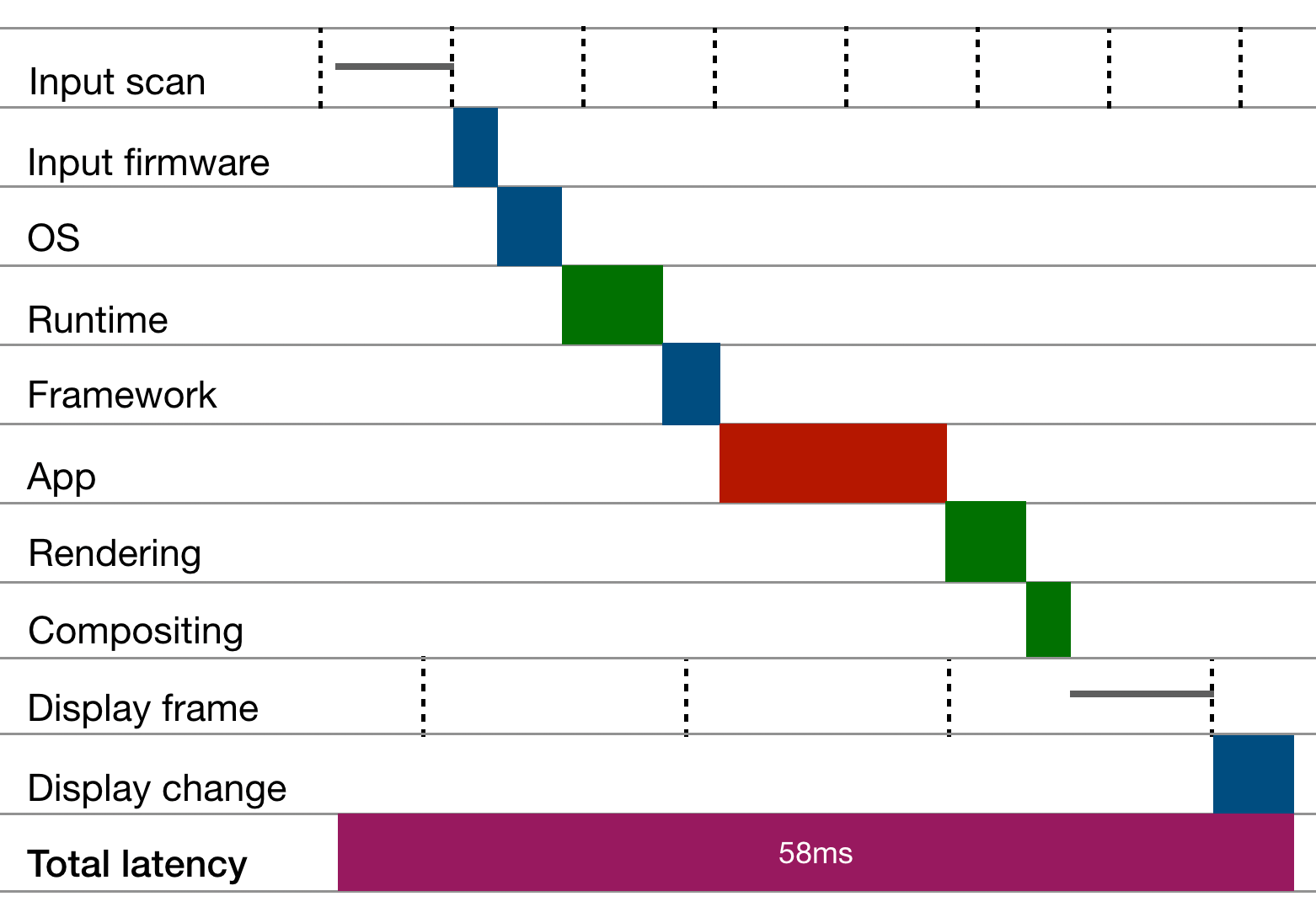
There's no reason for software to be slow anymore
The other day, I saw a viral tweet saying that people talking about how LLMs are causing slow, bloated, code are going to eat crow once they re-write everything in super-optimized assembly. We're not quite at the point where we want to write everything in assembly, but some variant of what Nolan Lawson said about testing, you can choose how many bugs you want now, which I less eloquently noted here, is becoming more true for performance.
🐌 Slow Software for a Burning World 🔥
In a world of “move fast and break things,” we’ve chosen a different tempo — one rooted in care, deep listening, and collective stewardship. Slow software means building for long-term resilience and meaningful participation, rather than chasing novelty, speed, or scale.
Speed Comparison - Programming Languages
Benchmarks run on GitHub Actions. Results may vary based on runner hardware.
Software Acceleration and Desynchronization
A look at the ever-present drive to make software delivery faster and how it might break down various activity loops in organizations.

There continue to be reasons for software to be slow
A discussion on the various reasons why performance is slow, and which ones are unlikely to be affected by LLMs. Originally written as a counter-point to Dan Luu
Why Computing Won't Be Limited By Moore's Law. Ever
Silicon-based computing is reaching its limits. But a new technology that emulates the way our brains process information could sidestep those in a clever and profoundly important way.
Jevons paradox
The Jevons paradox or Jevons effect is an economic phenomenon said to occur when technological improvements that increase the efficiency of a resource's use lead to a rise, rather than a fall, in total consumption of that resource. Greater efficiency reduces the amount of the resource needed per application, lowering its effective cost; if demand is sufficiently price elastic, this induces demand, frequently resulting in a net increase of total resource consumption.

The Software We Haven’t Invented Yet, discussion and dinner hosted by Boxd and BlueYard · Luma
If this is such a big moment for software, why are we mostly imagining faster versions of what we already do? Better coding tools are the obvious part. The…
Jevons paradox
In economics, the Jevons paradox, or Jevons effect, is said to occur when technological improvements that increase the efficiency of a resource's use lead to a rise, rather than a fall, in total consumption of that resource. Greater efficiency reduces the amount of the resource needed per application, lowering its effective cost; if demand is sufficiently price elastic, this induces demand, frequently resulting in a net increase of total resource consumption.

be diligent
For individuals It's challenging to work a process when it moves slower than feels appropriate. In the context of computer conversations, the tactic of s...

The future of software In the limit, software won't mean anything anymore. But in the interim period we'll wander through an increasingly odd "in-between" age for software. This… | Thomas Wolf | 63 comments
The future of software In the limit, software won't mean anything anymore. But in the interim period we'll wander through an increasingly odd "in-between" age for software. This transition period will be defined by three new precepts. Everflux software - instead of stepping from release to release, software now evolves continuously. Software creation has broken the sound barrier of our own keystrokes, and every model release pushes it faster. There is no reason to wait weeks or months for the next release when a single company merges over 30,000 code changes a day. Bug and vulnerability fixes need to ship quickly and continuously. And every piece of software sits in a lattice of dependencies, each one now shipping at a blistering pace. Translucent sources – A new territory has opened between open source and closed source. Today Claude will happily pick apart any Electron app, and any binary shipped with debug symbols has become a reverse-engineering playground for LLMs. In other words, much so-called closed-source software is now open source in all but name, and keeping code closed makes less and less sense. Even the notion of IP and copyright is breaking in software. I'm writing this text on a personal text editor I prompted Claude to vibe-code from a few videos of people demoing editor features they liked. A mere description of the interface is increasingly enough for an LLM to rebuild the internals. Software IP seems to be dissolving like cotton candy in a raccoon's paws. Bespoke features - Now that all software is open source, nothing prevents us from modifying everything. And personalization is just one prompt and a couple million tokens away, so there is absolutely no reason anymore to wait for someone else to add this feature you want. Everyone becomes their own product manager. Want a search box, an API bridge, a custom button? It's a couple of minutes away. A major challenge appears when bespoke features crash into our first tenet: everflux software. I could fork it for good to add my search box, but I'd lose all future benefit from the software creator. How do you personalize software that was never meant to be personalized, without shouldering all of its future maintenance? Merge conflicts won't be the exception anymore; they'll be a constant of everflux software. Agents will rebase our personal features onto each new release overnight, and software will look less like a product and more like a living species, evolving through constant mutation. Substack post: https://lnkd.in/dw2Re-kA Image: M.C. Escher, Metamorphosis II, November 1939 - March 1940 | 63 comments on LinkedIn

The $70B Open Source Software Paradox
It’s no news that over the last 10-15 years, particularly noticeable in the last 5 years, the enterprise software industry has gradually transformed from complex, expensive, closed-source (proprietary) software stacks to extensible/configurable,...

Slow down to speed up: so much has changed in 6 months’ time
An overview of what’s changed in engineering during the last six months, how various tech companies are changing how they work, and why slowing down could be a sensible strategy
Legendary Productivity And The Fear Of Modern Programming | TechCrunch
JavaScript master Douglas Crockford once said that software is the most complex thing that humans have ever created. It’s made up of intricate bits and bytes pieced together like virtual puzzles. The greatest programming minds are capable of using software to multiply massive integers that are bigger than the universe.

