

Lifespan maximization is the extension of hardware lifespan by the users. It may be supported by planned longevity from the manufacturer's side, but it rarely is.
planned longevity
Planned longevity is the opposite of planned obsolescence: the way of designing systems, especially hardware, so that it supports lifespan maximization.
planned obsolescence
Planned obsolescence is a capitalist strategy where companies design and produce things with a limited useful lifespan — on purpose. The intention is to encourage new purchases, when none would be necessary. This tactic emerged in the early 20th century and has become common across all industries and especially in electronics, fashion, and home appliances. Companies implement obsolescence through various approaches.
obsolescence
Obsolescence takes place when something is no longer maintained or required, even if it could still be usable. Planned obsolescence takes place when obsolescence is actively designed and initiated by the manufacturer/maintainer.
The Multiple Paths to Multiple Life
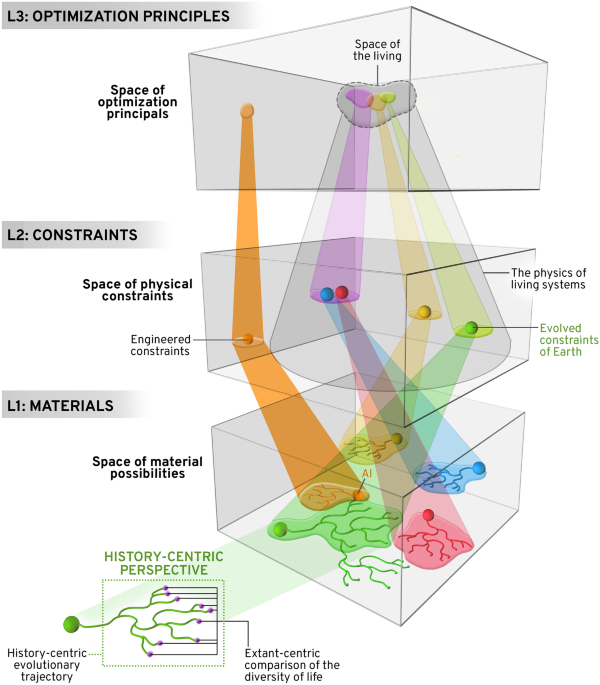
We argue for multiple forms of life realized through multiple different historical pathways. From this perspective, there have been multiple origins of life on Earth—life is not a universal homology. By broadening the class of originations, we significantly expand the data set for searching for life. Through a computational analogy, the origin of life describes both the origin of hardware (physical substrate) and software (evolved function). Like all information-processing systems, adaptive systems possess a nested hierarchy of levels, a level of function optimization (e.g., fitness maximization), a level of constraints (e.g., energy requirements), and a level of materials (e.g., DNA or RNA genome and cells). The functions essential to life are realized by different substrates with different efficiencies. The functional level allows us to identify multiple origins of life by searching for key principles of optimization in different material form, including the prebiotic origin of proto-cells, the emergence of culture, economic, and legal institutions, and the reproduction of software agents.
maximalism
Maximalism is, generally speaking, the idea that more is better. It often incorporates the idea that qualitative improvements are dependent on quantitative increases – that "progress" is not even possible without quantitative growth. Maximalism is prominent in many areas of modern technological civilization but is particularly so in computing, thanks to Moore's law.
Wirth's law
Wirth's law is Niklaus Wirth's variant of the Jevons paradox: Software is getting slower more rapidly than hardware is getting faster.
» The Life and Times of Maxis, Part 3: The Sims The Digital Antiquarian
I don’t think people realize how much tactical and strategic forethought goes into their daily lives. There’s a whole subconscious time-efficiency layer in our lives. In essence, real-time strategy is our lives.
Permacomputing
Permacomputing is a computing design philosophy which aims to improve resilience by using regenerative design in computer and network technology. It is inspired by permaculture.[1] Permacomputing approaches to computing often involve paying more attention to the life-cycle of hardware (including re-use and designing for older hardware),[1] using low-level languages such as FORTH that have greater operability with older hardware, and fostering a more mindful relationship with technology.[2]
Intelligence Per Watt
From 1946 to 2009, computing efficiency—performance per watt—doubled every 1.5 years. This trend, documented by Koomey and colleagues, transformed where computing could happen. Workloads migrated from mainframe rooms to desktops, then laptops, then pockets. The transition from centralized time-sharing to personal computing didn't occur because PCs surpassed mainframes in raw performance. It occurred when efficiency gains made computing capable enough within the power constraints of personal devices.
Pi Durable | Earendil
Pi Durable is a new experimental package for long-running, durable, and malleable agents that can run anywhere. A tour of what we built and why.
The Tyranny of the Marginal User
why consumer software gets worse, not better, over time

GPU Pricing — Live Platform Rates | Vast.ai
Live GPU pricing on Vast.ai. Prices set by supply and demand across 40+ data centers. On-demand, interruptible, or reserved — find the right GPU at the right price.
You have to beat the models at something
In 2025, I wrote that software engineers ought to be assessed by “value over replacement”: not how much money they made for their company, but how much they…
Designing Data-Intensive Applications
Data is at the center of many challenges in system design today. Difficult issues need to be figured out, such as scalability, consistency, reliability, efficiency, and... - Selection from Designing Data-Intensive Applications [Book]
Increlution
Survive the ever increasing pressure of time for as long as you can! A minimalistic incremental game about time management that takes inspiration from roguelite games, with a focus on meta-progression. Every generation has a better chance at survival, because previous lives influence its instincts

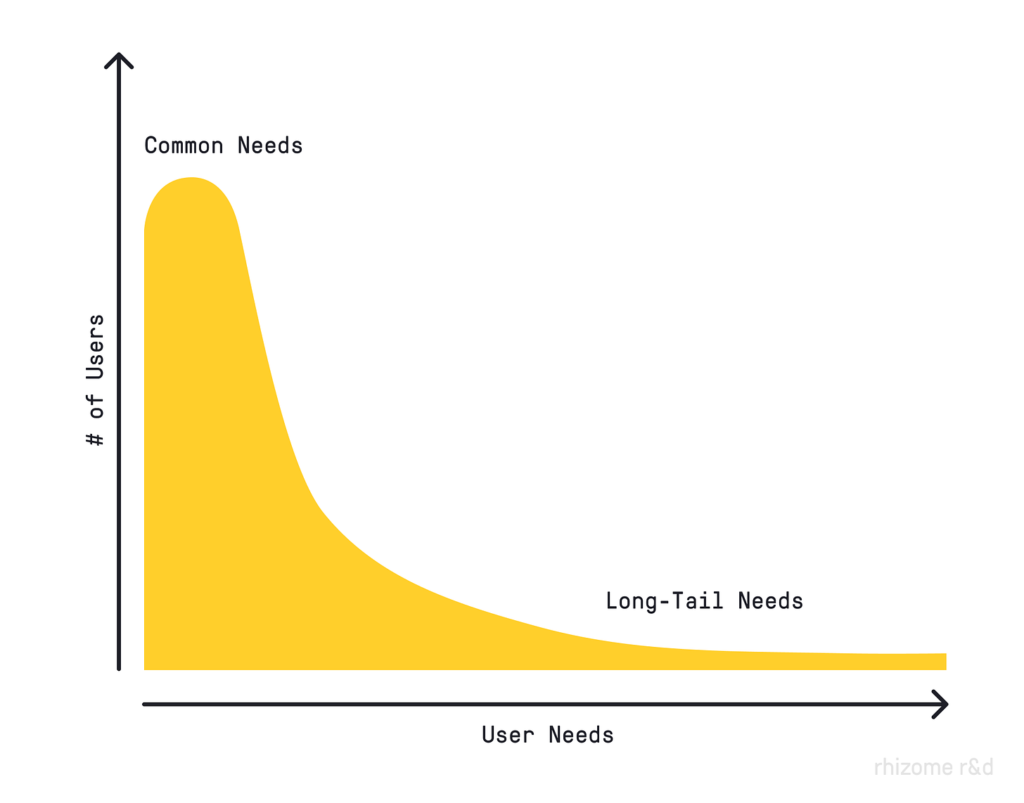
Long-tail of user needs

An analogy to understand how the rigidity of software interfaces fails to meet what we need from it.

User Agency in Other People's Websites - Orion Reed at JOTB25
When to Design for Emergence