

There's a surprisingly nuanced discussion in development about the political economy of clients and servers in the Atmosphere
The politics of purely client-side apps - Paul's Leaflets
There's a surprisingly nuanced discussion in development about the political economy of clients and servers in the Atmosphere
Paul's Leaflets
There's a surprisingly nuanced discussion in development about the political economy of clients and servers in the Atmosphere
The politics of ‘platforms’ - Tarleton Gillespie, 2010
Online content providers such as YouTube are carefully positioning themselves to users, clients, advertisers and policymakers, making strategic claims for what ...

The platformization of cultural production: Theorizing the contingent cultural commodity
This article explores how the political economy of the cultural industries changes through platformization: the penetration of economic and infrastructural extensions of online platforms into the web, affecting the production, distribution, and circulation of cultural content. It pursues this investigation in critical dialogue with current research in business studies, political economy, and software studies. Focusing on the production of news and games, the analysis shows that in economic terms platformization entails the replacement of two-sided market structures with complex multisided platform configurations, dominated by big platform corporations. Cultural content producers have to continuously grapple with seemingly serendipitous changes in platform governance, ranging from content curation to pricing strategies. Simultaneously, these producers are enticed by new platform services and infrastructural changes. In the process, cultural commodities become fundamentally “contingent,” that is increasingly modular in design and continuously reworked and repackaged, informed by datafied user feedback.
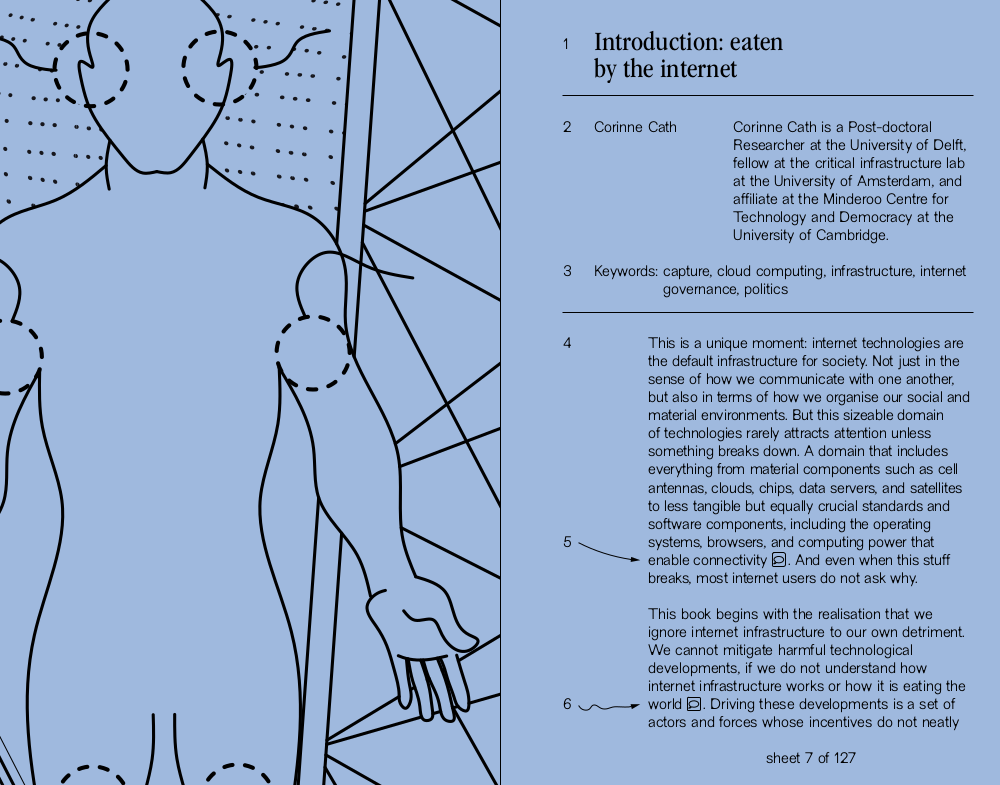
Eaten by the Internet
This book makes internet infrastructure visible as a force of political power, which is transforming the social world, from the bottom up—through fifteen chapters contributed by a global set of researchers, activists, and techies. We are living a unique moment: internet technologies are the default infrastructure for society, not just how we communicate but also how we organise our social life, politics, and economy, all the way down to our material environments, like cities. Our world is eaten by the internet. This means that those who control the internet control the bounds of public speech, economic production, social cohesion, and politics, making its infrastructure a core political terrain in the networked age. The book’s chapters cover a wide set of topics, spanning from the global politics of content moderation by internet infrastructure to the colonialism inherent in the race to plug the moon, from the harms wrought by blockchain companies in rural America to the particularities of online censorship across Asia. The chapters take on thorny topics, discussing power consolidation in the advertisement and cloud industry, the role of internet infrastructure in the war in Ukraine, and tech’s environmental impact—amongst others. In doing so, this book roots contemporary technology debates in the politics of internet infrastructure and urges us to ask how can we ensure our infrastructures sustain us, rather than consume us?
Money as Message | Andreessen Horowitz
Network effects — where a product or service becomes more valuable to its users as more people use it — are one of the key ways software businesses maintain a better product and more defensible market position. This is especially true of messaging apps like WeChat — which, as I’ve argued before, is not just...

X users’ views of politics, experiences on the site differ by party %page%
Most X users say their recent experiences using the platform have been mostly positive or neutral.

Trust and Faith in Our Web
I’m not Brennan, but I’m very interested in decentralization and a fan of AtProto specifically, so I’d like to weigh in. First I should mention I’ve personally never been able to get into microblogging, so I haven’t touched bluesky myself, despite having an account for ATProto reasons. But I agree it’s concerning that the company chooses to continue to host the content of harmful individuals and calling that act “neutral”. I’m certainly against the idea of the “marketplace of ideas” as it’s cle...


Almost everyone is doing the API economy wrong | TechCrunch
It’s time to hold companies to a higher standard when it comes to APIs. As software "eats the world," it seems like it’s not enough for a business to just serve its customers and hopefully make a profit, they also have to be “platforms” -- and, as any developer would respond, these days you just can’t be a platform without an API.

Guys... GUYS, listen. I am begging you all to think bigger! The Atmosphere may be a fun space to explore how familiar services and apps interact—but it's still just social media. The protocol enables us to change behaviors and solve *systemic* problems It's the thing that gets us TO the thing.

zeu
this is why i love ya'll
As @ricardo.bsky.social might put it, the infrastructure behind the Bluesky app is becoming more like a product (as opposed to a project). A natural evolution would be to charge Atmosphere app developers who piggyback on it and would like to have standard commercial SLAs and technical support.

AT Protocol Developers
Today we’re launching Bluesky Protocol Services, a new brand and website for the infrastructure Bluesky operates. And Jetstream v2, the best way for developers to use atproto at scale, now with network replay. atproto.com/blog/introducing-bluesky-prot…
Politics is the defining aspect of networked technology. AT corresponds best to the kind of institutional structure that is key to large scale democracy. AP is a better match for smaller, village-style governance, which is very valid but not the problem I care about.

Ronen Tamari
Can everyone building on atproto please answer this question? 😇
🦋 ATstatus clients (web)

Frontend clients or viewers for the microblogging / status aspect of the ATmosphere network. This is for web-based clients or viewers. #ATmosphereConf
bsky-clients

retired in favor of atstore.fyi for client apps that don’t provide unique community features

secretsky
tenna.party
twinkl.social ☆ under construction
mu
Couch Sky
backyard
tomarigi — とまり木
feeds.social — Minimalist Bluesky Client
akari
SkyDeck

Aerune App - App Store

Couch Sky - Bluesky social network for your Television


