

Three years ago, I was part of a team responsible for developing and maintaining Kubernetes clusters for end user customers. A main source for downtime in customer environments occurred when image registries went down. The traditional way to solve this problem is to set up a stateful mirror, however we had to work within customer budget and time constraints which did not allow it. During a Black Friday, we started getting hit with a ton of traffic while GitHub container registries were down. This limited our ability to scale up the cluster as we depended on critical images from that registry. After this incident, I started thinking about a better way to avoid these scalability issues. A solution that did not need a stateful component and required minimal operational oversight. This is where the idea for Spegel came from.
Cloud native Go: building reliable services in unreliable environments
What do Docker, Kubernetes, and Prometheus have in comm…

ATCR - Distributed Container Registry
Push and pull Docker images on the AT Protocol. Same Docker, decentralized.
Seamark - Distributed Container Registry
Push and pull Docker images on the AT Protocol. Same Docker, decentralized.
eBPF and Kubernetes: Little Helper Minions for Scaling Microservices - Daniel Borkmann, Cilium
Watchtower
A container-based solution for automating Docker container base image updates.
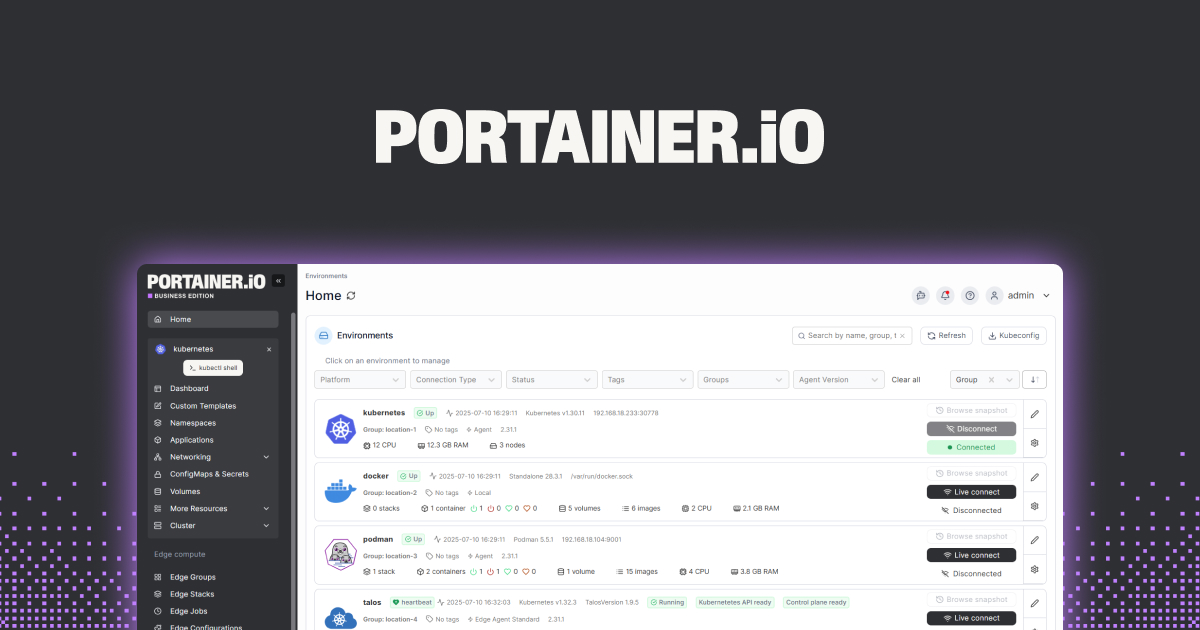
Portainer.io - Enterprise Kubernetes & Docker Container Management Platform
Operational control for Kubernetes and Docker without specialist overhead. Govern multi-cluster infrastructure or deploy OT software at scale.
Self-host and scale web apps without Kubernetes complexity | Uncloud
Take your Docker Compose apps to production with zero-downtime deployments, automatic HTTPS, and cross-machine scaling. Self-hosting made reliable without the complexity.

Lightning Talk: Securing Your Systems with Service Mesh - Tyler Schade, Solo.io
An Internet for the KV Cache: Rethinking Classical Infrastructure Boundaries in the LLM Inference Age
LLM inference has become a global-scale, heterogeneous workload spanning agents, retrieval, tool-use, code execution and multi-modal reasoning. These workloads naturally enable context reuse from overlapping inputs, creating a major opportunity to store and reuse the contexts' KV Caches instead of recomputing them. However, model-side advances that shrink the KV Cache and system-side advances that reduce compute, storage, and transfer costs are evolve independently within legacy cloud boundaries. We argue that future inference infrastructure should allow decoupling of compute and KV Cache storage across cloud and datacenters. The network becomes an active distribution channel; bandwidth, latency and pricing directly determines how the KV Cache should be managed. We propose a vision for an Internet for the KV Cache, with KV Cache management working as a content-distribution system. In this view, KV Cache storage and recompute decisions are driven by model, infrastructure, and application metrics, to enable adaptive, content-driven decisions for minimizing latency and cost.

Jake Lazaroff — Building more resilient local-first software with atproto
The World's Largest Public Container Registry | Docker
Docker Hub is the world's largest registry for images, models, and MCP servers, with curated content and governance that developers and teams can rely on.
Apptainer - Portable, Reproducible Containers
Apptainer is an open source container platform designed to run complex applications on high-performance computing (HPC) clusters in a simple, portable, and reproducible way.
Trying the Software factory pattern.
One of the interesting challenges of the AI ecosystem in 2026 is that new, effective patterns emerge faster than I can adopt them. I’ll find a handful, get back to work, and realize a month later that I’d missed four or five more. The adoption cycle for Imprint this year has been something like: January: get every engineer onto Claude Code every single day March: ok, let’s also get everyone else onto Claude Code or Claude Cowork every single day April: local development is bottlenecked on checkout and worktree model, instead create ~10 local workspaces which each have an independent checkout of every repository, and operate at the workspace level, not at the repository level, so it can generate cross-repository pull requests across frontend, backend, infrastructure and data monorepos June: oh boy, agent-driven development is heavily constrained by lack of a common task management system with higher visibility and less permission complexity than Jira, so let’s migrate the entire company over to Linear and hard stop on Jira July: yikes, now we have visibility into all these tickets, many of them are trivial but managing them through local development isn’t scaling, let’s roll out an orchestrated harness which internally we call “Agent Fleet”, along the lines of Stripe’s Minions The most recent question for me has been figuring out how to adopt the software factory pattern. (After some light research, the specific AI-context origin of this term is slightly messy to attribute, but I think it might be Justin McCarthy in February 2026’s Software Factories And The Agentic Moment.)

Ambassador: Building a Control Plane for an Envoy-Powered API Gateway on Kubernetes
This article provides an insight into the creation of the Ambassador open source API gateway for Kubernetes, and discusses the technical challenges and lessons learned from building a developer-focused control plane for managing ingress or "edge" traffic within microservice-based applications.

Peter van Hardenberg - Ink and Switch, Automerge
The future of Kubernetes and cloud infrastructure
New development approaches and open-source tools are set to address the complexity and scaling challenges of Kubernetes and evolve cloud infrastructure as we know it today.