


(Phys.org) —The results of a new study support what many people intuitively know about winning political elections: the party that has a more connected voter network usually receives more votes. However, ...
The Geometry of Alliances: Vote Transfer Modelling in French Two-Round Elections
Two-round legislative elections are decided not only by first-round vote shares, but by how voters whose preferred party did not advance redistribute their votes among the surviving candidates. We develop a principled model of this transfer process, grounded in multi-dimensional ideological embeddings derived from the Chapel Hill Expert Survey, and apply it to French legislative elections. Calibrated on the 2017 and 2022 elections, the model is evaluated on the unusually complex 2024 contest, in which three ideologically distinct blocs reached the second round simultaneously, achieving 90.34 percent constituency-level accuracy. We show that ideological proximity alone explains the large majority of vote transfers, that a simple left-right axis is insufficient to capture the relevant distances, and that the structural configuration of the 2024 electorate was far less favorable to the far right than pre-election forecasts suggested.

How Media – Namely News, Ads and Social Posts – Can Shape an Election
How Media – Namely News, Ads and Social Posts – Can Shape an Election

Social Physics: How Good Ideas Spread | Sandy Pentland | Talks at Google

A mathematical analysis of what happened the last time the House went Republican
A few years ago, some mathematicians analyzed the US Congress using network theory, trying to determine which committees were linked by shared members.

The network science of collective intelligence
In the last few years, breakthroughs in computational and experimental techniques have produced several key discoveries in the science of networks and human collective intelligence. This review presents the latest scientific findings from two key fields of research: collective problem-solving and the wisdom of the crowd. I demonstrate the core theoretical tensions separating these research traditions and show how recent findings offer a new synthesis for understanding how network dynamics alter collective intelligence, both positively and negatively.

An Examination of Ranked Choice Voting in the United States, 2004-2022
From the perspective of social choice theory, ranked-choice voting (RCV) is known to have many flaws. RCV can fail to elect a Condorcet winner and is susceptible to monotonicity paradoxes and the spoiler effect, for example. We use a database of 182 American ranked-choice elections for political office from the years 2004-2022 to investigate empirically how frequently RCV's deficiencies manifest in practice. Our general finding is that RCV's weaknesses are rarely observed in real-world elections, with the exception that ballot exhaustion frequently causes majoritarian failures.
Election results | Tech Influence Watch
Results from the latest federal elections, and how candidates backed or opposed by crypto- and AI-focused super PACs and donors fared

Statistical Modeling, Causal Inference, and Social Science
I’ve developed an election prediction model based on a transformer architecture; I thought you might find it interesting. The model will update its information automatically in the run-up to the midterm elections; you can also click on a state/district to see what information the model is leaning on to make its predictions. You can find an explainer for exactly how it works in the website.
How Approval Voting and Ranked Choice Voting Are Different | Center for Election Science
How Approval Voting and Ranked Choice Voting Are Different

How the internet flips elections and alters our thoughts | Aeon Essays
The internet has spawned subtle forms of influence that can flip elections and manipulate everything we say, think and do

The Strength of the Strongest Ties in Collaborative Problem Solving
Complex problem solving in science, engineering and business has become a highly collaborative endeavor. Teams of scientists or engineers collaborate on projects using their social networks to gather new ideas and feedback. Here we bridge the literature on team performance and information networks by studying teams' problem solving abilities as a function of both their within-team networks and their members' extended networks. We show that, while an assigned team's performance is strongly correlated with its networks of expressive and instrumental ties, only the strongest ties in both networks have an effect on performance. Both networks of strong ties explain more of the variance than other factors, such as measured or self-evaluated technical competencies, or the personalities of the team members. In fact, the inclusion of the network of strong ties renders these factors non-significant in the statistical analysis. Our results have consequences for the organization of teams of scientists, engineers and other knowledge workers tackling today's most complex problems.
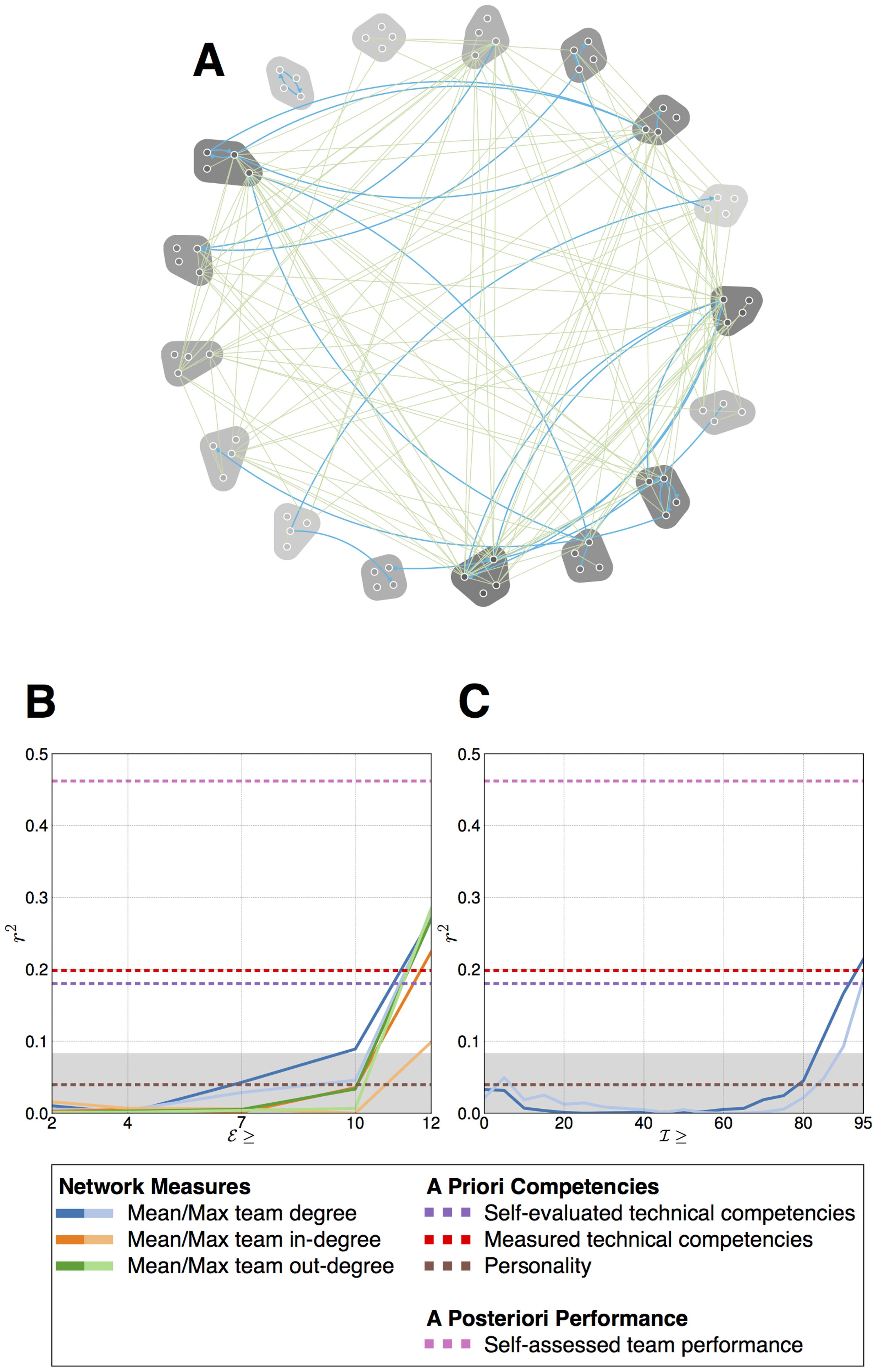
The Strength of the Strongest Ties in Collaborative Problem Solving
Complex problem solving in science, engineering and business has become a highly collaborative endeavor. Teams of scientists or engineers collaborate on projects using their social networks to gather new ideas and feedback. Here we bridge the literature on team performance and information networks by studying teams' problem solving abilities as a function of both their within-team networks and their members' extended networks. We show that, while an assigned team's performance is strongly correlated with its networks of expressive and instrumental ties, only the strongest ties in both networks have an effect on performance. Both networks of strong ties explain more of the variance than other factors, such as measured or self-evaluated technical competencies, or the personalities of the team members. In fact, the inclusion of the network of strong ties renders these factors non-significant in the statistical analysis. Our results have consequences for the organization of teams of scientists, engineers and other knowledge workers tackling today's most complex problems.
Opinion | This Is What Will Ruin Public Opinion Polling for Good
Instead of navigating the obstacles to conduct polls with human respondents, pollsters are running A.I. simulations instead. Why?

Why Being The Most Connected Is A Vanity Metric
Research shows that being the most connected person is not an effective way to build your network. The single best strategy is one that almost no one talks about.

This paper claims to provide evidence offline networks matter more than online for voting preferences, but winds up mistaking noise for signal and seems to forget that some folks online are quite influential. academic.oup.com/pnasnexus/article/4/10/pgaf30…

Physical partisan proximity outweighs online ties in predicting US voting outcomes
academic.oup.com