


Social networks affect every aspect of our lives, from the jobs we get and the technologies we adopt to the partners we choose and the healthiness of our lifestyles. But where do they come from?
Why I care about social networks
I care so much about social networks is because I view social networks as collective sense-making tools. And different social networks have different views

A New Social
Our mission is to liberate people's networks from their platforms, enabling The Last Network Effect and leveling the playing field across the open social web.
A New Social
Our mission is to liberate people's networks from their platforms, enabling The Last Network Effect and leveling the playing field across the open social web.
The year social networks were no longer social | TechCrunch
The term “social network” has become a meaningless association of words. Pair those two words and it becomes a tech category, the equivalent of a single

Brad's Thoughts on the Social Graph
I've been thinking a lot about the social graph for awhile now: aggregating the graph, decentralization, social network portability, etc.
Brad's Thoughts on the Social Graph
I've been thinking a lot about the social graph for awhile now: aggregating the graph, decentralization, social network portability, etc.
Social Physics: How Good Ideas Spread | Sandy Pentland | Talks at Google
Get Out of the Nest! Drivers of social influence in the Twitter migration to Mastodon
Elon Musk's purchase of Twitter on October 2022 triggered a mass exodus to Mastodon, the largest decentralized online social network. This is a unique example of collective behavioral change that is documented through large-scale digital traces, and can teach us a lot about how people coordinate.

Virality Prediction and Community Structure in Social Networks
How does network structure affect diffusion? Recent studies suggest that the answer depends on the type of contagion. Complex contagions, unlike infectious diseases (simple contagions), are affected by social reinforcement and homophily. Hence, the spread within highly clustered communities is enhanced, while diffusion across communities is hampered. A common hypothesis is that memes and behaviors are complex contagions. We show that, while most memes indeed spread like complex contagions, a few viral memes spread across many communities, like diseases. We demonstrate that the future popularity of a meme can be predicted by quantifying its early spreading pattern in terms of community concentration. The more communities a meme permeates, the more viral it is. We present a practical method to translate data about community structure into predictive knowledge about what information will spread widely. This connection contributes to our understanding in computational social science, social media analytics and marketing applications.

Social Networking Utopia — Matt
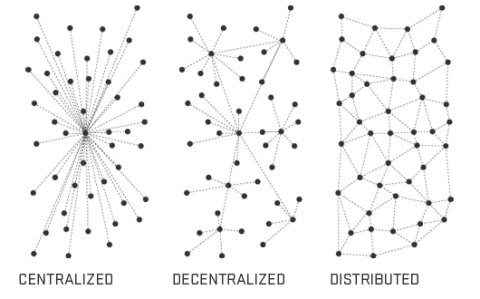
In discussing the network topology of social networks — whether centralized like Facebook or federated like ActivityPub — I think the ult...

Why Equitable Networks? - Interaction Institute for Social Change
Readers of this blog know how much promise we at IISC see in networks to bring about greater depth and breadth of change in our country and communities. At the same time, we do not see networks as a panacea. In fact, there are good reasons to be vigilant about “net work” to ensure that... Read More
The Majority Illusion in Social Networks
Social behaviors are often contagious, spreading through a population as individuals imitate the decisions and choices of others. A variety of global phenomena, from innovation adoption to the emergence of social norms and political movements, arise as a result of people following a simple local rule, such as copy what others are doing. However, individuals often lack global knowledge of the behaviors of others and must estimate them from the observations of their friends' behaviors. In some cases, the structure of the underlying social network can dramatically skew an individual's local observations, making a behavior appear far more common locally than it is globally. We trace the origins of this phenomenon, which we call "the majority illusion," to the friendship paradox in social networks. As a result of this paradox, a behavior that is globally rare may be systematically overrepresented in the local neighborhoods of many people, i.e., among their friends. Thus, the "majority illusion" may facilitate the spread of social contagions in networks and also explain why systematic biases in social perceptions, for example, of risky behavior, arise. Using synthetic and real-world networks, we explore how the "majority illusion" depends on network structure and develop a statistical model to calculate its magnitude in a network.

Network Behaviors to Leverage Network Effects - Interaction Institute for Social Change
Think like a network, act like a node. At IISC, we continue to emphasize that networks, not organizations, are the unit of social change. Part of the reason for this is that networks at their best are able to leverage what are known as “network effects.” These effects, as described by Madeleine Taylor and Peter Plastrik, include... Read More

(PDF) Algorithmically Mediating Communication to Enhance Collective Decision-Making in Online Social Networks
PDF | Many collective decision-making contexts involve communication among group members. Sometimes this communication helps the collective reach an... | Find, read and cite all the research you need on ResearchGate

this is, I think, the path to atproto victory: social platforms have become samey network effect vehicles that exist only to copy each others' features, so all atproto has to do is build a large enough network effect of its own that it can absorb closed socials' features in the same way

norvid_studies
one thing is it seems there's a lot more fast copying for eg every 'social' thing converging on shortform video / all kind of looking like each other but with their existing users. this is a very anecdotal impression though
