


A deceptively simple question spurred an exploration of physicists’ views on whether their theories describe reality.
Claude is an Electron App because we’ve lost native
Article argues that Claude is not an Electron app not because LLMs can’t do it, but because there are no advantages left for native
Making Software: How is data stored?
Invariably, it involves trying to trap electrons in increasingly complicated ways.

Re-Engineering Wimsatt for Limited Beings
Science is the best way to produce facts about reality. The best, at least, that limited human beings have devised so far. Yet, not even scientists quite seem to understand how scientific knowledge is generated. This is not only a philosophical but also a practical problem, as our misunderstandings affect the quality of our research and limit the directions it can take. In light of this, it may be good if we reflected a bit more on how we do science — to become better researchers through philosophy. Here, I provide an accessible introduction to a philosophical approach that achieves precisely this: William Wimsatt’s multi-perspectival realism. It disabuses us of widespread but misleading myths and idealizations about science, such as the idea that everything in the world can be reduced to a fundamental level, or that we can approach a “view from nowhere” — complete and objectively detached knowledge of the world. Wismatt proposes an alternative view based on his thorough studies of actual research practice. It cuts deeply into the layered yet messy structure of reality, and the improvised but potent tools we have available, as limited and evolved beings, to explore it. Wimsatt reframes science as an irregular yet adaptive process rather than a cumulative repository of unalterable facts. His philosophy provides a workable and grounded middle way between radical skepticism and naïve belief in the objective truth of science. It explains how knowledge is conceptually constructed by humans, but still connects us to reality in a trustworthy way. We need such a new view of science, not only to improve our research practices and outcomes but, more generally, to gain a more realistic understanding of ourselves, the world, and our place and role within it.
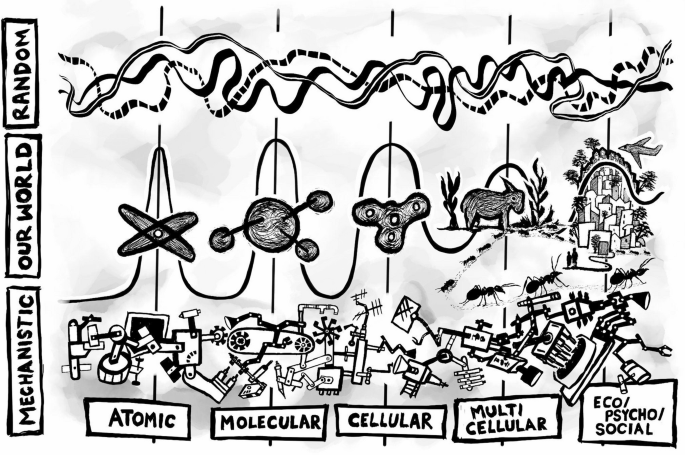
‘Shut up and calculate’ does a disservice to quantum mechanics | Aeon Essays
The cliché has it that the Copenhagen interpretation demands adherence without deep enquiry. That does physics a disservice
Weird Studies
Professor Phil Ford and writer J. F. Martel host a series of conversations on art and philosophy, dwelling on ideas that are hard to think and art that opens up rifts in what we are pleased to call "reality."
Electron Spins: a special case of Chromium mods | Little Bear Labs
John's a dev who likes to build to last; most known for his work in native-compiling languages like Rust & C++. Dive deep or collaborate: why not both?
How accurate have Ed Zitron's AI skeptic predictions been?
What Theory is Not, Theorizing Is

Theory Beyond Theorems and Proofs: A Guest Post
Scott’s foreword: I’m extremely grateful to my brilliant colleagues, Pravesh Kothari, Raghu Meka, and Prasad Raghavendra, for sharing the guest post below about how theoretical computer…

nLab
particle, relativistic particle, fundamental particle, spinning particle, superparticle
The Origins Of <br>‘Planetary Realism’ And <br>‘Whole Earth’ Thinking | NOEMA
There is no escaping an interconnected world.

ORI Polls App
The director of research at the Qualia Research Institute recently posted this poll asking whether people believed in universes with different laws of physics
I am a strange loop
Hofstadter's long-awaited return to the themes of Gödel, Escher, Bach--an original and controversial view of the nature of consciousness and identity. What do we mean when we say "I"? Can a self, a soul, a consciousness, an "I" arise out of mere matter? If it cannot, then how can you or I be here? This book argues that the key to understanding selves and consciousness is a special kind of abstract feedback loop inhabiting our brains. Deep down, a human brain is a chaotic soup of particles, on a higher level it is a jungle of neurons, and on a yet higher level it is a network of abstractions that we call "symbols." The most central and complex symbol in your brain or mine is the one we both call "I." But how can such a mysterious abstraction be real--or is our "I" merely a convenient fiction?--From publisher description

The Electron changes here are quite interesting. It's not "add full browser extension support to Electron". Is more like "add special limbo space where extension support and things like it are possible". github.com/electron/electron/pull/44411

feat: service worker preload scripts for improved extensions support by samuelmaddock · Pull Request #44411 · electron/electron
github.com