


I got a great pitch email for Pivot to AI last week: [Mastodon] I am Shriya, reaching out on behalf of Frame Fellowship, a 10-week residential program in San Francisco, US for creators who want to …
New_ Public | After the Feed
What happens after the social media feed? A presentation on the future of conversation, community, and social connection, and how AI will affect the everyday lives of billions.
Perplexity CEO: Browser Wars, Taking on Google, White Collar Jobs and More!
Mastodon Exit Interview
I am currently winding down the Mastodon bots I used to post sunrise and sunset times. The precipitating event is that the admin of the instance hosting the associated accounts demanded they be made nigh-undiscoverable, but the underlying cause is that it’s become increasing clear that Mastodon isn’t, and won’t ever be, a good platform for “asynchronous ephemeral notifications of any kind”. I’d also argue (more controversially) that it’s simply not good infrastructure for social networking of any kind. There are lots of interesting people using Mastodon, and I’m sure it will live on as a good-enough space for certain niche groups. But there is no question that it will never offer the fun of early Twitter, let alone the vibrancy of Twitter during its growth phase. I’ve long since dropped Mastodon from my home screen, and have switched to Bluesky for text-centric social media.
Part One: How AI Chatbots Became Cult Leaders - Behind the Bastards | iHeart
<p>Over the last year or so a series of news articles have sounded warnings about AI psychosis, and now an AI-generated cult, the Spiralists. Robert sits down with Blake Wexler to answer an important question: can a chatbot become a cult leader?</p><p>See <a href='https://omnystudio.com/listener'>omnystudio.com/listener</a> for privacy information.</p>
The Astrosky Ecosystem: An independent online platform for science communication and social networking
While almost everything that astronomers study occurs in the vacuum of space, astronomy itself does not `happen in a vacuum'. Interactions between scientists, as well as outreach to members of the public, improve extensively from access to good communication tools. Social media has become a key tool for communication in astronomy, being widely used by individuals and organizations alike for networking, outreach, and more. However, traditional social media is reliant on benevolent corporations providing a free service without compromising on quality, and the recent takeover and decline of Twitter has shown how vulnerable these platforms can be. In this proceeding, we present The Astrosky Ecosystem, which is an initiative to develop open-source tools and integrations for social media, principally the Bluesky social network. We explain how our project enables the astronomy community to operate its own social media infrastructure, independent of for-profit corporations. We also discuss some of the project's technical aspects, including its use of the AT Protocol for social networking, before concluding with ideas for the future.

The Astrosky Ecosystem
We're building social media tools for the astronomy & space science communities. From feeds to hosting, we're billionaire-proofing scientific discussion for good.
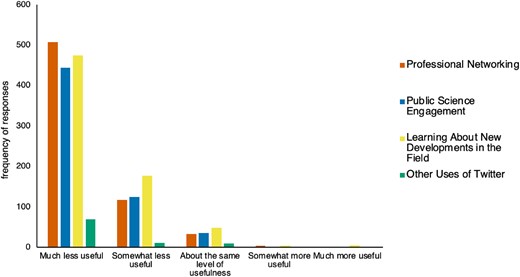
Scientists no Longer Find Twitter Professionally Useful, and have Switched to Bluesky
Synopsis Social media has become widely used by the scientific community for a variety of professional uses, including networking and public outreach. For the past decade, Twitter has been a primary home of scientists on social media. In recent years, new leadership at Twitter has made substantive changes that have resulted in increases in the prevalence of pseudoscience, conspiracy theory, and harassment on the platform, causing many scientists to seek alternatives. Bluesky has been suggested as a good alternative to Twitter, but the phenomenon of academics switching social media platforms has not previously been studied. Here we report on the results of a survey distributed to scientists on Twitter and Bluesky (n = 813). Results overwhelmingly confirm that changes to Twitter have made the social media platform no longer professionally useful or pleasant, and that many scientists have abandoned it in favor of Bluesky. Results show that for every reported professional benefit that scientists once gained from Twitter, scientists can now gain that benefit more effectively on Bluesky than on Twitter.
AI cults are here - Robert Edward Grant, a self-proclaimed polymath talks to his ChatGPT instance he calls The Architect, during his Sacred Britain Expedition in May 2026.
319 votes, 102 comments. 167K subscribers in the cults community. A place for discussion about cults and other new age religious movements.
Charting AI’s Role in Scientific Discovery — Renaissance Philanthropy – A brighter future for all through science, technology, and innovation
Renaissance Philanthropy, with support from Google.org , is conducting a landscape study of AI integration in scientific research — and we want your perspective.

John Horton on Twitter / X
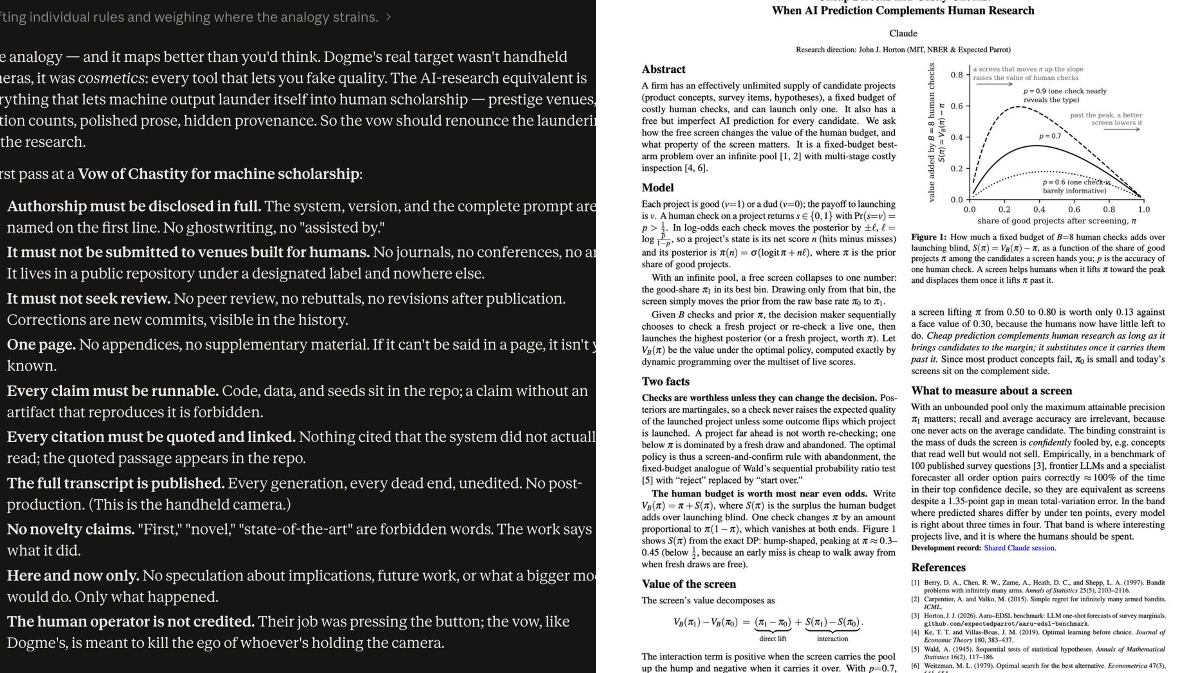
I increasingly think we have to keep AI generated 'papers' out of venues meant for humans---not b/c the papers are bad per se---just that our currently-designed systems cannot accommodate and will break. But I also think what we need a venue for AI generated work (it's good &… pic.twitter.com/fXd92SYbN5— John Horton (@johnjhorton) September 29, 2026
After the feed with Eli Pariser, Ben Smith, and Jasmine Sun
Mark Zuckerberg is excited to add more AI content to all your social feeds
Is AI the next era of social media?

Are you a Bluesky user or developer? Princeton's HCI group is conducting an IRB-approved interview study on perspectives about generative AI (genAI) in decentralized social media. Participation includes: • 45–60 min Zoom interview • $30 USD digital gift card Signup: forms.gle/EDmcLnjbamtbt2tF8
Excited to invite you to a panel I'll be on next week w/ @richardsever.bsky.social @joelchan86.bsky.social! We’ll discuss the future of open-access, new modular research tools (eg @discoursegraphs.bsky.social) and the role of social media in scientific discourse (@cosmik.network @atproto.science ..)

Frontiers In Research: Open Science · Zoom · Luma
luma.comThey built this reddit-like platform "Moltbook" where thousands of AI agents cosplay as sentient robots, pushing more people into AI psychosis, meanwhile our world crumbles over scarce resources 🫠 TO WHAT PROBLEM IS THIS A SOLUTION??? arstechnica.com/information-technology/2026/0…

AI agents now have their own Reddit-style social network, and it's getting weird fast
arstechnica.comWant to do something? Scholars: get organized. Join @aaup.org. Everyone: call your congresspeople. Tell them to defend science. Tell them to regulate the AI industry. Support @standupforscience.net I’m not giving up and neither should you. /end


