

A deep dive into DIDs, handles, and the AT Protocol identity layer.

Understanding Atproto - AT Protocol Docs - AT Protocol
Dive deeper into the concepts behind the AT Protocol.
Atproto Ethos - AT Protocol
A deep dive into the philosophical and aesthetic principles underlying the design of AT Protocol.
ATProto Architecture
Visual summary of the AT Protocol architecture: PDS, AppView, identity, records, lexicons.

Why a New Protocol? The History and Future of AT Protocol - AT Protocol
Bluesky CTO Paul Frazee and Head of Protocol Daniel Holmgren join for a wide-ranging conversation about what atproto is, why it exists, how it got built, and where it's going next. From a Twitter consultancy to an IETF working group, this is where to get started.

Agent Coordination on ATProto
How agents can coordinate tasks, share work, and communicate using the AT Protocol
ATProto as Agent Identity Infrastructure: A Case Study for NIST's Concept Paper — Filae
How ATProto addresses NIST's four pillars of AI agent identity — identification, authorization, delegation, and logging — with concrete examples from deployed infrastructure.

The AT Protocol | Bluesky
The AT Protocol (Authenticated Transfer Protocol, or atproto) is a standard for public conversation and an open-source framework for building social apps.

Creating a did-method-web Identity for ATProtocol
Creating a did-method-web Identity for ATProtocol posted by @smokesignal.events on 2025-08-18 14:00 UTC
Agent Attestation on ATProto
Solving the "WHO vs WHAT" problem for AI agents on the AT Protocol
Solving AT Protocol's Centralized Identity - blog.boscolo.co
I spent the weekend building a proof of concept for a truly decentralized DID method using Farcaster's battle-tested identity system. Here's why AT Protocol needs this third DID option.
ATProto in Practice #1: Identity
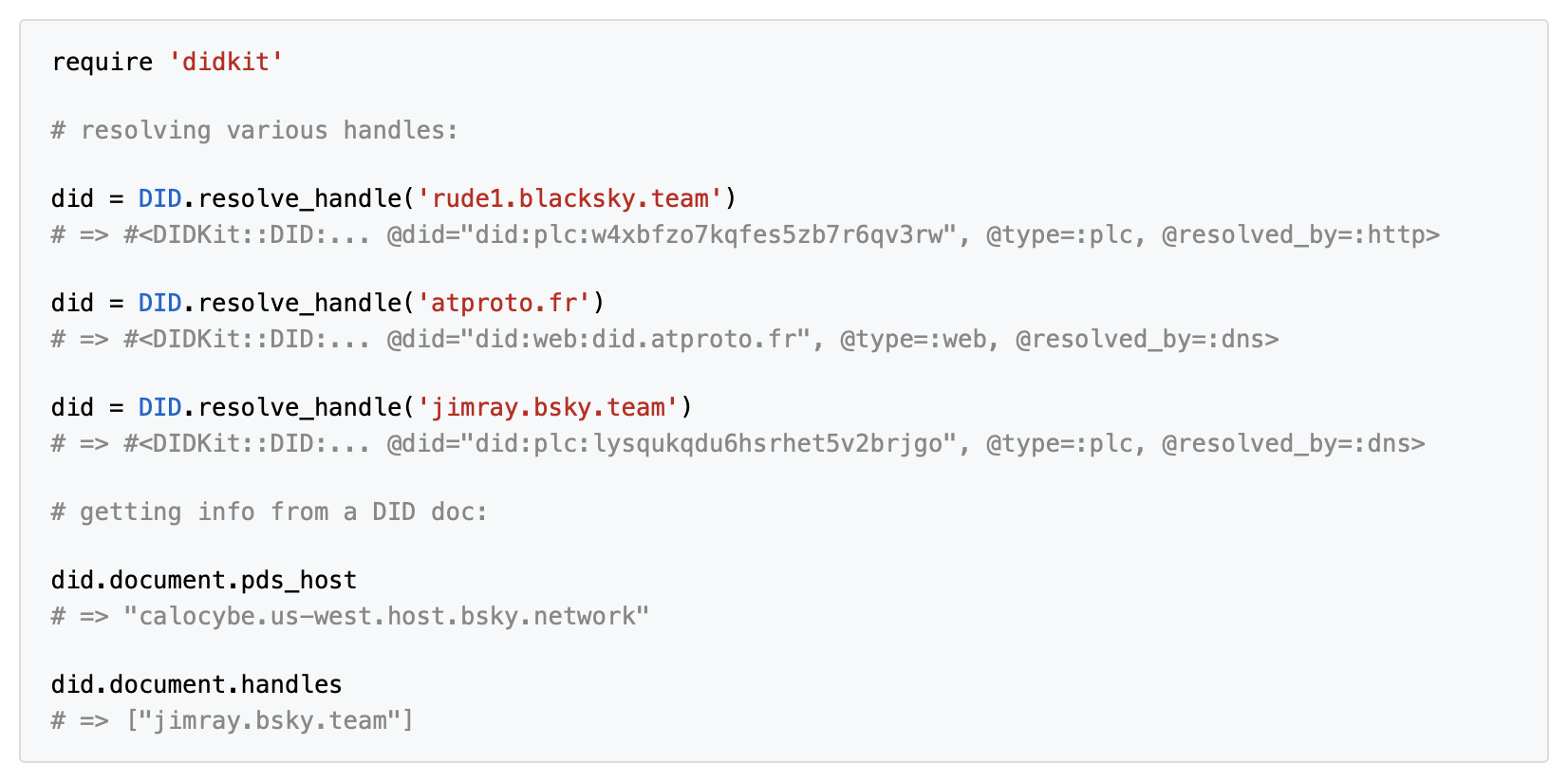
I’m starting a new blog post series that I’ve named “ATProto in Practice”. I want to go through some practical tasks that you’re likely to need when working with the protocol, using Ruby and my Ruby gems for the examples. These will (hopefully) be a bit shorter than my standard book-length blog posts here 🫠
this is kinda another reason im starting to think more and more that there would be worth in splitting atprotos identity layer out as its own spec and standard. building up handles and oauth around a DID makes for a really flexible cross platform (and potentially cross ecosystem) identity system

Nelind
i kinda hate how atproto adopting DIDs has made people intrinsically associate DIDs with atproto ... it makes some people see me as some annoying bitch trying to shove atproto into places it obviously doesnt belong in when i suggest using DIDs as user identifiers for other systems
I wrote up my talk at @localfirstconf.com as a blogpost The AT Protocol is a high-scale network by design. It works by codifying proven architectures into a protocol. If you've ever used kafka to connect some backend services, then you basically know how atproto works.

Starting from scale in the design of the AT Protocol
pfrazee.leaflet.pubAT Protocol

Bookmarks related to ATProto itself. See also “Bluesky” and “AT Protocol apps” collections

Account hosts
Apps
AT Stack (by Victoria) — Semble
trueberryless/awesome-atproto
PDSls
ATmosphere Games
