
Exploring the Potentials of Cooperative Models In the age of the ever-expanding platform economy, questions over the ownership and governance of social media platforms have become increasingly…
Platform co-op governance: deep democracy on scale
This article was written with new inspiration from many conversations around the the Platform Cooperatives conference in NYC in Nov 2017…

Platform Politics
Available open access digitally under a CC-BY-NC-ND license. The 'sharing economy', powered by companies like Airbnb, Uber and Deliveroo, promised to revolutionize the way we work and live. But what changes have come about, and why? This book shows how platform capitalism is not only shaped by business decisions, but is a result of struggles involving social movements, consumer politics and state interventions. It focuses in particular on the controversial tactics used by platform giants to avoid regulation. Drawing on cutting-edge research and analysis, the book provides a critical overview of the struggles around platforms, examines platform power, and reflects on the different possible futures of the platform economy.

Social media algorithms can be redesigned to bridge divides — here’s how
"It falls to both the tech companies that built these systems and an engaged public to create technologies designed for social cohesion."

Does the World Need Publicly-Owned Social Networks? - Slashdot
"Do we need publicly-owned social networks to escape Silicon Valley?" asks an opinion piece in Spain's El Pais newspaper. It argues it's necessary because social media platforms "have consolidated themselves as quasi-monopolies, with a business model that consists of violating our privacy in search...

Community by Design
Social media empower distributed content creation by algorithmically harnessing "the social fabric" (explicit and implicit signals of association) to serve this content. While this overcomes the bottlenecks and biases of traditional gatekeepers, many believe it has unsustainably eroded the very social fabric it depends on by maximizing engagement for advertising revenue. This paper participates in open and ongoing considerations to translate social and political values and conventions, specifically social cohesion, into platform design. We propose an alternative platform model that includes the social fabric an explicit output as well as input. Citizens are members of communities defined by explicit affiliation or clusters of shared attitudes. Both have internal divisions, as citizens are members of intersecting communities, which are themselves internally diverse. Each is understood to value content that bridge (viz. achieve consensus across) and balance (viz. represent fairly) this internal diversity, consistent with the principles of the Hutchins Commission (1947). Content is labeled with social provenance, indicating for which community or citizen it is bridging or balancing. Subscription payments allow citizens and communities to increase the algorithmic weight on the content they value in the content serving algorithm. Advertisers may, with consent of citizen or community counterparties, target them in exchange for payment or increase in that party's algorithmic weight. Underserved and emerging communities and citizens are optimally subsidized/supported to develop into paying participants. Content creators and communities that curate content are rewarded for their contributions with algorithmic weight and/or revenue. We discuss applications to productivity (e.g. LinkedIn), political (e.g. X), and cultural (e.g. TikTok) platforms.

Cooperative non-profit social media for Canada - CoSocial Community Cooperative
CoSocial, officially CoSocial Community Cooperative, is a member-owned organization with the purpose of providing democratically-run open social media.

Building Consensus Through Deliberation in Large Collaborations, Organizations, and Cooperatives
As groups grow in size, participatory decision-making becomes difficult. Can online platforms make it easier for large groups to deliberate…


Delete Your Account: On the Theory of Platform Capitalism | Los Angeles Review of Books
The platform confuses capital-flow and social form, rearranging the relationship of profit to community and intelligence to organization.

It's obvious why we hate social media
We need better internet platforms. We're already building them.

The Case for a Public Social Media Platform - JSTOR Daily
Artist and writer Joshua Citarella explores why corporate platforms corrode democracy—and what a postal-service-style digital commons could do differently.
Who Makes Money From Social Media?
Investigate platforms' revenue redistribution schemes.
The Launch of the European Social Association
Social media’s impact on society and citizens clearly shows the need for change. European social media companies and civil society are joining forces to move away from large monopolistic platforms to establish a diverse and resilient infrastructure for information and social connection in Europe, keeping more jobs and revenue generated with social media circulating in Europe. For the first time, the organisations and people building Europe’s open social technologies have aligned behind one declaration, backed by 12 Founding Signatories, 100+ organisations and 600+ individuals. On 4 November the coalition becomes an organisation: the European Social Association, a charitable association based in Germany, and led by civil society. At the launch event, we will lay out European Social´s path towards common projects on moderation, bridging and other infrastructure elements, policy approaches, advocacy and fundraising based on common values and principles that shape the Open Social Web. Curious and interested to support? Please join in. **Schedule** 10.00 **Check-In and Get-Together** 10.30 **The launch of the European Social Association** with founding members Michael Foster (Newsmast Foundation), Sophie Bloemen (Commons Network), Jantien Borsboom (PublicSpaces), Björn Staschen (Save Social – Networks For Democracy), Felix Hlatky (Mastodon), Sebastian Vogelsang(Eurosky), Cathleen Berger (Co-Initiator Open Social Web Alliance) 11.00 **The platforms: The state of the Open Social Web** Panel discussion with Felix Hlatky (Mastodon), Sebastian Vogelsang (Eurosky) Moderation: Björn Staschen (Save Social) 11.30 **Civil Society: The need for an Open Social Web** Panel discussion with Sophie Bloemen (Commons Network), Jantien Borsboom (PublicSpaces), Cathleen Berger (Co-Initiator Open Social Web Alliance) Moderation: Michael Foster (Newsmast Foundation) 12.00 - 12.30 Coffee, Tea & Soft Drinks **Location:** Room "Mosaik" at Wikimedia Deutschland (thanks for hosting us!) **→ Please let us know if you can attend, places are limited:** https://savesocial.eu/eulaunch
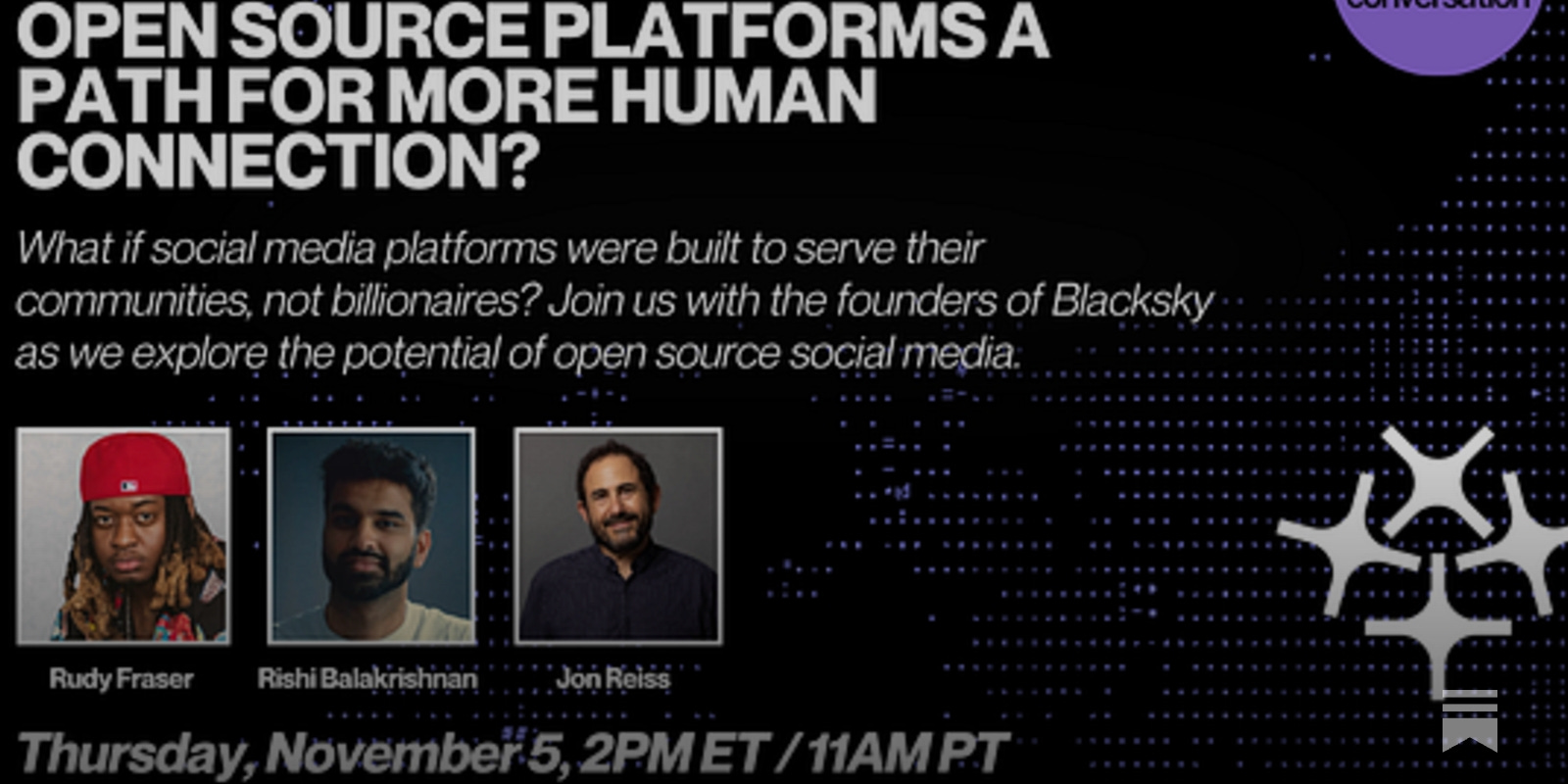
Reclaiming Social Spaces: Are Open Source Platforms a Path for More Human Connection?
What if social media platforms were built to serve their communities, not billionaires? Join us with the founders of Blacksky as we explore the potential of open source social media.
W-Social: What does sovereignty mean for social media? – Open Future
The European Commission’s move to W-Social frames it as a European alternative to X, but its closed-source code and reliance on Bluesky’s infrastructure show that sovereign social media requires open infrastructure—not European ownership alone.
Directing the Herd
Social media platforms don’t produce a common public; they produce competing sub-publics, each with its own sense of what everyone knows.