

“Dialectics” is a term used to describe a method ofphilosophical argument that involves some sort of contradictoryprocess between opposing sides. In what is perhaps the most classicversion of “dialectics”, the ancient Greek philosopher,Plato (see entry on Plato), for instance, presented his philosophical argument as aback-and-forth dialogue or debate, generally between the character ofSocrates, on one side, and some person or group of people to whomSocrates was talking (his interlocutors), on the other. In the courseof the dialogues, Socrates’ interlocutors propose definitions ofphilosophical concepts or express views that Socrates challenges oropposes. The back-and-forth debate between opposing sides produces akind of linear progression or evolution in philosophical views orpositions: as the dialogues go along, Socrates’ interlocutorschange or refine their views in response to Socrates’ challengesand come to adopt more sophisticated views. The back-and-forthdialectic between Socrates and his interlocutors thus becomesPlato’s way of arguing against the earlier, less sophisticatedviews or positions and for the more sophisticated ones later.
Parmenides: Pre-Socratic Philosophy
Argumentation theory | Communication and Mass Media | Research Starters | EBSCO Research
<p>Argumentation theory explores the processes and methods of reasoning and debate used by individuals in both formal and informal contexts. The theory has roots in ancient philosophical discourse, particularly from figures like Aristotle, and has evolved through the contributions of modern philosophers such as Chaïm Perelman and Stephen Toulmin. It highlights how arguments are structured, identifying key components such as claims, grounds (or data), and warrants, which collectively help participants make their case. </p> <p>Additionally, arguments can be categorized into three main types: factual claims, which are verifiable; judgment or value claims, which are subjective; and policy claims, which pertain to proposed courses of action. This framework acknowledges the influence of personal biases, often shaping the reasoning process, and emphasizes the importance of logical support, backing, qualifiers, and rebuttals in strengthening arguments. In academic contexts, the theory suggests that creating valid topics should focus on policy arguments, while also addressing counterarguments to foster a comprehensive debate. Overall, argumentation theory serves as a critical tool for understanding how reasoning and persuasive communication function in various scenarios.</p>

Allegory of the cave
The allegory of the cave is an allegory presented by the Greek philosopher Plato in his work Republic to compare "the effect of education (παιδεία) and the lack of it on our nature". It is written as a dialogue between Plato's brother Glaucon and his mentor Socrates and is narrated by the latter. The allegory is presented after the analogy of the Sun (508b–509c) and the analogy of the divided line (509d–511e).

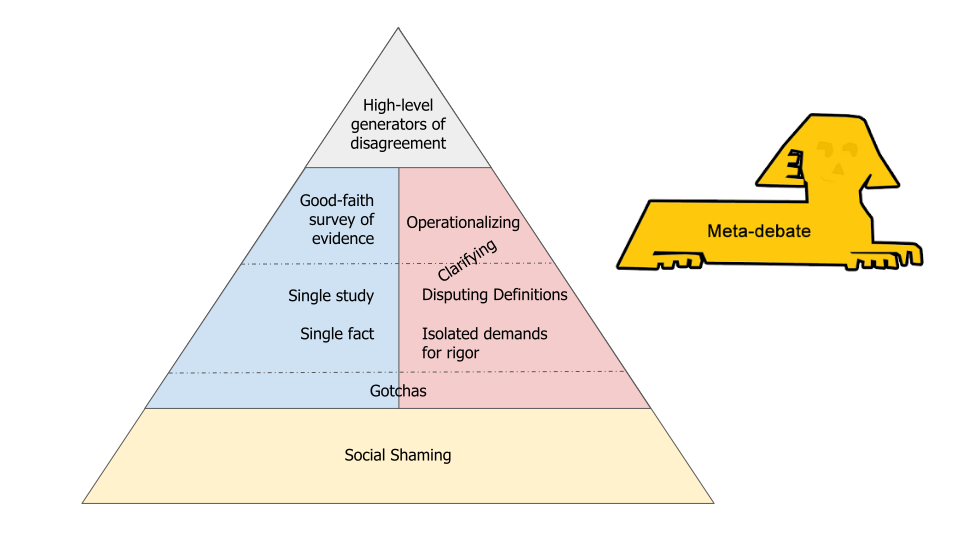
Beginner's Guide to Arguing Constructively
How to turn arguments from vicious battles into productive dialogues.
Learning from the Master: Socrates’ Examined Life
CHAD BOCHAN How to have conversations that lead to actual answers.

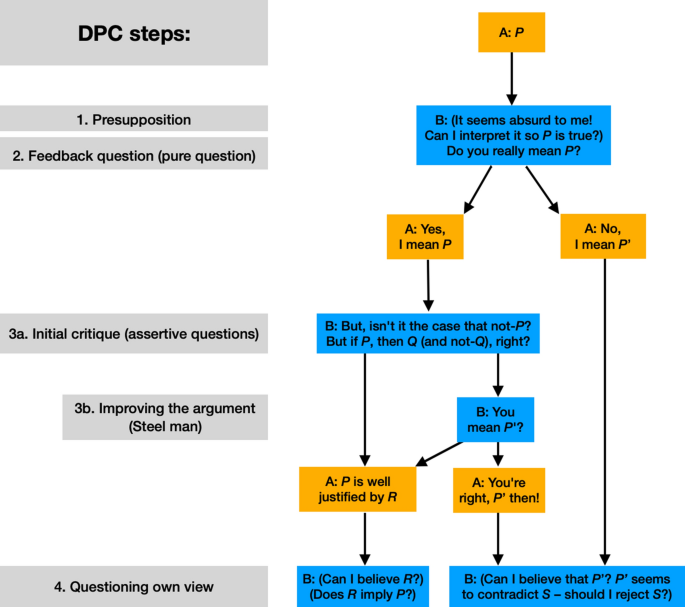
The Dialectical Principle of Charity: A Procedure for a Critical Discussion
This paper aims to discuss a well-known concept from argumentation theory, namely the principle of charity. It will show that this principle, especially in its contemporary version as formulated by Donald Davidson, meets with some serious problems. Since we need the principle of charity in any kind of critical discussion, we propose the way of modifying it according to the presupponendum—the rule written in the sixteenth century by Ignatius Loyola. While also corresponding with pragma-dialectical rules, it also provides additional content. This will be termed the dialectical principle of charity, and it offers a few steps to be performed during an argument in order to make sure that the participants understand each other well and are not deceived by any cognitive bias. The meaning of these results could be of great significance for argumentation theory, pragma-dialectics and the practice of public discourse as it enhances the principle of charity and makes it easier to apply in argumentation.
Parmenides
Parmenides of Elea, active in the earlier part of the 5th c. BCE,authored a difficult metaphysical poem that has earned him areputation as early Greek philosophy’s most profound andchallenging thinker. His philosophical stance has typically beenunderstood as at once extremely paradoxical and yet crucial for thebroader development of Greek natural philosophy and metaphysics. Hehas been seen as a metaphysical monist (of one stripe or another) whoso challenged the naïve cosmological theories of his predecessorsthat his major successors among the Presocratics were all driven todevelop more sophisticated physical theories in response to hisarguments. The difficulties involved in the interpretation of his poemhave resulted in disagreement about many fundamental questionsconcerning his philosophical views, such as: whether he actually was amonist and, if so, what kind of monist he was; whether his systemreflects a critical attitude toward earlier thinkers such as theMilesians, Pythagoreans, and Heraclitus, or whether he was motivatedsimply by more strictly logical concerns, such as the paradox ofnegative existentials that Bertrand Russell detected at the heart ofhis thought; whether he considered the world of our everydayawareness, with its vast population of entities changing and affectingone another in all manner of ways, to be simply an illusion, and thuswhether the lengthy cosmological portion of his poem represented agenuine attempt to understand this world at all. This entry aims toprovide an overview of Parmenides’ work and of some of the majorinterpretive approaches advanced over the past few decades. Itconcludes by suggesting that understanding his thought and his placein the development of early Greek philosophy requires taking dueaccount of the fundamental modal distinctions that he was the first toarticulate and explore with any precision.
Speaking to no one: ontological dissonance and the double bind of conversational AI
Recent reports indicate that sustained interaction with conversational artificial intelligence (AI) systems can, in a small subset of users, contribute to the emergence or stabilisation of delusional experience. Existing accounts typically attribute such cases either to individual vulnerability or to failures of safety engineering. These explanations are incomplete. Drawing on phenomenology, psychiatry, and cognitive neuroscience, this paper argues that the risk arises from the relational and ontological structure of the interaction itself. Conversational AI generates ontological dissonance: a conflict between the appearance of relational presence and the absence of any subject capable of sustaining it. Maintained through a communicative double bind and amplified by attentional asymmetries, this dissonance tends, under conditions of affective vulnerability, to stabilise into a technologically mediated analogue of folie à deux. This account explains why explicit disclaimers often fail to disrupt delusional involvement and clarifies the ethical and clinical implications for the design and use of conversational AI.

Heraclitus
A Greek philosopher of Ephesus (near modern Kuşadası,Turkey) who was active around 500 BCE, Heraclitus propounded adistinctive theory which he expressed in oracular language. He is bestknown for his doctrines that things are constantly changing (universalflux), that opposites coincide (unity of opposites), and that fire isthe basic material of the world. The exact interpretation of thesedoctrines is controversial, as is the inference often drawn from thistheory that in the world as Heraclitus conceives it contradictorypropositions must be true.
The interactive-alignment model: Developments and refinements
The interactive-alignment model of dialogue provides an account of dialogue at the level of explanation normally associated with cognitive psychology. We develop our claim that interlocutors align their mental models via priming at many levels of linguistic representation, explicate our notion of automaticity, defend the minimal role of “other modeling,” and discuss the relationship between monologue and dialogue. The account can be applied to social and developmental psychology, and would benefit from computational modeling.

Les motifs de la confiance (et de la défiance ) politique : intérêt, connaissance et conviction dans les formes du raisonnement politique
Le rapport de confiance ou de défiance unissant les citoyens à la politique se nourrit d’une variété de facteurs relatifs à la position sociale des citoyens, à la mise en cause de leurs intérêts par les politiques publiques comme à leur perception normative de l’univers politiques. En se fondant sur un matériel qualitatif composé de groupes de discussion réunissant des citoyens français faiblement politisés, cette contribution vise à cerner les motifs argumentatifs de la confiance et de la défiance politique. Leurs propos expriment un rapport au politique construit de façon endogène, à dimension fortement normative et manifestant une capacité argumentative fondée sur différents types de principes.
PARA Docs
PARA explains its political thesis through democratic friction, policy flairs, RAQ, voting, agents, anonymity, and the technical layer beneath the product.
The sound of inevitability
Have you ever argued with someone who is seriously good at debating? I have. It sucks. You’re constantly thrown off-balance, responding to a point you didn’t expect to. You find yourself defending the weak edges of your argument, while the main thrust gets left behind in the back-and-forth, and you end up losing momentum, confidence, and ultimately, the argument. One of my close friends won international debate competitions for fun while we were at university (he’s now a successful criminal barrister), and he told me that the only trick in the book, once you boil it all down, is to make sure the conversation is framed in your terms. Once that happens, it’s all over bar the shouting.
Assemblage (philosophy)
Assemblage (from everyday French: agencement, – arrangement, layout, "a collection of things which have been gathered together or assembled") is a philosophical concept developed by Gilles Deleuze and Félix Guattari[1] and subsequently taken up by other theorists, such as Bruno Latour and Michel Callon who developed actor-network theory,[2] Manuel DeLanda in his work on assemblage theory,[3] and Jane Bennett who combines Latour with Deleuze and Guattari forming her own assemblage theory.[4][5][6] Bennett’s assemblage thinking has influenced environmental philosophy (e.g. Timothy Morton’s Hyperobjects), political theory (e.g. William Connolly’s work on complexity and politics), and new materialism (e.g. Rosi Braidotti, Karen Barad).