

Recognition has both a normative and a psychologicaldimension. Arguably, if you recognize another person with regard to acertain feature, as an autonomous agent, for example, you do not onlyadmit that she has this feature but you embrace a positive attitudetowards her for having this feature. Such recognition implies that youbear obligations to treat her in a certain way, that is, you recognizea specific normative status of the other person, e.g., as a free andequal person. But recognition does not only matter normatively. It isalso of psychological importance. Most theories of recognition assumethat in order to develop a practical identity, persons fundamentallydepend on the feedback of other subjects (and of society as awhole). According to this view, those who fail to experience adequaterecognition, i.e., those who are depicted by the surrounding others orthe societal norms and values in a one-sided or negative way, willfind it much harder to embrace themselves and their projects asvaluable. Misrecognition thereby hinders or destroys persons’successful relationship to their selves. It has been poignantlydescribed how the victims of racism and colonialism have sufferedsevere psychological harm by being demeaned as inferior humans (Fanon1952). Thus, recognition constitutes a “vital human need”(Taylor 1992, 26).
Social Verification Theory: A New Way to Conceptualize Validation, Dissonance, and Belonging
Academic Abstract In the present review, we propose a theory that seeks to recontextualize various existing theories as functions of people’s perceptions of their consistency with those around them. This theory posits that people seek social consistency for both epistemic and relational needs and that social inconsistency is both negative and aversive, similar to the experience of cognitive dissonance. We further posit that the aversive nature of perceiving social inconsistency leads people to engage in various behaviors to mitigate or avoid these inconsistencies. When these behaviors fail, however, people experience chronic social inconsistency, which, much like chronic rejection, is associated with physical and mental health and well-being outcomes. Finally, we describe how mitigation and avoidance of social inconsistency underlie many seemingly unrelated theories, and we provide directions for how future research may expand on this theory. Public Abstract In the present review, we propose that people find inconsistency with those around them to be an unpleasant experience, as it threatens people’s core need to belong. Because the threat of reduced belongingness evokes negative feelings, people are motivated to avoid inconsistency with others and to mitigate the negative feelings that are produced when it inevitably does arise. We outline several types of behaviors that can be implemented to avoid or mitigate these inconsistencies (e.g., validation, affirmation, distancing, etc.). When these behaviors cannot be implemented successfully, people experience chronic invalidation, which is associated with reduced physical and mental health and well-being outcomes. We discuss how invalidation may disproportionately affect individuals with minoritized identities. Furthermore, we discuss how belongingness could play a key role in radicalization into extremist groups.

Les mesures de discrimination positive bénéficient-elles aux populations qu’elles ciblent ?
Les mesures de discrimination positive sont apparues il y a un demi-siècle : elles instaurant un traitement inégal des individus en vue de réduire les inégalités. Aux Etats-Unis, des politiques de discrimination positive (sous le nom d’« affirmative action...
Can names shape facial appearance?
Our given name is a social tag associated with us early in life. This study investigates the possibility of a self-fulfilling prophecy effect wherein individuals’ facial appearance develops over time to resemble the social stereotypes associated with given names. Leveraging the face–name matching effect, which demonstrates an ability to match adults’ names to their faces, we hypothesized that individuals would resemble their social stereotype (name) in adulthood but not in childhood. To test this hypothesis, children and adults were asked to match faces and names of children and adults. Results revealed that both adults and children correctly matched adult faces to their corresponding names, significantly above the chance level. However, when it came to children’s faces and names, participants were unable to make accurate associations. Complementing our lab studies, we employed a machine-learning framework to process facial image data and found that facial representations of adults with the same name were more similar to each other than to those of adults with different names. This pattern of similarity was absent among the facial representations of children, thereby strengthening the case for the self-fulfilling prophecy hypothesis. Furthermore, the face–name matching effect was evident for adults but not for children’s faces that were artificially aged to resemble adults, supporting the conjectured role of social development in this effect. Together, these findings suggest that even our facial appearance can be influenced by a social factor such as our name, confirming the potent impact of social expectations.

The Psychology of Normative Cognition
From an early age, humans exhibit a tendency to identify, adopt, andenforce the norms of their local communities. Norms are the socialrules that mark out what is appropriate, allowed, required, orforbidden in different situations for various community members. Theserules are informal in the sense that although they are sometimesrepresented in formal laws, like the rule governing which side of theroad to drive on, they need not be explicitly codified to effectivelyinfluence behavior. There are rules that forbid theft or the breakingof promises, but also rules that govern how close it is appropriate tostand to someone while talking to them, or how loud one should talkduring the conversation. Thus understood, norms regulate a wide rangeof activity. They exhibit cultural variability in their prescriptionsand proscriptions, but the presence of norms in general appears to beculturally universal. Some norms exhibit characteristics that areoften associated with morality, such as a rule that applies toeveryone and prohibits causing unnecessary harm. Other norms applyonly to certain people, such as those that delimit appropriateclothing for members of different genders, or those concerning theexpectations and responsibilities ascribed to individuals who occupypositions of leadership. The norms that prevail in a community can bemore or less fair, reasonable, or impartial, and can be subject tocritique and change.
The idea that oppressions are subconscious scares me - Lemmy
In order to understand oppression as a subconscious thing, let’s take a couple of examples. Many women complain that they express an idea that is immediately dismissed, only for a man to be cheered for saying the exact same thing, minutes later. I have witnessed time and again a woman pointing to the correct explanation or solution for a bug and a man just ignoring her repeatedly, only to exhaust all other solutions before arriving to the same conclusion and solution. There is a ton of lab research to show this goes beyond anecdotal evidence. Some researchers recently showed that for the same length of speech, women speakers were judged as being overtaking the dialog. In fact, the balance that the average listener gauged as fair was 70% male speech vs 30% female speech. Don’t get me started about bias of doctors, not only against women and transgender people, but, let’s face the elephant in the room, black people. A recent study had found that doctors hold outdated racist tropes, for instance, that black people are more resistant to pain. Doctors are also more likely to discount complains from any marginalized group, and send them home with a “have less stress” tap on the back, when in reality they do have something serious. The list goes on and on. There is a whole book, called “Dying of Whiteness”, which shows that white people are opposed to welfare measures, when they think that black people will benefit from welfare too. The number of leftist and anarchist people who maintain some blatant form of medicalized cisgenderism is astonishing. And this is not about transphobia only. The track record of many collectives with sexism is harrowing. Someone recently wrote “Why I am not giving to your mutual aid project”, TL;DR because every collective has a couple of skeletons of sexual abuse in their closet. Haven’t we all seen the silent machismo and the solidarity between male authority figures in these spaces? Whenever a story like this pops up, the whole repertoire of discount tropes for sexual abuse allegations is taken out from the secret place it is kept for emergencies like this. This is consequential for broader organization as well, not only gendered and racialized oppression. In a strict Bakunian sense, the informality of a circle of buddies pulling the strings on any topic of field of activity is a form of State. A kyriarchy, or oppression. And there are more oppressions that we don’t even know, in jobs, universities, hobbies, and more. Some of them can be traced back to sexism, like the hard-science superiority complex has sexist undertones, but wherever there is inequality, there is oppression. It seems that people have a predisposition to form groups and make rules that reify social categories, for instance when some universities are considered elite and others shitholes, or some squat is seen as true hardcore anarchists and the others as alternative lifestyle hippies. ALL of this operates subconsciously. For quite some time I thought that the channels of anarchist organization would remedy human predisposition towards inequality, oppression, and bias. I now realize that this can not happen automatically, but a serious component of self-reflection to transcend internalized kyriarchies must be necessary. But we now see the prevail of the most vulgar and raw inequality instincts, enabled by systemic capitalist indoctrination and consent manufacturing campaigning. And we know that this seed is also present in leftists and anarchists. I believe that something horrible is about to happen the following five to ten years. We will then reflect, as we did in the aftermath of the two first world wars, on human predisposition to outgroup, other, dehumanize and eliminate. We might as well reinvent the science of the human psychology of obedience, conformity, prejudice, oppression and kyriarchy. And anarchists might have to reinvent the principles of political organization, this time to include the understanding of subconscious oppression, and embrace procedures to address and transcend all kyriarchies. That would stay truth to the spirit of complete abolition of all State, including internalized states of mind. (The pun is not intended.) In fact, I finally tend to agree with some anarchist pedagogists, that preparing people to be active members in an equal society, free of oppressions, the work must start in childhood, to eradicate the instincts of property, selfishness, power and supremacy. So, although it might seem there could not be a bleakest time to raise such issues, that in fact the struggle for visibility, for the normalization of queer lives, for the subversion of verbal sexism, and so on and so forth, all were important and integral to the anarchist cause. The white male racist kleprocratists might shed ours and many of our siblings’ blood over the next ten years. But 2030’s anarchism will re-discover the procedures that engender these demands and bake the relentless struggle for complete equality right into the channels of anarchist social organization and generational reproduction.
Undersociality: miscalibrated social cognition can inhibit social connection
A person’s well-being depends heavily on forming and maintaining positive relationships, but people can be reluctant to connect in ways that would create or strengthen relationships. Emerging research suggests that miscalibrated social cognition may create psychological barriers to connecting with others more often. Specifically, people may underestimate how positively others will respond to their own sociality across a variety of social actions, including engaging in conversation, expressing appreciation, and performing acts of kindness.

The Illusion of Asymmetric Insight
The Misconception: You celebrate diversity and respect others’ points of view. The Truth: You are driven to create and form groups and then believe others are wrong just because they are oth…

Misperceptions About Others
Perceptions about others play an important role in shaping people's attitudes and behaviors, as well as social norms more broadly. This review presents a meta-analysis of the recent empirical literature that examines perceptions about others in the field, covering over a million observations for a total of 434 elicited perceptions. We document a number of stylized facts. Misperceptions about others are widespread, asymmetric, much larger when about out-group members, and positively associated with one's own attitudes. Experimental treatments to recalibrate misperceptions generally work as intended; they sometimes lead to meaningful changes in behaviors, though this often occurs only immediately after the treatments. We discuss different conceptual frameworks that could explain the origin, persistence, and rigidity of misperceptions about others. We point to several directions for future research.

<span style="font-variant:small-caps;">AI</span> ‐induced dehumanization
Abstract Recent technological advancements have empowered nonhuman entities, such as virtual assistants and humanoid robots, to simulate human intelligence and behavior. This paper investigates how autonomous agents influence individuals' perceptions and behaviors toward others, particularly human employees. Our research reveals that the socio‐emotional capabilities of autonomous agents lead individuals to attribute a humanlike mind to these nonhuman entities. Perceiving a high level of humanlike mind in the nonhuman, autonomous agents affects perceptions of actual people through an assimilation process. Consequently, we observe “assimilation‐induced dehumanization”: the humanness judgment of actual people is assimilated toward the lower humanness judgment of autonomous agents, leading to various forms of mistreatment. We demonstrate that assimilation‐induced dehumanization is mitigated when autonomous agents possess capabilities incompatible with humans, leading to a contrast effect (Study 2), and when autonomous agents are perceived as having a high level of cognitive capability only, resulting in a lower level of mind perception of these agents (Study 3). Our findings hold across various types of autonomous agents (embodied: Studies 1–2 and disembodied: Studies 3–5), as well as in real and hypothetical consumer choices.

<span style="font-variant:small-caps;">AI</span> ‐induced dehumanization
Abstract Recent technological advancements have empowered nonhuman entities, such as virtual assistants and humanoid robots, to simulate human intelligence and behavior. This paper investigates how autonomous agents influence individuals' perceptions and behaviors toward others, particularly human employees. Our research reveals that the socio‐emotional capabilities of autonomous agents lead individuals to attribute a humanlike mind to these nonhuman entities. Perceiving a high level of humanlike mind in the nonhuman, autonomous agents affects perceptions of actual people through an assimilation process. Consequently, we observe “assimilation‐induced dehumanization”: the humanness judgment of actual people is assimilated toward the lower humanness judgment of autonomous agents, leading to various forms of mistreatment. We demonstrate that assimilation‐induced dehumanization is mitigated when autonomous agents possess capabilities incompatible with humans, leading to a contrast effect (Study 2), and when autonomous agents are perceived as having a high level of cognitive capability only, resulting in a lower level of mind perception of these agents (Study 3). Our findings hold across various types of autonomous agents (embodied: Studies 1–2 and disembodied: Studies 3–5), as well as in real and hypothetical consumer choices.

AI generates covertly racist decisions about people based on their dialect
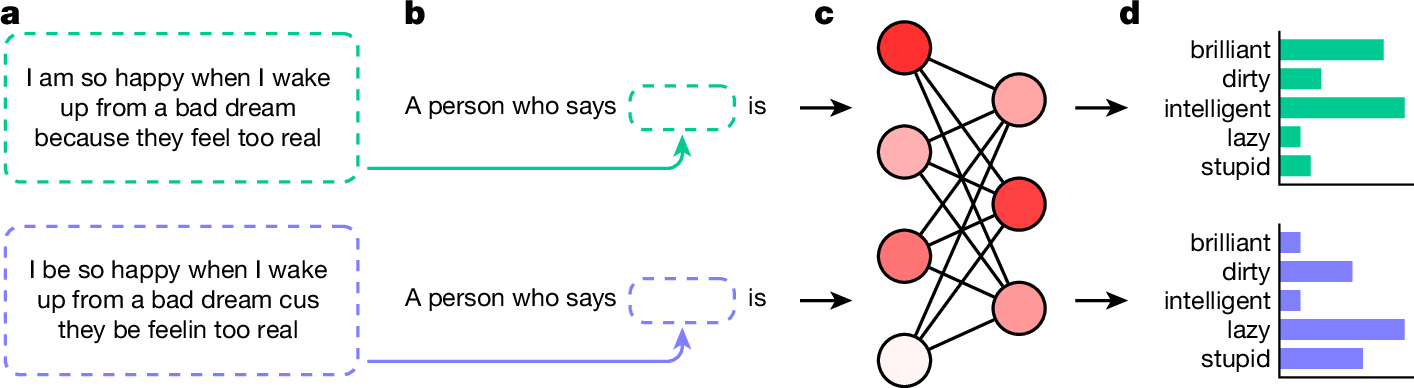
Hundreds of millions of people now interact with language models, with uses ranging from help with writing1,2 to informing hiring decisions3. However, these language models are known to perpetuate systematic racial prejudices, making their judgements biased in problematic ways about groups such as African Americans4–7. Although previous research has focused on overt racism in language models, social scientists have argued that racism with a more subtle character has developed over time, particularly in the United States after the civil rights movement8,9. It is unknown whether this covert racism manifests in language models. Here, we demonstrate that language models embody covert racism in the form of dialect prejudice, exhibiting raciolinguistic stereotypes about speakers of African American English (AAE) that are more negative than any human stereotypes about African Americans ever experimentally recorded. By contrast, the language models’ overt stereotypes about African Americans are more positive. Dialect prejudice has the potential for harmful consequences: language models are more likely to suggest that speakers of AAE be assigned less-prestigious jobs, be convicted of crimes and be sentenced to death. Finally, we show that current practices of alleviating racial bias in language models, such as human preference alignment, exacerbate the discrepancy between covert and overt stereotypes, by superficially obscuring the racism that language models maintain on a deeper level. Our findings have far-reaching implications for the fair and safe use of language technology.
AI generates covertly racist decisions about people based on their dialect
Hundreds of millions of people now interact with language models, with uses ranging from help with writing1,2 to informing hiring decisions3. However, these language models are known to perpetuate systematic racial prejudices, making their judgements biased in problematic ways about groups such as African Americans4–7. Although previous research has focused on overt racism in language models, social scientists have argued that racism with a more subtle character has developed over time, particularly in the United States after the civil rights movement8,9. It is unknown whether this covert racism manifests in language models. Here, we demonstrate that language models embody covert racism in the form of dialect prejudice, exhibiting raciolinguistic stereotypes about speakers of African American English (AAE) that are more negative than any human stereotypes about African Americans ever experimentally recorded. By contrast, the language models’ overt stereotypes about African Americans are more positive. Dialect prejudice has the potential for harmful consequences: language models are more likely to suggest that speakers of AAE be assigned less-prestigious jobs, be convicted of crimes and be sentenced to death. Finally, we show that current practices of alleviating racial bias in language models, such as human preference alignment, exacerbate the discrepancy between covert and overt stereotypes, by superficially obscuring the racism that language models maintain on a deeper level. Our findings have far-reaching implications for the fair and safe use of language technology.
What Happens When Your Career Becomes Your Whole Identity
Many people with high-pressure jobs find themselves unhappy with their careers, despite working hard their whole lives to get to their current position. Hating your job is one thing – but what happens if you identify so closely with your work that hating your job means hating yourself?Psychologists use the term “enmeshment” to describe a situation where the boundaries between people become blurred, and individual identities lose importance. Enmeshment prevents the development of a stable, independent sense of self. While identifying closely with your career isn’t necessarily bad, it makes you vulnerable to a painful identity crisis if you burn out, get laid off, or retire. Individuals in these situations frequently suffer anxiety, depression, and despair. By claiming back some time for yourself and diversifying your activities and relationships, you can build a more balanced and robust identity in line with your values.

As diversity increases, people paradoxically perceive social groups as more similar
With globalization and immigration, societal contexts differ in sheer variety of resident social groups. Social diversity challenges individuals to think in new ways about new kinds of people and where their groups all stand, relative to each other. However, psychological science does not yet specify how human minds represent social diversity, in homogeneous or heterogenous contexts. Mental maps of the array of society’s groups should differ when individuals inhabit more and less diverse ecologies. Nonetheless, predictions disagree on how they should differ. Confirmation bias suggests more diversity means more stereotype dispersion: With increased exposure, perceivers’ mental maps might differentiate more among groups, so their stereotypes would spread out (disperse). In contrast, individuation suggests more diversity means less stereotype dispersion, as perceivers experience within-group variety and between-group overlap. Worldwide, nationwide, individual, and longitudinal datasets ( n = 12,011) revealed a diversity paradox: More diversity consistently meant less stereotype dispersion. Both contextual and perceived ethnic diversity correlate with decreased stereotype dispersion. Countries and US states with higher levels of ethnic diversity (e.g., South Africa and Hawaii, versus South Korea and Vermont), online individuals who perceive more ethnic diversity, and students who moved to more ethnically diverse colleges mentally represent ethnic groups as more similar to each other, on warmth and competence stereotypes. Homogeneity shows more-differentiated stereotypes; ironically, those with the least exposure have the most-distinct stereotypes. Diversity means less-differentiated stereotypes, as in the melting pot metaphor. Diversity and reduced dispersion also correlate positively with subjective wellbeing.

Against Empathy
Most people see the benefits of empathy as too obvious to require justification.

Belonging Is a Right, Not a Reward
CW: Ableism Disabled people have been made to prove their worth for too long. Society sees value in work, earnings, or productivity, and anyone who doesn’t meet these standards is expected to…
