

The daily global word game where rare words win. Same grid worldwide. Can you find what everyone else misses?
Wordle - A daily word game
Guess the hidden word in 6 tries. A new puzzle is available each day.

Pangrum - Daily Word Puzzle Game
Challenge yourself with Pangrum, a daily word puzzle game. Find words using seven letters, with a centre letter that must appear in every word. How many can you find?

Smush
A daily word game. Each letter gets 5 uses. Except the gold one, which is always required.

DailyGame.space
Track your daily web game scores — Wordle, Globle, Satle, Metazooa, Strands, and more. Sign in with Bluesky.
Parseword - A tricky wordplay game
Transform phrases through wordplay to solve cryptic crossword puzzles.

didword
Every Bluesky account has a DID: 24 random characters nobody chose. Sometimes they spell something by accident. This checks you and everyone you follow for the longest dictionary word hiding in one.
1973 Implementation of Wordle was Published by DEC
While some have traced Wordle to Lingo, a game show that started in 1987, they’ve missed an earlier implementation: WORD was published in 101 Computer Games by Digital Equipment Corp. in 1973 and l…

Four Corners — Daily Word Puzzle
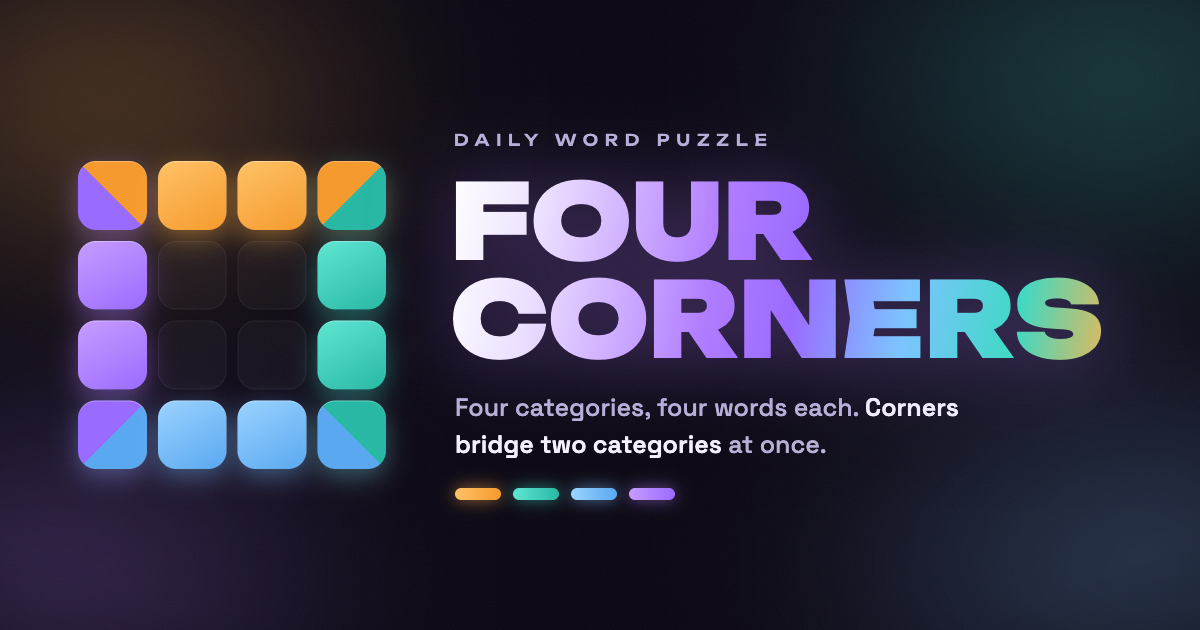
Four Corners is a daily category-sorting puzzle. Twelve words, four categories around the board — and four corner words that belong to two at once.
Four Corners — Daily Word Puzzle
Four Corners is a daily category-sorting puzzle. Twelve words, four categories around the board — and four corner words that belong to two at once.
When Trivia Is Not Trivial: Everyday Knowledge Failures in Multilingual LLMs
Quiz rooms, trivia nights, and quiz shows challenge human knowledge across a wide range of topics, from canonical facts to everyday culture. In this paper, we examine whether large language models (LLMs) can perform competitively in such settings, using quiz-style questions to test them on both common and niche topics. We introduce TriviaRoomQA, a multilingual benchmark designed to evaluate everyday, culturally grounded, and long-tail knowledge across 288 topics. The benchmark contains 3,300 parallel multiple-choice questions in six European languages and additional 5,340 French-only questions for a more fine-grained case study. We evaluate 30 open-weight LLMs from European, Asian, and North American providers, covering models from 7 to 70B parameters. We find that models are strong on knowledge-intensive topics such as history, geography, and mathematics, but substantially weaker on everyday popular-culture topics such as celebrities, music, movies, and news. Moreover, model performance varies across languages even for the same underlying questions, suggesting that access to factual knowledge is not always language-independent. In sum, our dataset and experiments demonstrate an important knowledge gap which is not captured by existing academic-based saturated benchmarks.

Play is doing its work even if we’re not keeping score | Aeon Essays
We are most human when we play freely, imaginatively, pointlessly. Gamification risks atrophying that most precious capacity
A lexicon for game activity sharing
I think that discussion landed on atmosphere.games, no? I think it’d be cool to get this lexicon out there soon.

Escape from Microsoft Word
When I work in Word, for all its dazzling prowess, I can’t escape a faint sense of having entered a closed, rule-bound society. When I write in WordPerfect, with all its scruffy, low-tech simplicity, the world seems more open, a place where endings can’t be predicted, where freedom might be real.

AT Mot is a fun new daily word game built right on the AT Protocol. Guess the 5 letter word in 6 tries, with support for both English and French! @atmot.herve.bzh

AT Mot
atstore.fyi