

Maybe it seems weird that AI bosses won't stop publicly rending their garments about the terrible potential of their products, from the jobspocalypse that will ensue when AI can do our jobs better than us, to the impending moment when the word-guessing programs learn too many words, wake up and turn us all into paperclips.
Pluralistic: IP can’t save you from AI (18 Aug 2026) – Pluralistic: Daily links from Cory Doctorow
You don't have to believe that AI "art" is any good (I don't), nor do you have to believe that AI "art" can be any good (I don't) to understand that the reason that the capital markets are putting trillions into AI is that they believe they can fire workers of every kind and replace them with AI:
Pluralistic: “Rights for robots” and the AI slavery fantasy (10 Jul 2026) – Pluralistic: Daily links from Cory Doctorow
While the AI bubble is primarily a material phenomenon (driven by the calculation that bosses are easy marks for a sales pitch that sees them replacing workers with software), there is an inescapable ideological component to it: the desire for a world without people in it:
Pluralistic: Austerity creates fascism (13 Apr 2026) – Pluralistic: Daily links from Cory Doctorow
I'm worried about AI psychosis. Specifically, I'm worried about the psychosis that makes our "capital allocators" spend $1.4T on the money-losingest technology in the history of the human race, in pursuit of a bizarre fantasy that if we teach the word-guessing program enough words, it will take all the jobs. That's some next-level underpants-gnomery:
Agentic AI and the next intelligence explosion
For decades, the artificial intelligence (AI) “singularity” has been heralded as a single, titanic mind bootstrapping itself to godlike intelligence, consolidating all cognition into a cold silicon point. But this vision is almost certainly wrong in its most fundamental assumption. If AI development follows the path of previous major evolutionary transitions or “intelligence explosions,” our current step-change in computational intelligence will be plural, social, and deeply entangled with its forebears (us!).

Pluralistic: Ad-tech is fascist tech (10 Mar 2026) – Pluralistic: Daily links from Cory Doctorow
A core tenet of the enshittification hypothesis is that all the terrible stuff we're subjected to in our digital lives today is the result of foreseeable (and foreseen) policy choices, which created the enshittogenic policy environment in which the worst people's worst ideas make the most money:
Pluralistic: Ad-tech is fascist tech (10 Mar 2026) – Pluralistic: Daily links from Cory Doctorow
A core tenet of the enshittification hypothesis is that all the terrible stuff we're subjected to in our digital lives today is the result of foreseeable (and foreseen) policy choices, which created the enshittogenic policy environment in which the worst people's worst ideas make the most money:
Anthropomorphism in AI: hype and fallacy
This essay focuses on anthropomorphism as both a form of hype and fallacy. As a form of hype, anthropomorphism is shown to exaggerate AI capabilities and performance by attributing human-like traits to systems that do not possess them. As a fallacy, anthropomorphism is shown to distort moral judgments about AI, such as those concerning its moral character and status, as well as judgments of responsibility and trust. By focusing on these two dimensions of anthropomorphism in AI, the essay highlights negative ethical consequences of the phenomenon in this field.

Anthropomorphism in AI: hype and fallacy
This essay focuses on anthropomorphism as both a form of hype and fallacy. As a form of hype, anthropomorphism is shown to exaggerate AI capabilities and performance by attributing human-like traits to systems that do not possess them. As a fallacy, anthropomorphism is shown to distort moral judgments about AI, such as those concerning its moral character and status, as well as judgments of responsibility and trust. By focusing on these two dimensions of anthropomorphism in AI, the essay highlights negative ethical consequences of the phenomenon in this field.
Pluralistic: AI solipsists and AI cynics (24 Jul 2026) – Pluralistic: Daily links from Cory Doctorow
As a technology, AI isn't exceptional. It's not exceptionally wicked. It's not exceptionally good. Take away the accompanying, galactic-scale stock-swindle, and we'd call AI's applications "plug-ins" and we'd use them and abuse them in the same way that we've used every other technology:
Big Mother: The Technological Body of Evil
A bold examination of artificial intelligence, consciou…

Pluralistic: Google’s AI pricing plan (21 Jan 2026) – Pluralistic: Daily links from Cory Doctorow
Google is spending a lot on AI, but what's not clear is how Google will make a lot from AI. Or, you know, even break even. Given, you know, that businesses are seeing zero return from AI:
Anthropic blames dystopian sci-fi for training AI models to act “evil”
But training on "synthetic stories" that model good AI behavior can help.

Pluralistic: Three more AI psychoses (12 Mar 2026) – Pluralistic: Daily links from Cory Doctorow
"AI psychosis" is one of those terms that is incredibly useful and also almost certainly going to be deprecated in smart circles in short order because it is: a) useful; b) easily colloquialized to describe related phenomena; and c) adjacent to medical issues, and there's a group of people who feel very strongly any metaphor that implicates human health is intrinsically stigmatizing and must be replaced with an awkward, lengthy phrase that no one can remember and only insiders understand.
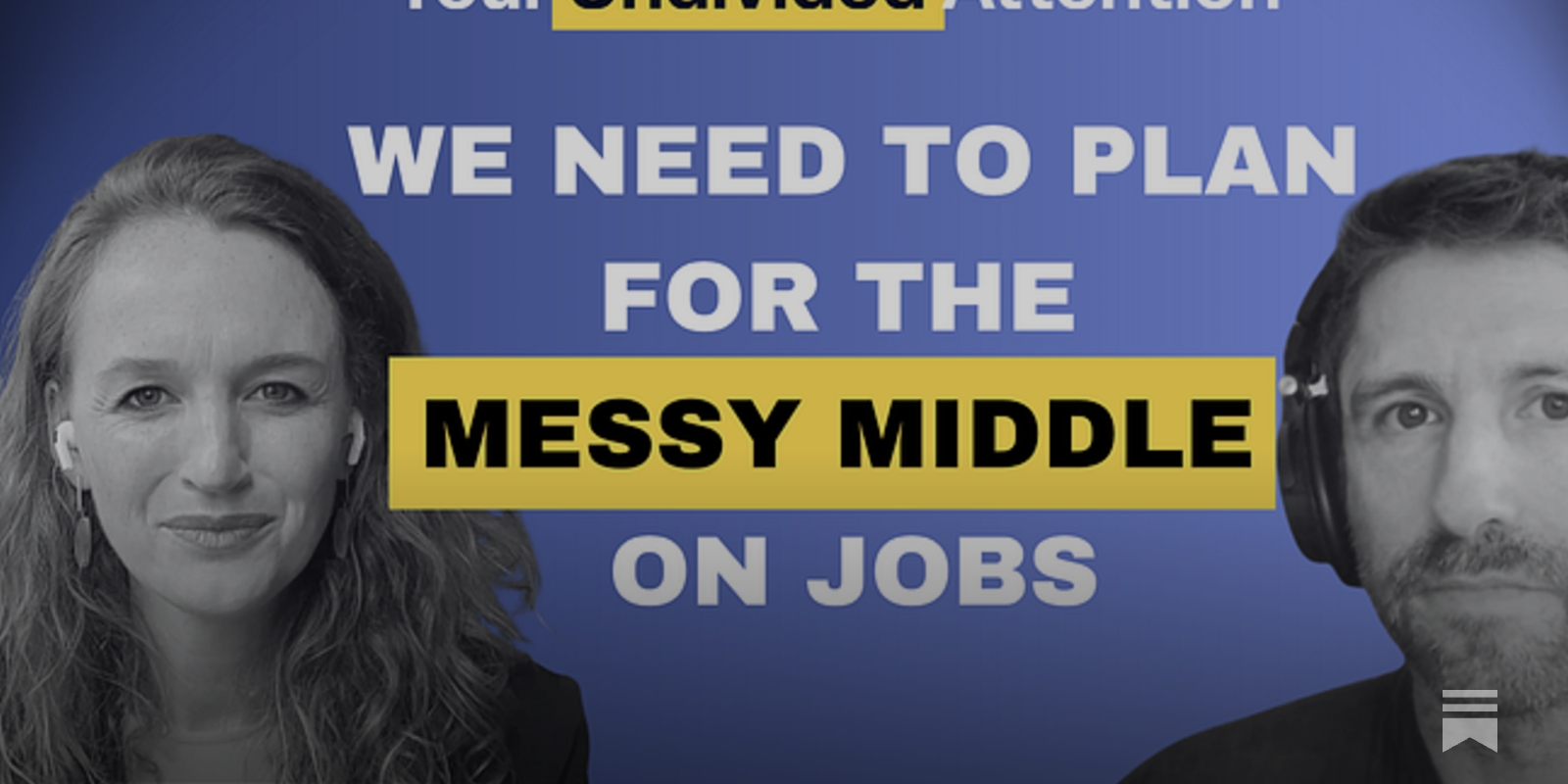
Enough Debate about the AI Jobpocalypse. We Need To Plan for the Messy Middle.
Caught between arguments of abundance and apocalypse, economist Molly Kinder explores what workers can expect in the near future — and what we can do about it.
Pluralistic: Love of corporate bullshit is correlated with bad judgment (19 Mar 2026) – Pluralistic: Daily links from Cory Doctorow
I'm a writer, so of course I care about words! But I'm a writer, so I also think that words are improved by their malleability, duality and nuance.
It feels like nearly every dev talking about AI is either: a maximalist – Font of hype and boosterism. Manic energy on building. Signs of AI psychosis. a skeptic – Depressed by the torrent of slop and disappearance of craft. Waiting for the industry to implode when token prices skyrocket.
