


Official websites use .gov A .gov website belongs to an official government organization in the United States.
Microloans
Official websites use .gov A .gov website belongs to an official government organization in the United States.

Plan Ahead for Disasters | Ready.gov
Official websites use .gov A .gov website belongs to an official government organization in the United States.
Commentary: Children's Sense of Fairness as Equal Respect
Official websites use .gov A .gov website belongs to an official government organization in the United States.
Beyond the Individual: Understanding the Evolution of Collective Intelligence
This chapter outlines the evolution of collective intelligence, starting from its ancient roots and concluding with modern digital platforms. It discusses intelligence theories, project examples, and the impact of technology on collaborative efforts. Key focuses include the role of the internet and online communities in boosting our collective IQ, with a particular emphasis on Douglas Engelbart's contributions and the open-source movement, as exemplified by Linux's development. The chapter examines how digital transformation has facilitated new forms of community and knowledge sharing, significantly influencing fields such as management, decision-making, and organizational learning. Various scholars and their definitions of CI are discussed, including Pierre Lévy's vision of universally distributed intelligence and the concept of swarm intelligence in biological sciences. We then move on to practically implemented CI projects, exploring crowdsourcing as a manifestation of CI in business and social projects and examining possibilities of harnessing the wisdom of crowds for problem-solving and innovation. The chapter concludes with a presentation of the current state of collective intelligence academic research.

Building Collective Intelligence Networks for Flourishing Scientific Communities
Scientific communities are straining under mounting challenges—knowledge fragmentation, outdated publication processes, institutional erosion and funding cuts—that threaten our capacity to address urgent global problems. Traditional scientific process
Home Page
We are an international community of communities bound by a common interest in persistent infrastructure. So far, we have welcomed agencies that manage communities spanning entertainment, standards, the built environment, natural history collections, scholarly communications, and research data.
Restrictive ID Policies: Implications for Health Equity
Official websites use .gov A .gov website belongs to an official government organization in the United States.
Science Communication as a Collective Intelligence Endeavor: A Manifesto and Examples for Implementation
Effective science communication is challenging when scientific messages are informed by a continually updating evidence base and must often compete against misinformation. We argue that we need a new program of science communication as collective intelligence—a collaborative approach, supported by technology. This would have four key advantages over the typical model where scientists communicate as individuals: scientific messages would be informed by (a) a wider base of aggregated knowledge, (b) contributions from a diverse scientific community, (c) participatory input from stakeholders, and (d) better responsiveness to ongoing changes in the state of knowledge.

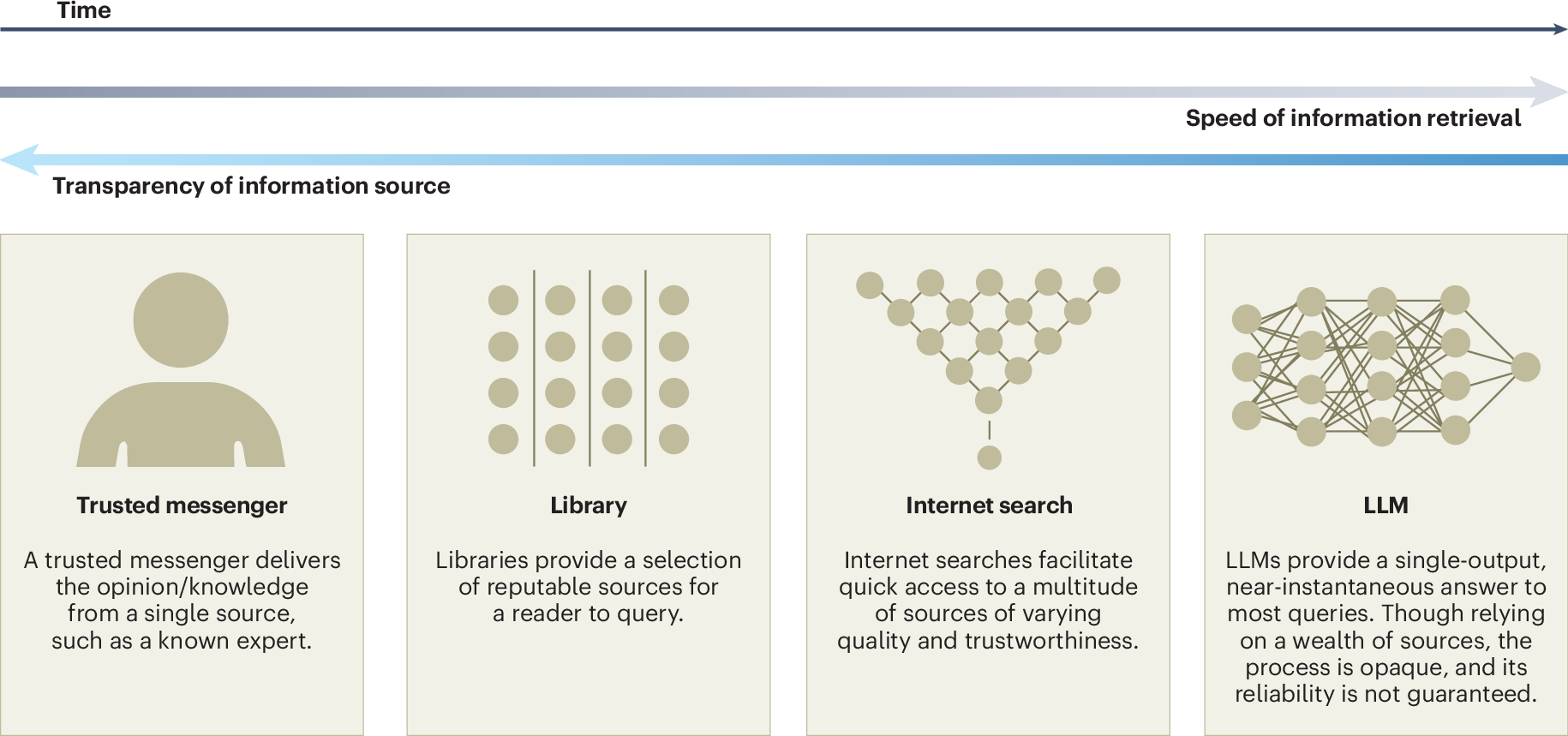
How large language models can reshape collective intelligence
Collective intelligence underpins the success of groups, organizations, markets and societies. Through distributed cognition and coordination, collectives can achieve outcomes that exceed the capabilities of individuals—even experts—resulting in improved accuracy and novel capabilities. Often, collective intelligence is supported by information technology, such as online prediction markets that elicit the ‘wisdom of crowds’, online forums that structure collective deliberation or digital platforms that crowdsource knowledge from the public. Large language models, however, are transforming how information is aggregated, accessed and transmitted online. Here we focus on the unique opportunities and challenges this transformation poses for collective intelligence. We bring together interdisciplinary perspectives from industry and academia to identify potential benefits, risks, policy-relevant considerations and open research questions, culminating in a call for a closer examination of how large language models affect humans’ ability to collectively tackle complex problems.
How large language models can reshape collective intelligence
Collective intelligence underpins the success of groups, organizations, markets and societies. Through distributed cognition and coordination, collectives can achieve outcomes that exceed the capabilities of individuals—even experts—resulting in improved accuracy and novel capabilities. Often, collective intelligence is supported by information technology, such as online prediction markets that elicit the ‘wisdom of crowds’, online forums that structure collective deliberation or digital platforms that crowdsource knowledge from the public. Large language models, however, are transforming how information is aggregated, accessed and transmitted online. Here we focus on the unique opportunities and challenges this transformation poses for collective intelligence. We bring together interdisciplinary perspectives from industry and academia to identify potential benefits, risks, policy-relevant considerations and open research questions, culminating in a call for a closer examination of how large language models affect humans’ ability to collectively tackle complex problems.
Hypercerts — Collective Intelligence for Funding Impact
Hypercerts create shared context—evidence, expert input, and community trust—for better resource allocation.
Table 43
A .gov website belongs to an official government organization in the United States.

A Science Funding System Beyond the Linear Model
Research funders should embrace a new ontology of scientific work to improve the relationship between science and the public.

More Versus Better: Artificial Intelligence, Incentives, and the Emerging Crisis in Peer Review | Organization Science
As the AI Task Force for Organization Science, we provide an early account of artificial intelligence’s (AI) impact on both submissions and reviews at a major academic journal. Submission volume ha...

Outcomes Graph: A protocol for applied science coordination - DeepScience Ventures
In this article, we explain how our Outcomes Graph works, including how the functions of scientific knowledge shape the features we've developed and how we're using it to harness the collective intelligence of venture scientists.

Want to do something? Scholars: get organized. Join @aaup.org. Everyone: call your congresspeople. Tell them to defend science. Tell them to regulate the AI industry. Support @standupforscience.net I’m not giving up and neither should you. /end
