


INTRODUCTION: Artificial intelligence (AI) is having a significant impact on people's lives. Despite the benefits associated with this technological advancement, there may be gender-related inequalities in accessing and using AI systems. The present study aimed to test gender differences in factors likely to influence AI adoption, in particular, the moderating role of gender in the relationship between AI anxiety and positive attitudes toward AI. METHOD: Participants were 335 adults (52.2% women; mean age = 29.96, SD = 13.88) who filled in an online self-report anonymous questionnaire. To test the hypotheses, both a MANOVA and a moderation model were adopted. RESULTS: Results revealed significant gender differences in AI adoption dimensions, with women reporting higher AI anxiety, lower positive attitudes toward AI, lower use of AI, and lower perceived knowledge of AI. A significant negative relationship was found between AI anxiety and positive attitudes toward AI. An interaction between gender and AI anxiety was found: At low levels of anxiety, women showed lower levels of positive attitudes toward AI than men, while at high levels of AI anxiety, gender differences were less evident. DISCUSSION: These findings suggest that AI anxiety works as a "gender differences leveler." The present study contributes to expanding knowledge about gender differences in technology, which will underpin practical interventions for reducing the gender digital gap. Limitations and future research directions are discussed.
Gender differences in artificial intelligence: the role of artificial intelligence anxiety
IntroductionArtificial intelligence (AI) is having a significant impact on people's lives. Despite the benefits associated with this technological advancement, there may be gender-related inequalities in accessing and using AI systems. The present study aimed to test gender differences in factors likely to influence AI adoption, in particular, the moderating role of gender in the relationship between AI anxiety and positive attitudes toward AI.MethodParticipants were 335 adults (52.2% women; mean age = 29.96, SD = 13.88) who filled in an online self-report anonymous questionnaire. To test the hypotheses, both a MANOVA and a moderation model were adopted.ResultsResults revealed significant gender differences in AI adoption dimensions, with women reporting higher AI anxiety, lower positive attitudes toward AI, lower use of AI, and lower perceived knowledge of AI. A significant negative relationship was found between AI anxiety and positive attitudes toward AI. An interaction between gender and AI anxiety was found: At low levels of anxiety, women showed lower levels of positive attitudes toward AI than men, while at high levels of AI anxiety, gender differences were less evident.DiscussionThese findings suggest that AI anxiety works as a “gender differences leveler.” The present study contributes to expanding knowledge about gender differences in technology, which will underpin practical interventions for reducing the gender digital gap. Limitations and future research directions are discussed.

AI adoption higher among men than women: Survey
This large gap — 81.3% compared to 58.8% — stems from the higher representation of women in skilled trades, where AI usage remains extremely low.
Women treat AI with greater skepticism than men do, study suggests
Women perceive artificial intelligence (AI) as riskier than men do, according to a study. Beatrice Magistro and colleagues hypothesized that women are both more exposed to risk from AI and are more averse ...

Why women are more skeptical of AI than men, according to a new study
Drawing on survey data, the study finds that women consistently perceive AI as riskier, especially when its economic effects are uncertain.

The AI gender gap | Datawrapper Blog
In this Weekly Chart, we examine the gender gap in AI adoption.
The Large Gender Gap in Who Uses AI
A recent study finds that AI usage tilts heavily toward men. Part of the reason: Women worried they might be penalized for using AI.

Women and AI: The Gender Gap in AI Adoption and Recognition [Data]
Lean In’s survey shows how women are losing out in the AI age. Learn how women and men compare in AI adoption in the workplace, recognition, and more.
Opinion: A gender gap is emerging in AI adoption, and women risk being left behind
Women appear less inclined to use AI tools, producing a disadvantage they can ill afford

Examining the behavioral determinants of AI adoption in higher education: a focus on perceptional factors and demographic differences
Purpose. Artificial intelligence (AI) has seen considerable growth recently and is denoted as an emerging technology, particularly in educational settings. This study aims to explain the students’ perceptions and behavioral factors in adopting AI. This paper utilized gender and country differences to explore the adoption patterns influenced by perceptual and behavioral factors, including AI literacy, AI anxiety, AI self-efficacy, relevance, and perceived enjoyment.Design/methodology/approach. A survey was conducted on Malaysian students using purposive sampling. The finalized sample of 391 respondents was tested using MS Excel, SPSS and SmartPLS to obtain the results. Moreover, to observe the differences, this paper used multigroup analysis based on gender and country.Findings. This paper found that the theoretical factors strongly influence the intention of students to adopt AI in higher education. AI anxiety, AI self-efficacy and perceived enjoyment affect ease of use (PEOU). AI literacy, PEOU, relevance and subjective norms influence perceived usefulness (PU). In addition, both PU and PEOU shape students’ attitudes and intentions to adopt AI in their learning.Originality/value. The use of AI has garnered significant attention from both consumers and organizations. This study specifically focuses on students, shedding light on the perceptual, behavioral and social factors influencing AI adoption in higher education.

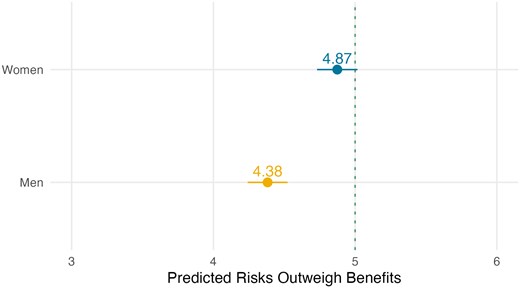
Explaining women’s skepticism toward artificial intelligence: The role of risk orientation and risk exposure
Abstract. This article examines the gender gap in attitudes toward the adoption of AI in the workplace, with a focus on how gender differences in risk orie
Explaining women’s skepticism toward artificial intelligence: The role of risk orientation and risk exposure
Abstract. This article examines the gender gap in attitudes toward the adoption of AI in the workplace, with a focus on how gender differences in risk orie
Predictors of Artificial Intelligence Technology Adoption Behaviour among Female Entreprenuers in a Typical Emerging Market
Though artificial intelligence (AI) adoption among female entrepreneurs in emerging economies is still limited and poorly understood, AI presents revolutionary

Can the adoption of AI technology widen the gender gap in science? postdocs' use of AI technology
There is a known gender gap in science. Some studies suggest that this gap is decreasing, others that it is not. Although many studies have been conducted on gender equity in science, none have yet focused on the possibility that generative artificial intelligence (AI), a technology that promises to revolutionize research and academic work can have on widening or narrowing the gender gap in science. Postdoctoral researchers are a particularly important population to study in this context, as they have already demonstrated scientific maturity and independence and are poised to become the next generation in science and academia. Thus, this paper focuses on the gendered use of AI technology by postdocs. By using data from the 2023 Nature Post-Doctoral Survey, this paper investigates how postdocs are adopting AI and whether the usage of AI technology is likely to affect the gender gap in science and academia. The results show that females are less engaged with AI than male postdocs by 34%. This disparity may put female researchers at a disadvantage, potentially causing the gender gap to increase or be maintained. The study also reveals variations in AI adoption within gender groups. Younger female postdocs tend to use AI more than their older counterparts. Compared to female postdocs without promising job opportunities, those with good job prospects tend to use AI more frequently. Additionally, female postdocs working outside their native country are more engaged with AI than those working within their native country. For male postdocs, the results indicate that employment is an important factor in AI adoption. Regardless of age, male postdocs tend to use AI as part of their postdoc: they start using it once they begin their postdocs positions and use it more if they are satisfied with their postdoctoral experience.

AI's got a gender gap: Women are more skeptical
Men are more enthusiastic about AI, while women are more skeptical, according to CNBC's 5th annual SurveyMonkey Women at Work survey.

The Beauty of AI and Why AI Needs More Women
While women remain underrepresented in the Artificial Intelligence (AI) and tech workforce, their participation is considered crucial for developing the right AI for tomorrow.

The gen AI gender gap
Data from the Survey of Consumer Expectations shows that 50% of men use generative AI tools, compared to 37% of women. Privacy concerns and perceived opportunities and risks explain a quarter of the gender gap. Respondents’ self-assessed knowledge emerges as the most important factor.