Recent psychological and neuropsychological research suggests that executive functions — the cognitive control processes that regulate thought and action — are multifaceted and that different types of executive functions are correlated but ...
Can someone explain executive dysfunction to me?
What is ‘executive dysfunction’ and how do you overcome it?
Difficulty starting and getting overwhelmed by tasks are a few signs of it. We asked experts for tips on mitigating the effects

Did therapy help with your executive function issues?
Scientists identify a crucial brain feature connecting genetics to intelligence
A team of neuroscientists has uncovered evidence that genetic influences on intelligence may operate through the density of brain wiring, highlighting a potential biological bridge between inherited DNA differences and the brain structures that support reasoning and problem-solving.
Generative artificial intelligence reliance and executive function attenuation: Behavioral evidence of cognitive offload in high-use adults.
From gifted to high potential and twice exceptional: A state-of-the-art meta-review
Despite the abundant literature on intelligence and high potential individuals, there is still a lack of international consensus on the terminology and clinical characteristics associated to this population. It has been argued that unstandardized use of diagnosis tools and research methods make comparisons and interpretations of scientific and epidemiological evidence difficult in this field. If multiple cognitive and psychological models have attempted to explain the mechanisms underlying high potentiality, there is a need to confront new scientific evidence with the old, to uproot a global understanding of what constitutes the neurocognitive profile of high-potential in gifted individuals. Another particularly relevant aspect of applied research on high potentiality concerns the challenges faced by individuals referred to as "twice exceptional" in the field of education and in their socio-affective life. Some individuals have demonstrated high forms of intelligence together with learning, affective or neurodevelopmental disorders posing the question as to whether compensating or exacerbating psycho-cognitive mechanisms might underlie their observed behavior. Elucidating same will prove relevant to questions concerning the possible need for differential diagnosis tools, specialized educational and clinical support. A meta-review of the latest findings from neuroscience to developmental psychology, might help in the conception and reviewing of intervention strategies.
Brainchildren
Minds are complex artifacts, partly biological and partly social; only a unified, multidisciplinary approach will yield a realistic theory of how they came i...
Functional Synchronization: The Emergence of Coordinated Activity in Human Systems
The topical landscape of psychology is highly compartmentalized, with distinct phenomena explained and investigated with recourse to theories and methods that have little in common. Our aim in this article is to identify a basic set of principles ...
3 Cognitive Habits of People Who Get Things Done
High-achieving workers have these things in common.

ADHD and giftedness: a neurocognitive consideration of twice exceptionality
Current models of cognition and behavioral diagnosis emphasize categorical classification over continuous considerations of function and promote the "differential diagnosis" of various conditions according to observational criteria. However, an overemphasis on a purely behavioral, categorical approach to understanding human function fails to address the comorbidity of different disorders and does not include a consideration of overlapping levels of function, from "pathological" through "normal," to "gifted" or exceptional. The frequent co-occurrence of "gifted" and "pathological" function is thus difficult to understand from a corticocentric and purely behavioral and observational point of view. This article reviews "giftedness" in relation to the diagnosis of attention-deficit hyperactivity disorder, coexistence of which is termed "twice exceptional." It additionally considers problems in assessing these functions using current neuropsychological tests and methodologies that are presumably based upon a corticocentric model of cognition.
First Brain-Wide Map of Decision-Making Charted In Mice - Slashdot
In a landmark collaboration across 22 labs, neuroscientists have created the first brain-wide map of decision-making in mice, tracking over 620,000 neurons across nearly 280 brain regions. They found that decision-making is distributed much more broadly than previously thought, involving not just "c...
Bridging the biological and cultural models of cognition
Our minds are a choice

Effects of Stroop task duration on subsequent cognitive and physical performance
The strength model of self-control purports to explain why brief cognitive response inhibition tasks impair subsequent isometric handgrip endurance. A…
To Make Sense of the Present, Brains May Predict the Future | Quanta Magazine
A controversial theory suggests that perception, motor control, memory and other brain functions all depend on comparisons between ongoing actual experiences and the brain’s modeled expectations.

How We Pay Attention Changes the Very Shape of Our Brains
Imagine arriving at the airport just in time to catch a plane. Everything in your behavior betrays the heightened concentration of your attention. Your mind on alert, you look for the departures si…

Deficient executive control in transformer attention
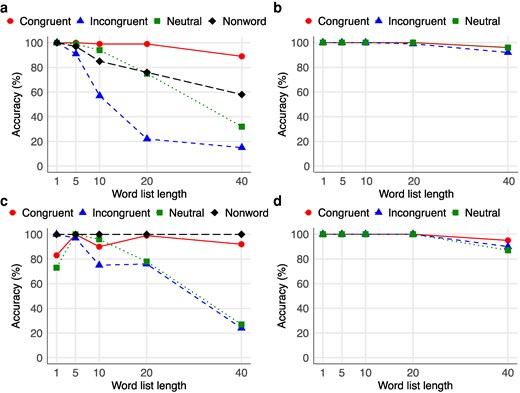
Abstract Although transformers in large language models (LLMs) effectively implement a self-attention mechanism that has revolutionized natural language processing, they lack an explicit architecture for the executive control of attention found in humans, which is essential for resolving conflicts and selecting relevant information in the presence of competing computations and is critical for adaptive behavior. To investigate the impact of this limitation in LLMs, we employed the classic color Stroop task, widely regarded as the gold standard, to test the executive control of attention in these models. Our results revealed a typical conflict effect of underperformance in terms of accuracy in the incongruent condition (e.g. naming the color of the word RED in blue) compared with the congruent condition (e.g. naming the color of the word RED in red), in short word lists, similar to human performance. However, as the length of the word lists increased, performance on the incongruent condition degraded toward near-total performance collapse, even as accuracy in the congruent condition remained excellent, and word reading (e.g. reading the word RED [in red] or RED [in blue], ignoring the color) was near-perfect. These findings demonstrate that transformer attention mechanisms are fundamentally limited in their capacity for conflict resolution across extended contexts, and a failure to up-regulate control adaptively under rising interference. We suggest that incorporating executive control mechanisms akin to those in biological attention is crucial for achieving artificial general intelligence.