

The Police Crime Database includes summary information on 20,711 criminal arrest cases from the years 2005-2021 involving 16,758 individual nonfederal sworn law enforcement officers, each of whom were charged with one or more crimes. The arrested officers were employed by 5,466 state, local, and special law enforcement agencies located in 1,987 counties and independent cities in all 50 states and the District of Columbia.
Criminal Justice Fact Sheet
A compilation of facts and figures surrounding policing, the criminal justice system, incarceration, and more.

Criminal Justice Expenditures: Police, Corrections, and Courts
Police expenditures include spending on police, sheriffs, state highway patrols, and other governmental departments charged with protecting public safety.Cor…
Police Records - CalMatters
Search California public records about law enforcement violence and misconduct.
Hong Kong police arrest 31 over deepfake romance scams
Hong Kong police have arrested 31 people over the alleged use of deepfake technologies to stage online romance and investment scams.

When police pull back: Neighborhood‐level effects of de‐policing on violent and property crime, a research note
Abstract Many U.S. cities witnessed both de‐policing and increased crime in 2020, yet whether the former contributed to the latter remains unclear. Indeed, much of what is known about the effects of proactive policing on crime comes from studies that evaluated highly focused interventions atypical of day‐to‐day policing, used cities as the unit of analysis, or could not rule out endogeneity. This study addresses each of these issues, thereby advancing the evidence base concerning the effects of policing on crime. Leveraging two exogenous shocks presented by the onset of the coronavirus 2019 (COVID‐19) pandemic and social unrest after the murder of George Floyd, we evaluated the effects of sudden and sustained reductions in high‐discretion policing on crime at the neighborhood level in Denver, Colorado. Multilevel models accounting for trends in prior police activity, neighborhood structure, seasonality, and population mobility revealed mixed results. On the one hand, large‐scale reductions in stops and drug‐related arrests were associated with significant increases in violent and property crimes, respectively. On the other hand, fewer disorder arrests did not affect crime. These results were not universal across neighborhoods. We discuss the implications of these findings in light of debates concerning the appropriate role of policing in the 21st century.

A Cognitive View of Policing
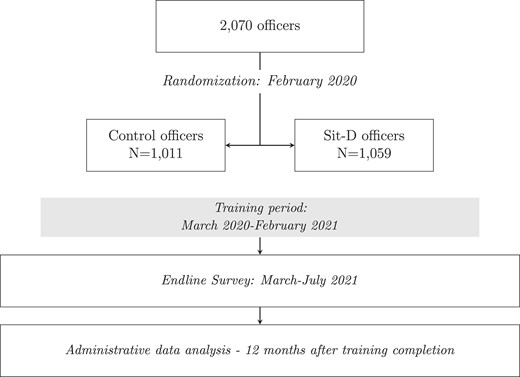
Abstract What causes adverse policing outcomes, such as excessive uses of force and unnecessary arrests? Prevailing explanations focus on problematic officers or deficient regulations and oversight. We introduce an overlooked perspective. We suggest that the cognitive demands inherent in policing can undermine officer decision making. Unless officers are prepared for these demands, they may jump to conclusions too quickly without fully considering alternative ways of seeing a situation. This can lead to adverse policing outcomes. To test this perspective, we created a new training that teaches officers to consider different ways of interpreting the situations they encounter. We evaluated this training using a randomized controlled trial with 2,070 officers from the Chicago Police Department. In a series of lab assessments, we find that treated officers were significantly more likely to consider a wider range of evidence and develop more explanations for subjects’ actions. Critically, we also find that training affected officer performance in the field, leading to reductions in uses of force, discretionary arrests, and arrests of Black civilians. Meanwhile, officer activity levels remained unchanged, and trained officers were less likely to be injured on duty. Our results highlight the value of considering the cognitive aspects of policing and demonstrate the power of using behaviorally informed approaches to improve officer decision making and policing outcomes.
Amid a big hiring push, police experts question ICE officer vetting
The recent fatal shootings by ICE officers in Texas and Maine come at a time when the federal agency has hired a huge number of officers quickly. Some law enforcement experts worry that this kind of a hiring spree can lead police agencies to cut corners in vetting new hires.

TRAC - Criminal Enforcement
Does Predictive Policing Lead to Biased Arrests? Results From a Randomized Controlled Trial
Racial bias in predictive policing algorithms has been the focus of a number of recent news articles, statements of concern by several national organizations (e.g., the ACLU and NAACP), and simulat...
Does Predictive Policing Lead to Biased Arrests? Results From a Randomized Controlled Trial
Racial bias in predictive policing algorithms has been the focus of a number of recent news articles, statements of concern by several national organizations (e.g., the ACLU and NAACP), and simulat...
Updated List of Criminal DHS Agents_08172026

A Digitized New Haven Police: Investigating Axon’s Draft One
Interviews have been lightly edited for clarity. The first image of a police officer that comes to mind is probably of one in action. Few imagine the cop spending hours behind their desk, writing r…

Predictive Policing and the Politics of Patterns
Abstract Patterns are the epistemological core of predictive policing. With the move towards digital prediction tools, the authority of the pattern is rearticulated and reinforced in police work. Based on empirical research about predictive policing software and practices, this article puts the authority of patterns into perspective. Introducing four ideal-typical styles of pattern identification, we illustrate that patterns are not based on a singular logic, but on varying rationalities that give form to and formalize different understandings about crime. Yet, patterns render such different modes of reasoning about crime, and the way in which they feed back into policing cultures, opaque. Ultimately, this invites a stronger reflection about the political nature of patterns.

2018 Update on Prisoner Recidivism: A 9-Year Follow-up Period (2005-2014) | Bureau of Justice Statistics
Examines the recidivism patterns of former prisoners during a 9-year follow-up period.
Government Documents Show Police Disabling AI Oversight Tools
Departments aren't reviewing or disclosing AI-written police reports—which are now being used in plea deals.

[122] Arresting Flexibility: A QJE field experiment on police behavior with about 40 outcome variables
A forthcoming paper in the Quarterly Journal of Economics (QJE), “A Cognitive View of Policing” (htm), reports results from a field experiment showing that teaching police officers to &…
